
소득공제
수입
직수입양서
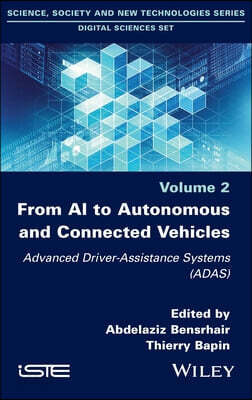
From AI to Autonomous and Connected Vehicles
Advanced Driver-Assistance Systems (ADAS)
Hardback, 1st Edition
Bensrhair, Abdelaziz
Wiley-ISTE
2021.09.22.
이미 소장하고 있다면 판매해 보세요.
- 국내배송만 가능
- 해외 거래처 사정에 의하여 품절/지연 가능
- 도서 정보 중 미표기 사항 안내?
- 문화비소득공제 가능
책소개
목차
|
Foreword 1 xi Foreword 2 xiii Dominique GRUYER Foreword 3 xix Alberto BROGGI Preface xxi Abdelaziz BENSRHAIR Chapter 1. Artificial Intelligence for Vehicles 1 Gerard YAHIAOUI 1.1. What is AI? 1 1.2. The main methods of AI 3 1.2.1. Deep Learning 3 1.2.2. Machine Learning 4 1.2.3. Clustering 5 1.2.4. Reinforcement learning 6 1.2.5. Case-based reasoning 8 1.2.6. Logical reasoning 8 1.2.7. Multi-agent systems 8 1.2.8. PAC learning 9 1.3. Modern AI challenges for the industry 9 1.3.1. Explainability: XAI (eXplainable Artificial Intelligence) 9 1.3.2. The design of so-called “hybrid” AI systems 10 1.4. What is an “intelligent” vehicle? 10 1.4.1. ADAS 11 1.4.2. The autonomous vehicle 14 1.4.2. The construction of the intelligent vehicle’s basic building blocks employing AI methods 18 1.5. References 21 Chapter 2. Conventional Vision or Not: A Selection of Low-level Algorithms 25 Fabien BONARDI, Samia BOUCHAFA, Hicham HADJ-ABDELKADER and Desire SIDIBE 2.1. Introduction 25 2.2. Vision sensors 26 2.2.1. Conventional cameras 27 2.2.2. Emerging sensors 30 2.3. Vision algorithms 33 2.3.1. Choosing the type of information to be retrieved from the images 34 2.3.2. Estimation of ego-movement and localization 39 2.3.3. Detection of the navigable space by a dense approach 44 2.3.4. From the detection of 3D plans to visual odometry 58 2.3.5. Detection of obstacles through the compensation of ego-movement 62 2.3.6. Visual odometry 66 2.4. Conclusion 71 2.5. References 72 Chapter 3. Automated Driving, a Question of Trajectory Planning 79 Olivier ORFILA, Dominique GRUYER and Remi SAINCT 3.1. Definition of planning 79 3.2. Trajectory planning: general characteristics 81 3.2.1. Variables 83 3.2.2. Constraints 83 3.2.3. Cost functions 83 3.2.4. Planning methodology 83 3.2.5. Co-pilot respecting legal traffic rules 88 3.2.6. Trajectory prediction for “ghost” objects and vehicles 92 3.2.7. Trajectory evaluation 100 3.2.8. Results on real vehicles and on simulators 101 3.3. Multi-objective trajectory planning 104 3.3.1. Linear scalarization 107 3.3.2. Nonlinear scalarization 114 3.3.3. Ideal methods 116 3.3.4. Summary of multi-objective planning methods 119 3.3.5. High level information 119 3.4. Conclusion on multi-agent planning for a fleet of vehicles: the future of planning 121 3.5. References 122 Chapter 4. From Virtual to Real, How to Prototype, Test, Evaluate and Validate ADAS for the Automated and Connected Vehicle? 125 Dominique GRUYER, Serge LAVERDURE, Jean-Sebastien BERTHY, Philippe DESOUZA and Mokrane HADJ-BACHIR 4.1. Context and goals 125 4.2. Generic dynamic and distributed architecture 128 4.2.1. Introduction 128 4.2.2. An interoperable platform 129 4.3. Environment and climatic conditions 132 4.3.1. Introduction 132 4.3.2. Environmental modeling: lights, shadows, materials and textures 132 4.3.3. Degraded, adverse and climatic conditions 136 4.3.4. Visibility layers and ground truths 140 4.4. Modeling of perception sensors 143 4.4.1. Typology of sensor technologies 143 4.4.2. From a functional model to a physical model 145 4.4.3. Optical sensors 145 4.4.4. LIght Detection And Ranging (LIDAR) 149 4.4.5. RAdio Detection And Ranging (RADAR) 151 4.4.6. Global Navigation Satellite System (GNSS) 153 4.5. Connectivity and means of communication 157 4.5.1. State of the art 157 4.5.2. Statistical model of the propagation channel 158 4.5.3. Multi-platform physico-realistic model 159 4.6. Some relevant use cases 161 4.6.1. Graphic resources 161 4.6.2. Communication and overall risk 161 4.6.3. Automated parking maneuver 166 4.6.4. Co-pilot and automated driving 169 4.6.5. Eco-mobility and eco-responsible driving profile 171 4.7. Conclusion and perspectives 174 4.8. References 176 Chapter 5. Standards for Cooperative Intelligent Transport Systems (C-ITS) 181 Thierry ERNST 5.1. Context and goals 182 5.1.1. Intelligent transport systems (ITS) 182 5.1.2. The connected and cooperative vehicle 184 5.1.3. Silos communication systems 185 5.1.4. Cooperative Intelligent Transport Systems (C-ITS) 186 5.1.5. Diversity of Cooperative ITS services 186 5.1.6. Standardization bodies 189 5.1.7. Genesis of the “Cooperative ITS” standards 190 5.2. “ITS station” architecture 192 5.2.1. General description 192 5.2.2. ITS station communication units 195 5.2.3. Types of ITS stations 195 5.3. Features of the ITS station architecture 197 5.3.1. Combination of communication technologies 197 5.3.2. Centralized communications 198 5.3.3. Localized communications (V2X) 198 5.3.4. Hybrid communications 200 5.3.5. Extensive communications 202 5.3.6. Communications management 203 5.3.7. Messaging 204 5.3.8. Data organization and identification 206 5.3.9. Secure communications and access to data 207 5.3.10. Evolution of standards 208 5.4. Features of the ITS station architecture 208 5.5. Deployment of Cooperative ITS services 209 5.6. References 213 Chapter 6. The Integration of Pedestrian Orientation for the Benefit of ADAS: A Moroccan Case Study 215 Aouatif AMINE, Abdelaziz BENSRHAIR, Safaa DAFRALLAH and Stephane MOUSSET 6.1. Introduction 215 6.2. Advanced Driver Assistance System (ADAS) 218 6.3. Proposal for an applicable system to the Moroccan case 219 6.4. General conclusion 230 6.5. References 231 Chapter 7. Autonomous Vehicle: What Legal Issues? 233 Axelle OFFROY 7.1. Introduction 233 7.2. The definition of the so-called “autonomous” vehicle 234 7.3. Legal framework and experiments 236 7.4. The notion of the “driver” 237 7.5. The notion of the “custodian” 238 7.6. What liability regime? 238 7.7. Self-driving vehicle insurance? 240 7.8. Personal data and the autonomous vehicle 242 7.9. The need for uniform regulation 245 List of Authors 247 Index 249 |
저자 소개
Abdelaziz Bensrhair?is a Professor at the INSA Rouen Normandie, France. He is the Founding Manager of the pedagogical chair of excellence in autonomous and connected vehicles (INSA Rouen Normandie and the ADAS Group of the NextMove cluster) and is an expert in the automotive and mobility R&D cluster NextMove. His research in focused on the field of Intelligent Transport Systems.
Thierry Bapin?has a scientific and legal background and is currently deputy general manager at NextMove, the French competitiveness cluster for automotive and mobility industry. He also coordinates the ADAS Group, manages programs for the creation and development of services for NextMove members (SMEs, higher education and research institutions and local authorities) and is in charge of the sector in the Normandy region.
Thierry Bapin?has a scientific and legal background and is currently deputy general manager at NextMove, the French competitiveness cluster for automotive and mobility industry. He also coordinates the ADAS Group, manages programs for the creation and development of services for NextMove members (SMEs, higher education and research institutions and local authorities) and is in charge of the sector in the Normandy region.
관련 분류
품목정보
- 발행일
- 2021년 09월 22일
- 쪽수, 무게, 크기
- 288쪽 | 10*10*10mm
- ISBN13
- 9781786307279
리뷰/한줄평0
상품정보안내
직수입외서의 경우, 해외거래처에서 제공하는 정보가 부족하여 제목, 표지, 가격, 유통상태 등의 정보가 미비하거나 변경되는 경우가 있습니다. 정확한 확인을 원하시는 경우, 일대일 상담으로 문의하여 주시면 답변 드리겠습니다.
(판형과 판수 등이 다양한 도서는 찾으시는 도서의 ISBN을 알려 주시면 보다 빠르고 정확한 안내가 가능합니다.)
해외거래처에서 품절인 경우, 2차 거래선을 통해 유럽과 미국 출판사로 직접 수입이 진행될 수 있습니다.
수입 진행 시점으로 부터 2~3주가 추가로 소요되며, 해외에서도 유통이 원활하지 않은 도서는 품절 안내가 지연될 수 있습니다.
해당 경우, 문자와 메일로 별도 안내를 드리고 있사오니 마이페이지에서 휴대전화번호와 메일주소를 다시 한번 확인해주시기 바랍니다.
(판형과 판수 등이 다양한 도서는 찾으시는 도서의 ISBN을 알려 주시면 보다 빠르고 정확한 안내가 가능합니다.)
해외거래처에서 품절인 경우, 2차 거래선을 통해 유럽과 미국 출판사로 직접 수입이 진행될 수 있습니다.
수입 진행 시점으로 부터 2~3주가 추가로 소요되며, 해외에서도 유통이 원활하지 않은 도서는 품절 안내가 지연될 수 있습니다.
해당 경우, 문자와 메일로 별도 안내를 드리고 있사오니 마이페이지에서 휴대전화번호와 메일주소를 다시 한번 확인해주시기 바랍니다.
248,050원
총 1개
248,050원
