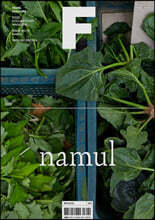

![매거진 F (격월) : 1월 영문판 [2022년]](https://image.yes24.com/Goods/106158902/S)
![매거진 F (격월) : 1월 영문판 [2022년]](https://image.yes24.com/goods/106158902/XL)
소득공제
정가제 Free
잡지
매거진 F (격월) : 1월 영문판 [2022년]
No.16 나물 (NAMUL)
Baemin ,Magazine B 공저
비미디어컴퍼니 주식회사
2022.01.10.
- 표지 스크래치, 내지 잉크 튐은 제작 과정 중 자연스럽게 발생할 수 있어 교환 대상이 아닙니다.
이미 소장하고 있다면 판매해 보세요.
- 국내배송만 가능
- 문화비소득공제 가능
상세 이미지

책소개
목차
|
2 Intro
8 Letter from F 12 Origin Namul seen in the context of Korea’s vegetable culture 16 Namul Tour Three namul production regions with widely different landscapes, foods, and culture 50 Encyclopedia of Namul Basic information on how to trim and store all the popular and rare varieties 56 Calendar A calendar of harvest seasons for a range of namul 58 Academic Manual History of these greens that are deeply rooted in Korean food culture, along with ways to manage the tastes and flavors of namul 72 F Cut Humble beauty residing in each and every leaf of namul 82 Interview 82 Joseph Lidgerwood Joseph Lidgerwood, chef of Evett, introduces free-minded and experimental dishes using Korean food ingredients 88 Taehwan Ryu Taehwan Ryu, owner-chef of Ryunique and Pigeel, puts his knowledge of local food ingredients acquired through travel to the test in new dishes 92 On the Table Fine-dining restaurants reinterpret the value of namul with creative recipes 104 One Good Meal The dining tables of three individuals highlight seeing the value in seasonal foods 110 Interview 110 Haseulram Song Haseulram Song, owner of Mamaleemarket, treats each Korean side dish as a main dish or tapa 114 Retail Diversified namul markets from a startup to a traditional market 128 Movement Small organizations leading new trends in food culture 134 Market A list of namul products by category 144 References Books and videos recommended by the experts featured in F 146 Dictionary 147 Index |
품목정보
- 발행일
- 2022년 01월 10일
- 쪽수, 무게, 크기
- 148쪽 | 170*240mm
- ISBN13
- 9791160361421
출판사 리뷰
|
Namul refers to wild edible plants foraged from fields and mountains or to seasoned herbal dishes. Although these edible plants are also found in neighboring countries like Japan and China, no place has cooked with namul for as long as Korea. An excellent side dish to steamed rice, these greens are an exciting addition to stews and even desserts. The montane Korean terrain naturally gave way to a culture of feasting on namul, with spring namul becoming an iconic Korean vegetable-based food staple that stands second only to kimchi. Today, local varieties like go-sa-ri bracken from Jeju-do Island, cham-du-reup fatsia shoots and nun-gae-seung-ma goatsbeard from Gangwon-do Province, and bang-pung namul coastal hog fennel from the coastal areas of Uljin, Gyeongsangbuk-do Province, are growing in popularity as a way to explore regional cuisines and bring foraged ingredients to the table.
|
사락 별점0
혜택 및 유의사항밑줄0
혜택 및 유의사항
17,100원
총 1개
17,100원