


이미 소장하고 있다면 판매해 보세요.
- 국내배송만 가능
- 해외 거래처 사정에 의하여 품절/지연 가능
- 도서 정보 중 미표기 사항 안내?
- 문화비소득공제 가능
이 분야의 이벤트
![[분야별] 외국도서 한정수량 특가할인](https://image.yes24.com/sysimage/renew/loadSpace.png)
책소개
목차
|
Preface.
1 Preliminaries. 1.1 Using the R Computing Environment. 1.1.1 Installing smida. 1.1.2 Loading smida. 1.2 Data Sets from Biological Experiments. 1.2.1 Arabidopsis experiment: Anna Amtmann. 1.2.2 Skin cancer experiment: Nighean Barr. 1.2.3 Breast cancer experiment: John Bartlett. 1.2.4 Mammary gland experiment: Gusterson group. 1.2.5 Tuberculosis experiment: BμG@S group. I Getting Good Data. 2 Set-up of a Microarray Experiment. 2.1 Nucleic Acids: DNA and RNA. 2.2 Simple cDNA Spotted Microarray Experiment. 2.2.1 Growing experimental material. 2.2.2 Obtaining RNA. 2.2.3 Adding spiking RNA and poly-T primer. 2.2.4 Preparing the enzyme environment. 2.2.5 Obtaining labelled cDNA. 2.2.6 Preparing cDNA mixture for hybridization. 2.2.7 Slide hybridization. 3 Statistical Design of Microarrays. 3.1 Sources of Variation. 3.2 Replication. 3.2.1 Biological and technical replication. 3.2.2 How many replicates? 3.2.3 Pooling samples. 3.3 Design Principles. 3.3.1 Blocking, crossing and randomization. 3.3.2 Design and normalization. 3.4 Single-channelMicroarray Design. 3.4.1 Design issues. 3.4.2 Design layout. 3.4.3 Dealing with technical replicates. 3.5 Two-channelMicroarray Designs. 3.5.1 Optimal design of dual-channel arrays. 3.5.2 Several practical two-channel designs. 4 Normalization. 4.1 Image Analysis. 4.1.1 Filtering. 4.1.2 Gridding. 4.1.3 Segmentation. 4.1.4 Quantification. 4.2 Introduction to Normalization. 4.2.1 Scale of gene expression data. 4.2.2 Using control spots for normalization. 4.2.3 Missing data. 4.3 Normalization for Dual-channel Arrays. 4.3.1 Order for the normalizations. 4.3.2 Spatial correction. 4.3.3 Background correction. 4.3.4 Dye effect normalization. 4.3.5 Normalization within and across conditions. 4.4 Normalization of Single-channel Arrays. 4.4.1 Affymetrix data structure. 4.4.2 Normalization of Affymetrix data. 5 Quality Assessment. 5.1 Using MIAME in Quality Assessment. 5.1.1 Components of MIAME. 5.2 Comparing Multivariate Data. 5.2.1 Measurement scale. 5.2.2 Dissimilarity and distance measures. 5.2.3 Representing multivariate data. 5.3 Detecting Data Problems. 5.3.1 Clerical errors. 5.3.2 Normalization problems. 5.3.3 Hybridization problems. 5.3.4 Array mishandling. 5.4 Consequences of Quality Assessment Checks. 6 Microarray Myths: Data. 6.1 Design. 6.1.1 Single-versus dual-channel designs? 6.1.2 Dye-swap experiments. 6.2 Normalization. 6.2.1 Myth: ‘microarray data is Gaussian’. 6.2.2 Myth: ‘microarray data is not Gaussian’. 6.2.3 Confounding spatial and dye effect. 6.2.4 Myth: ‘non-negative background subtraction’. II Getting Good Answers. 7 Microarray Discoveries. 7.1 Discovering Sample Classes. 7.1.1 Why cluster samples? 7.1.2 Sample dissimilarity measures. 7.1.3 Clustering methods for samples. 7.2 Exploratory Supervised Learning. 7.2.1 Labelled dendrograms. 7.2.2 Labelled PAM-type clusterings. 7.3 Discovering Gene Clusters. 7.3.1 Similarity measures for expression profiles. 7.3.2 Gene clustering methods. 8 Differential Expression. 8.1 Introduction. 8.1.1 Classical versus Bayesian hypothesis testing. 8.1.2 Multiple testing ‘problem’. 8.2 Classical Hypothesis Testing. 8.2.1 What is a hypothesis test? 8.2.2 Hypothesis tests for two conditions. 8.2.3 Decision rules. 8.2.4 Results from skin cancer experiment. 8.3 Bayesian Hypothesis Testing. 8.3.1 A general testing procedure. 8.3.2 Bayesian t-test. 9 Predicting Outcomes with Gene Expression Profiles. 9.1 Introduction. 9.1.1 Probabilistic classification theory. 9.1.2 Modelling and predicting continuous variables. 9.2 Curse of Dimensionality: Gene Filtering. 9.2.1 Use only significantly expressed genes. 9.2.2 PCA and gene clustering. 9.2.3 Penalized methods. 9.2.4 Biological selection. 9.3 Predicting ClassMemberships. 9.3.1 Variance-bias trade-off in prediction. 9.3.2 Linear discriminant analysis. 9.3.3 k-nearest neighbour classification. 9.4 Predicting Continuous Responses. 9.4.1 Penalized regression: LASSO. 9.4.2 k-nearest neighbour regression. 10 Microarray Myths: Inference. 10.1 Differential Expression. 10.1.1 Myth: ‘Bonferroni is too conservative’. 10.1.2 FPR and collective multiple testing. 10.1.3 Misinterpreting FDR. 10.2 Prediction and Learning. 10.2.1 Cross-validation. Bibliography. Index. |
저자 소개
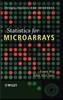
Ernst Wit is the author of Statistics for Microarrays: Design, Analysis and Inference, published by Wiley.
John McClure is the author of Statistics for Microarrays: Design, Analysis and Inference, published by Wiley.
품목정보
- 발행일
- 2004년 07월 23일
- 쪽수, 무게, 크기
- 282쪽 | 539g | 154*238*20mm
- ISBN13
- 9780470849934
리뷰/한줄평0
상품정보안내
직수입외서의 경우, 해외거래처에서 제공하는 정보가 부족하여 제목, 표지, 가격, 유통상태 등의 정보가 미비하거나 변경되는 경우가 있습니다. 정확한 확인을 원하시는 경우, 일대일 상담으로 문의하여 주시면 답변 드리겠습니다.
(판형과 판수 등이 다양한 도서는 찾으시는 도서의 ISBN을 알려 주시면 보다 빠르고 정확한 안내가 가능합니다.)
해외거래처에서 품절인 경우, 2차 거래선을 통해 유럽과 미국 출판사로 직접 수입이 진행될 수 있습니다.
수입 진행 시점으로 부터 2~3주가 추가로 소요되며, 해외에서도 유통이 원활하지 않은 도서는 품절 안내가 지연될 수 있습니다.
해당 경우, 문자와 메일로 별도 안내를 드리고 있사오니 마이페이지에서 휴대전화번호와 메일주소를 다시 한번 확인해주시기 바랍니다.
(판형과 판수 등이 다양한 도서는 찾으시는 도서의 ISBN을 알려 주시면 보다 빠르고 정확한 안내가 가능합니다.)
해외거래처에서 품절인 경우, 2차 거래선을 통해 유럽과 미국 출판사로 직접 수입이 진행될 수 있습니다.
수입 진행 시점으로 부터 2~3주가 추가로 소요되며, 해외에서도 유통이 원활하지 않은 도서는 품절 안내가 지연될 수 있습니다.
해당 경우, 문자와 메일로 별도 안내를 드리고 있사오니 마이페이지에서 휴대전화번호와 메일주소를 다시 한번 확인해주시기 바랍니다.
175,570원
총 1개
175,570원