
이미 소장하고 있다면 판매해 보세요.
- 국내배송만 가능
- 해외 거래처 사정에 의하여 품절/지연 가능
- 도서 정보 중 미표기 사항 안내?
- 문화비소득공제 가능
책소개
목차
|
Preface xix Part I: Foundations of Quantum Computing 1 1 Introduction to Quantum Computing 3 1.1 Evolution from Classical to Quantum Computing 3 1.2 Quantum Bits and Quantum States 4 1.3 Quantum Gates and Computation Model 5 1.4 Quantum Advantage and Its Significance 6 1.5 Industry Trends in Quantum Computing 7 1.6 Key Challenges in Quantum Computing 7 2 Mathematical Foundations of Quantum Computing 9 2.1 Introduction 9 2.2 Linear Algebra: Vectors, Matrices, and Tensor Products 10 2.3 Complex Numbers and Their Role in Quantum States 14 2.4 Probability Theory and Quantum Measurements 15 3 Principles of Quantum Mechanics 19 3.1 Introduction 19 3.2 Superposition Principle 20 3.3 Entanglement 21 3.4 Postulates of Quantum Mechanics 22 3.5 Wave–Particle Duality 24 3.6 Quantum Measurement Theory 25 3.7 Summary 26 4 Qubits and Quantum States 27 4.1 Introduction 27 4.2 Physical Representations of Qubits 28 4.3 Mathematical Description of a Qubit State 30 4.4 Bloch Sphere Visualization 30 4.5 Representation Using Dirac Notation 33 4.6 Summary 35 Part II: Quantum Circuits and Algorithms 37 5 Quantum Gates and Circuits 39 5.1 Introduction 39 5.2 Quantum Gates as Unitary Operators 39 5.3 Single-Qubit Gates 40 5.4 Multi-Qubit Gates 42 5.5 Building Quantum Circuits 44 5.6 Quantum Gate Implementation in Julia 44 5.7 Measurement in Julia 46 5.8 Summary 46 6 Grover's Algorithm and Quantum Search 49 6.1 Introduction 49 6.2 The Unstructured Search Problem 49 6.3 Mathematical Foundation of Grover's Algorithm 50 6.4 Geometric Interpretation 52 6.5 Julia Implementation of Grover's Algorithm 52 6.6 Applications of Grover's Algorithm 54 6.7 Limitations of Grover's Algorithm 55 6.8 Summary 55 7 Shor's Algorithm and Quantum Factorization 57 7.1 Introduction 57 7.2 Mathematical Foundations of Integer Factorization 58 7.3 Quantum Order-Finding Algorithm 59 7.4 Quantum Circuit Implementation 61 7.5 Julia Implementation of Shor's Algorithm (Simulation) 61 7.6 Impact on Cryptography 63 7.7 Limitations of Shor's Algorithm 64 7.8 Summary 64 8 Quantum Teleportation and Superdense Coding 65 8.1 Introduction to Quantum Communication 65 8.2 Fundamentals of Quantum Communication 66 8.3 Quantum Teleportation 67 8.4 Julia Implementation of Quantum Teleportation 70 8.5 Superdense Coding 72 8.6 Julia Implementation of Superdense Coding 73 8.7 Applications in Secure Communication 73 8.8 Limitations and Practical Challenges 74 8.9 Summary 74 9 Introduction to Quantum Programming Frameworks 75 9.1 Introduction 75 9.2 Role of Programming Frameworks in Quantum Computing 76 9.3 Overview of Qiskit 77 9.4 Overview of Cirq 81 9.5 Overview of Q# 82 9.6 Comparative Analysis of Quantum Programming Frameworks 84 9.7 Choosing the Right Tool for the Task 84 9.8 Setting Up the Quantum Development Environment 85 9.9 Challenges in Quantum Programming Frameworks 86 9.10 Future Trends in Quantum Programming 86 9.11 Summary 86 10 Working with Qiskit 87 10.1 Introduction 87 10.2 Qiskit Architecture Overview 87 10.3 Creating Basic Quantum Circuits 88 10.4 Simulating Quantum Algorithms 91 10.5 Transpilation and Hardware Constraints 92 10.6 Running Circuits on IBM Quantum Systems 93 10.7 Analyzing Results from Real Quantum Hardware 94 10.8 Practical Workflow Summary 95 10.9 Choosing Qiskit for Quantum Projects 95 10.10 Summary 95 11 Programming with Cirq 97 11.1 Introduction 97 11.2 Design Philosophy of Cirq 97 11.3 Fundamental Concepts in Cirq 98 11.4 Fundamentals of the Cirq Framework 99 11.5 Building Quantum Circuits in Cirq 100 11.6 Testing and Simulating Quantum Circuits 101 11.7 Noise Modeling and Circuit Validation 102 11.8 Accessing Google Quantum Processors 103 11.9 Comparison with Other Frameworks 104 11.10 Strengths and Limitations of Cirq 104 11.11 Future Directions for Cirq 104 11.12 Summary 105 12 Exploring Q#: Microsoft's Quantum Toolkit 107 12.1 Introduction 107 12.2 Microsoft's Quantum Software Ecosystem 108 12.3 Core Design Principles of Q# 108 12.4 Writing Quantum Code in Q# 109 12.5 Mathematical Interpretation of Q# Operations 111 12.6 Quantum Libraries in Q# 111 12.7 Quantum Simulation in Microsoft's Toolkit 112 12.8 Hybrid Quantum–Classical Programming 113 12.9 Comparison with Other Quantum Frameworks 114 12.10 Applications and Use Cases 115 12.11 Challenges and Limitations 115 12.12 Future Outlook 115 12.13 Summary 115 13 Quantum Cryptography 117 13.1 Introduction 117 13.2 Foundations of Cryptography: Classical vs Quantum 118 13.3 Fundamental Principles of Quantum Key Distribution 119 13.4 Quantum Key Distribution: General Protocol Structure 120 13.5 BB84 Protocol 120 13.6 Security Analysis of BB84 122 13.7 E91 Protocol 122 13.8 Comparison between BB84 and E91 123 13.9 Practical Implementations of QKD 123 13.10 Future of Quantum-Secure Communication 124 13.11 Challenges and Open Problems 124 13.12 Ethical and Societal Implications 125 13.13 Summary 125 14 Quantum Machine Learning 127 14.1 Introduction 127 14.2 Foundations of Quantum Machine Learning 128 14.3 Quantum Neural Networks (QNNs) 129 14.4 Data Encoding Techniques 130 14.5 Quantum Classifiers 132 14.6 Implementing a Quantum Classifier 132 14.7 Strengths and Limitations of Quantum Machine Learning 135 14.8 Future Directions 135 14.9 Summary 135 15 Optimization Using Quantum Algorithms 137 15.1 Combinatorial Optimization Problems 137 15.2 Variational Quantum Eigensolver (VQE) 140 15.3 Application in Portfolio Management 144 16 Quantum Chemistry 155 16.1 Theoretical Foundations of Electronic Structure 155 16.2 Simulating Molecules with Quantum Computers 158 16.3 Ansatz Design: The Art of the Quantum Circuit 162 16.4 Practical Applications in Material Science 165 16.5 Comprehensive Implementation with Qiskit 166 16.6 Limitations and Future Directions 171 16.7 Conclusion 172 17 NISQ Systems and Practical Implementations 173 17.1 Understanding Noisy Intermediate-Scale Quantum Systems 173 17.2 Hardware Modalities: The Battle for the Qubit 175 17.3 Algorithms for NISQ Devices 176 17.4 Current Hardware Limitations 178 17.5 Error Mitigation Strategies 179 17.6 Practical Implementation: Error Mitigation with Qiskit 180 17.7 The "Quantum Chasm": From NISQ to Fault Tolerance 185 18 Quantum Error Correction 187 18.1 Types of Errors in Quantum Systems 187 18.2 The Shor Code: The Rosetta Stone of QEC 189 18.3 The Stabilizer Formalism 190 18.4 Surface Codes and Topological QEC 191 18.5 Practical Implementation: The Steane Code with Qiskit 192 18.6 Advanced Concepts: Flag Qubits and Magic States 197 18.7 Current Limitations and Future Directions 198 18.8 Conclusion 199 19 Hybrid Quantum‑Classical Computing 201 19.1 Combining Classical and Quantum Resources 201 19.2 Quantum Annealing and Its Applications 203 19.3 Use Cases in Optimization 205 19.4 Use Cases in Machine Learning (QML) 206 19.5 Practical Implementation 207 19.6 Challenges and the Future 211 20 Future of Quantum Computing 213 20.1 Emerging Trends and Technologies 213 20.2 Ethical and Societal Implications 215 20.3 Preparing for the Quantum Era 217 20.4 Practical Demonstration: The Future of Security 218 20.5 Final Words 221 Bibliography 223 Index 233 |
저자 소개
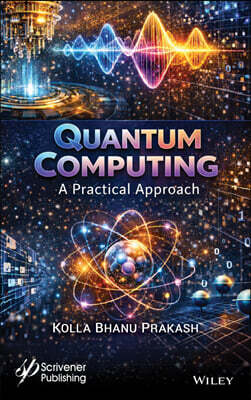
Kolla Bhanu Prakash, PhD is a Professor and Associate Dean of Research and Development at Koneru Lakshmaiah University, India and an Adjunct Professor at?Taylor’s University, Malaysia. He has published 15 patents, one copyright, and more than 150 research papers in national and international journals and conferences, edited 15 books, and authored three books. His research interests include deep learning, data science, and quantum computing.
품목정보
- 발행일
- 2026년 08월 13일
- 쪽수, 무게, 크기
- 256쪽 | 크기확인중
- ISBN13
- 9781394433902
사락 별점0
혜택 및 유의사항밑줄0
혜택 및 유의사항상품정보안내
직수입외서의 경우, 해외거래처에서 제공하는 정보가 부족하여 제목, 표지, 가격, 유통상태 등의 정보가 미비하거나 변경되는 경우가 있습니다. 정확한 확인을 원하시는 경우, 일대일 상담으로 문의하여 주시면 답변 드리겠습니다.
(판형과 판수 등이 다양한 도서는 찾으시는 도서의 ISBN을 알려 주시면 보다 빠르고 정확한 안내가 가능합니다.)
해외거래처에서 품절인 경우, 2차 거래선을 통해 유럽과 미국 출판사로 직접 수입이 진행될 수 있습니다.
수입 진행 시점으로 부터 2~3주가 추가로 소요되며, 해외에서도 유통이 원활하지 않은 도서는 품절 안내가 지연될 수 있습니다.
해당 경우, 문자와 메일로 별도 안내를 드리고 있사오니 마이페이지에서 휴대전화번호와 메일주소를 다시 한번 확인해주시기 바랍니다.
(판형과 판수 등이 다양한 도서는 찾으시는 도서의 ISBN을 알려 주시면 보다 빠르고 정확한 안내가 가능합니다.)
해외거래처에서 품절인 경우, 2차 거래선을 통해 유럽과 미국 출판사로 직접 수입이 진행될 수 있습니다.
수입 진행 시점으로 부터 2~3주가 추가로 소요되며, 해외에서도 유통이 원활하지 않은 도서는 품절 안내가 지연될 수 있습니다.
해당 경우, 문자와 메일로 별도 안내를 드리고 있사오니 마이페이지에서 휴대전화번호와 메일주소를 다시 한번 확인해주시기 바랍니다.
326,490원
총 1개
326,490원