

이미 소장하고 있다면 판매해 보세요.
- 국내배송만 가능
- 문화비소득공제 가능
책소개
목차
|
chapter 01 Introduction …11
chapter 02 English Phonemes and Spellings …29 chapter 03 Classification of English Phonemes …37 chapter 04 Allophonic Variations of English …73 chapter 05 Phonological Rules …133 chapter 06 Acoustic Phonetics …141 chapter 07 Practice and Evaluation Criteria …281 References …307 Appendix …309 |
저자 소개 1
Hyeonkwan Cho is a professor in the Department of English Language and Literature at Chungnam National University, Korea.
조현관의 다른 상품


품목정보
- 발행일
- 2026년 02월 20일
- 쪽수, 무게, 크기
- 310쪽 | 185*257*30mm
- ISBN13
- 9791165033286
책 속으로
|
Many people ask, “How many allophonic rules are there in English?” The answer is “infinite.” Even though each phoneme may have infinite allophones, it is practically and linguistically meaningless to explain all of them. Therefore, phonologists select and explain only the allophones that have prominent phonetic or acoustic characteristics. Additionally, some authors describe only the most representative allophonic rules, while others describe a wider range of rules. The allophonic rules that I want to introduce and explain to you in this book are the ones that are essential for Korean speakers to achieve native-like English pronunciation. If you study and apply these rules well, you can significantly improve your English pronunciation.
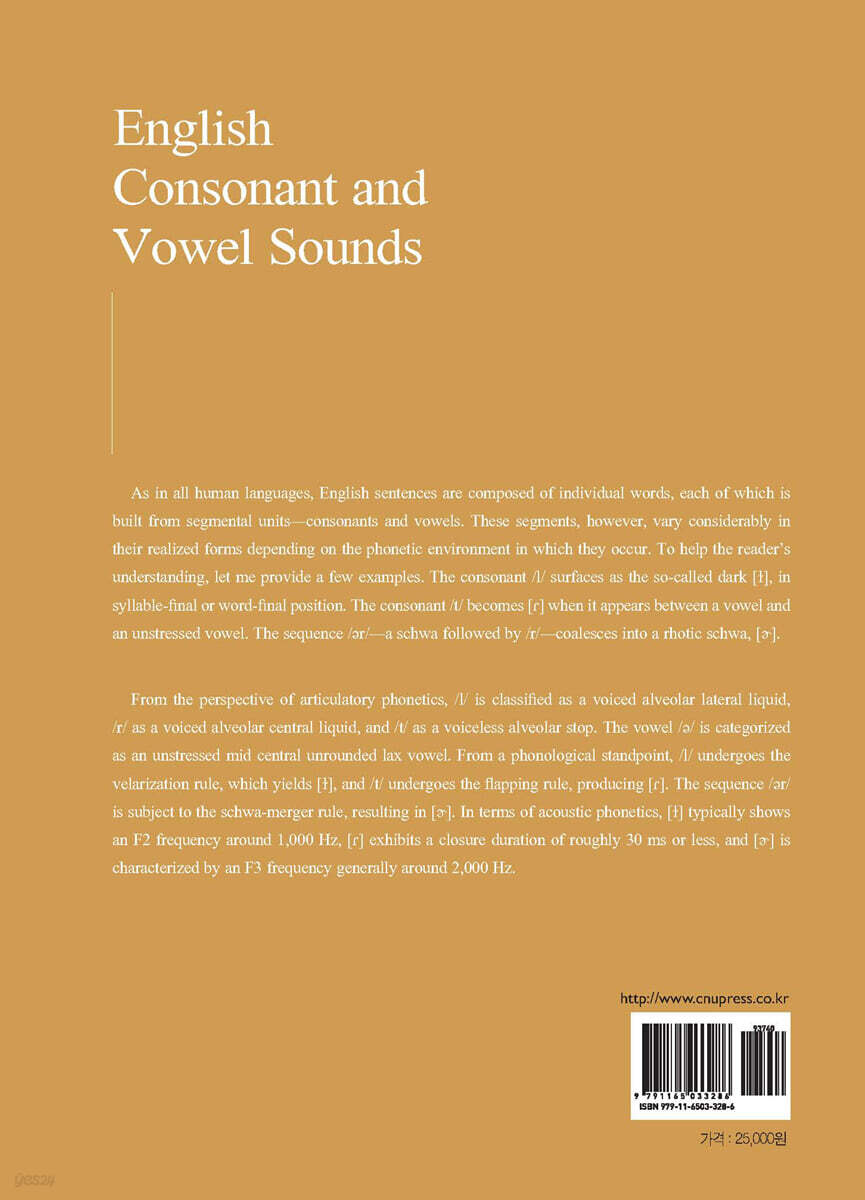
[ 저자서문 ] This book begins by presenting the phonetic properties and classificatory principles of English consonants and vowels from the perspective of articulatory phonetics. The subsequent stage discusses, within a phonological framework, the various sound changes that English consonants and vowels undergo, formulated here as a set of systematic pronunciation rules. The final stage offers an acoustic analysis of English consonants and vowels from the standpoint of acoustic phonetics. The sections on articulatory phonetics and phonology are primarily adapted and translated from my earlier work, English Pronunciation Rules and Transcription (2014), while the section on acoustic phonetics draws on my more recent work, Lecture Notes on English Consonants and Vowels (2023). As in all human languages, English sentences are composed of individual words, each of which is built from segmental units-consonants and vowels. These segments, however, vary considerably in their realized forms depending on the phonetic environment in which they occur. To help the reader’s understanding, let me provide a few examples. The consonant /l/ surfaces as the so-called ‘dark l,’ [?], in syllable-final or word-final position. The consonant /t/ becomes [?] when it appears between a vowel and an unstressed vowel. The sequence /?r/-a schwa followed by /r/-coalesces into a ‘rhotic schwa,’ [?]. The brief overview below is intended to help readers anticipate the overall structure and focus of this book. From the perspective of articulatory phonetics, /l/ is classified as a voiced alveolar lateral liquid, /r/ as a voiced alveolar central liquid, and /t/ as a voiceless alveolar stop. The vowel /?/ is categorized as an unstressed mid central unrounded lax vowel. From a phonological standpoint, /l/ undergoes the velarization rule, which yields [?], and /t/ undergoes the flapping rule, producing [?]. The sequence /?r/ is subject to the schwa-merger rule, resulting in [?]. In terms of acoustic phonetics, [?] typically shows an F2 frequency around 1,000 Hz, [?] exhibits a closure duration of roughly 30ms or less, and [?] is characterized by an F3 frequency generally below 2,000 Hz. This book is organized as follows. Chapter 1 offers an introduction to English articulatory phonetics and phonology. Chapter 2 provides a concise explanation of the relationship between English spelling and its phonetic transcription. Chapter 3 discusses the structure and function of the vocal organs, along with the linguistic principles used to classify English consonants and vowels. Chapter 4 presents a detailed account of nineteen allophonic rules, based on the relationship between phonemes and their allophones. Chapter 5 surveys a distinct class of phonological rules that operate beyond the domain of allophony. Chapter 6 introduces the fundamentals of acoustic phonetics and examines the acoustic properties of English consonants and vowels. Chapter 7 proposes acoustic evaluation criteria for pronunciation practice, with a particular focus on learners of English who are native speakers of Korean. --- 본문 중에서 |
리뷰/한줄평0
25,000원
총 1개
25,000원