
소개
목차
|
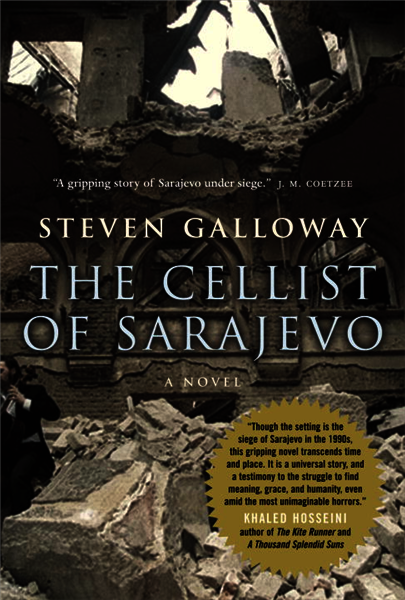
This brilliant novel with universal resonance tells the story of three people trying to survive in a city rife with the extreme fear of desperate times, and of the sorrowing cellist who plays undaunted in their midst.
One day a shell lands in a bread line and kills twenty-two people as the cellist watches from a window in his flat. He vows to sit in the hollow where the mortar fell and play Albinoni’s Adagio once a day for each of the twenty-two victims. The Adagio had been re-created from a fragment after the only extant score was firebombed in the Dresden Music Library, but the fact that it had been rebuilt by a different composer into something new and worthwhile gives the cellist hope. Meanwhile, Kenan steels himself for his weekly walk through the dangerous streets to collect water for his family on the other side of town, and Dragan, a man Kenan doesn’t know, tries to make his way towards the source of the free meal he knows is waiting. Both men are almost paralyzed with fear, uncertain when the next shot will land on the bridges or streets they must cross, unwilling to talk to their old friends of what life was once like before divisions were unleashed on their city. Then there is “Arrow,” the pseudonymous name of a gifted female sniper, who is asked to protect the cellist from a hidden shooter who is out to kill him as he plays his memorial to the victims. In this beautiful and unforgettable novel, Steven Galloway has taken an extraordinary, imaginative leap to create a story that speaks powerfully to the dignity and generosity of the human spirit under extraordinary duress. From the Hardcover edition. |
품목정보
- 발행일
- 2009년 02월 24일
- 이용안내
-
- 배송 없이 구매 후 바로 읽기
- 이용기간 제한없음
- TTS 불가능
- 저작권 보호를 위해 인쇄 기능 제공 안함
- 지원기기
- 크레마,PC(윈도우 - 4K 모니터 미지원),아이폰,아이패드,안드로이드폰,안드로이드패드,PC(Mac)
- 파일/용량
- EPUB(DRM) | 0.22MB ?
출판사 리뷰
|
The Cellist
It screamed downward, splitting air and sky without effort. A target expanded in size, brought into focus by time and velocity. There was a moment before impact that was the last instant of things as they were. Then the visible world exploded. In 1945, an Italian musicologist found four bars of a sonata’s bass line in the remnants of the firebombed Dresden Music Library. He believed these notes were the work of the seventeenth-century Venetian composer Tomaso Albinoni, and spent the next twelve years reconstructing a larger piece from the charred manuscript fragment. The resulting composition, known as Albinoni’s Adagio, bears little resemblance to most of Albinoni’s work and is considered fraudulent by most scholars. But even those who doubt its authenticity have difficulty denying the Adagio’s beauty. Nearly half a century later, it’s this contradiction that appeals to the cellist. That something could be almost erased from existence in the landscape of a ruined city, and then rebuilt until it is new and worthwhile, gives him hope. A hope that, now, is one of a limited number of things remaining for the besieged citizens of Sarajevo and that, for many, dwindles each day. And so today, like every other day in recent memory, the cellist sits beside the window of his second-floor apartment and plays until he feels his hope return. He rarely plays the Adagio. Most days he’s able to feel the music rejuvenate him as simply as if he were filling a car with gasoline. But some days this isn’t the case. If, after several hours, this hope doesn’t return, he will pause to gather himself, and then he and his cello will coax Albinoni’s Adagio out of the firebombed husk of Dresden and into the mortar-pocked, sniper-infested streets of Sarajevo. By the time the last few notes fade, his hope will be restored, but each time he’s forced to resort to the Adagio it becomes harder, and he knows its effect is finite. There are only a certain number of Adagios left in him, and he will not recklessly spend this precious currency. It wasn’t always like this. Not long ago the promise of a happy life seemed almost inviolable. Five years ago at his sister’s wedding, he’d posed for a family photograph, his father’s arm slung behind his neck, fingers grasping his shoulder. It was a firm grip, and to some it would have been painful, but to the cellist it was the opposite. The fingers on his flesh told him that he was loved, that he had always been loved, and that the world was a place where above all else the things that were good would find a way to burrow into you. Though he knew all of this then, he would give up nearly anything to be able to go back in time and slow down that moment, if only so he could more clearly recall it now. He would very much like to feel his father’s hand on his shoulder again. He can tell today won’t be an Adagio day. It has been only a half-hour since he sat down beside the window, but already he feels a little bit better. Outside, a line of people wait to buy bread. It’s been over a week since the market’s had any bread to buy, and he considers whether he might join them. Many of his friends and neighbours are in line. He decides against it, for now. There’s still work to do. It screamed downward, splitting air and sky without effort. A target expanded in size, brought into focus by time and velocity. There was a moment before impact that was the last instant of things as they were. Then the visible world exploded. When the mortars destroyed the Sarajevo Opera Hall, the cellist felt as if he were inside the building, as if the bricks and glass that once bound the structure together became projectiles that sliced and pounded into him, shredding him beyond recognition. He was the principal cellist of the Sarajevo Symphony Orchestra. That wa |
