
소개
목차
|
RETURNING TO TELEVISION AS AN ALL-NEW MINISERIES ON FOX
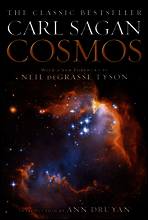
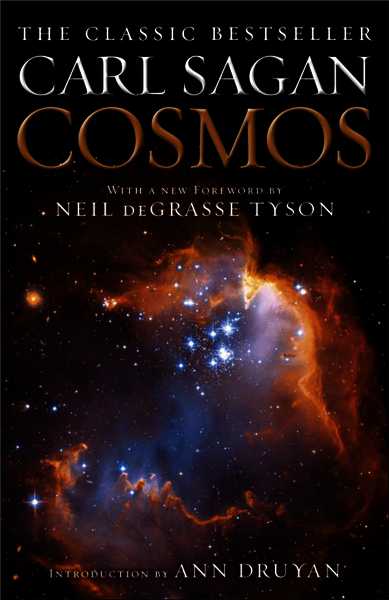
Cosmos is one of the bestselling science books of all time. In clear-eyed prose, Sagan reveals a jewel-like blue world inhabited by a life form that is just beginning to discover its own identity and to venture into the vast ocean of space. Cosmos retraces the fourteen billion years of cosmic evolution that have transformed matter into consciousness, exploring such topics as the origin of life, the human brain, Egyptian hieroglyphics, spacecraft missions, the death of the Sun, the evolution of galaxies, and the forces and individuals who helped to shape modern science. Praise for Cosmos “Magnificent . . . With a lyrical literary style, and a range that touches almost all aspects of human knowledge, Cosmos often seems too good to be true.”—The Plain Dealer “Sagan is an astronomer with one eye on the stars, another on history, and a third—his mind’s—on the human condition.”—Newsday “Brilliant in its scope and provocative in its suggestions . . . shimmers with a sense of wonder.”—The Miami Herald “Sagan dazzles the mind with the miracle of our survival, framed by the stately galaxies of space.”—Cosmopolitan “Enticing . . . iridescent . . . imaginatively illustrated.”—The New York Times Book Review NOTE: This edition does not include images. |
품목정보
- 발행일
- 2011년 07월 06일
- 이용안내
-
- 배송 없이 구매 후 바로 읽기
- 이용기간 제한없음
- TTS 불가능
- 저작권 보호를 위해 인쇄 기능 제공 안함
- 지원기기
- 크레마,PC(윈도우 - 4K 모니터 미지원),아이폰,아이패드,안드로이드폰,안드로이드패드,PC(Mac)
- 파일/용량
- EPUB(DRM) | 3.08MB ?
- KC인증
-
출판사 리뷰
|
Chapter I
The Shores of the Cosmic Ocean The first men to be created and formed were called the Sorcerer of Fatal Laughter, the Sorcerer of Night, Unkempt, and the Black Sorcerer . . . They were endowed with intelligence, they succeeded in knowing all that there is in the world. When they looked, instantly they saw all that is around them, and they contemplated in turn the arc of heaven and the round face of the earth . . . [Then the Creator said]: “They know all . . . what shall we do with them now? Let their sight reach only to that which is near; let them see only a little of the face of the earth! . . . Are they not by nature simple creatures of our making? Must they also be gods?” —The Popol Vuh of the Quiché Maya The known is finite, the unknown infinite; intellectually we stand on an islet in the midst of an illimitable ocean of inexplicability. Our business in every generation is to reclaim a little more land. —T. H. Huxley, 1887 The Cosmos is all that is or ever was or ever will be. Our feeblest contemplations of the Cosmos stir us—there is a tingling in the spine, a catch in the voice, a faint sensation, as if a distant memory, of falling from a height. We know we are approaching the greatest of mysteries. The size and age of the Cosmos are beyond ordinary human understanding. Lost somewhere between immensity and eternity is our tiny planetary home. In a cosmic perspective, most human concerns seem insignificant, even petty. And yet our species is young and curious and brave and shows much promise. In the last few millennia we have made the most astonishing and unexpected discoveries about the Cosmos and our place within it, explorations that are exhilarating to consider. They remind us that humans have evolved to wonder, that understanding is a joy, that knowledge is prerequisite to survival. I believe our future depends on how well we know this Cosmos in which we float like a mote of dust in the morning sky. Those explorations required skepticism and imagination both. Imagination will often carry us to worlds that never were. But without it, we go nowhere. Skepticism enables us to distinguish fancy from fact, to test our speculations. The Cosmos is rich beyond measure—in elegant facts, in exquisite interrelationships, in the subtle machinery of awe. The surface of the Earth is the shore of the cosmic ocean. From it we have learned most of what we know. Recently, we have waded a little out to sea, enough to dampen our toes or, at most, wet our ankles. The water seems inviting. The ocean calls. Some part of our being knows this is from where we came. We long to return. These aspirations are not, I think, irreverent, although they may trouble whatever gods may be. The dimensions of the Cosmos are so large that using familiar units of distance, such as meters or miles, chosen for their utility on Earth, would make little sense. Instead, we measure distance with the speed of light. In one second a beam of light travels 186,000 miles, nearly 300,000 kilometers or seven times around the Earth. In eight minutes it will travel from the Sun to the Earth. We can say the Sun is eight light-minutes away. In a year, it crosses nearly ten trillion kilometers, about six trillion miles, of intervening space. That unit of length, the distance light goes in a year, is called a light-year. It measures not time but distances—enormous distances. The Earth is a place. It is by no means the only place. It is not even a typical place. No planet or star or galaxy can be typical, because the Cosmos is mostly empty. The only typical place is within the vast, cold, universal vacuum, the everlasting night of intergalactic space, a place so strange and desolate that, by comparison, planets and stars and galaxies seem achingly rare and lovely. If we were randomly inserted int |