

소득공제
정가제 Free
EPUB
eBook
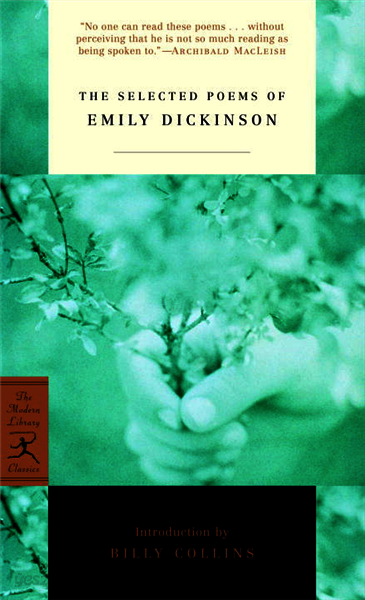
The Selected Poems of Emily Dickinson
EPUB
Random House Publishing Group
2012.08.22.
소개
목차
|
Emily Dickinson lived as a recluse in Amherst, Massachusetts, dedicating herself to writing a "letter to the world"--the 1,775 poems left unpublished at her death in 1886. Today, Dickinson stands in the front rank of American poets. This enthralling collection includes more than four hundred poems that were published between Dickinson's death and 1900. They express her concepts of life and death, of love and nature, and of what Henry James called "the landscape of the soul." And as Billy Collins suggests in his Introduction, "In the age of the workshop, the reading, the poetry conference and festival, Dickinson reminds us of the deeply private nature of literary art."
|
품목정보
- 발행일
- 2012년 08월 22일
- 이용안내
-
- 배송 없이 구매 후 바로 읽기
- 이용기간 제한없음
- TTS 불가능
- 저작권 보호를 위해 인쇄 기능 제공 안함
- 지원기기
- 크레마,PC(윈도우 - 4K 모니터 미지원),아이폰,아이패드,안드로이드폰,안드로이드패드,PC(Mac)
- 파일/용량
- EPUB(DRM) | 1.78MB ?
- ISBN13
- 9780307823786
출판사 리뷰
|
Today Emily Dickinson is recognized not only as a major poet of the American nineteenth century but also as one of the most intriguing poets of any place or time, in both her art and her life. The outline of her biography is well known. She was born in Amherst, Massachusetts, in 1830 and, except for a few excursions to Philadelphia, Washington, and Boston, spent her entire life there, increasingly limiting her activities to her father's house. "I do not cross my Father's ground to any House or Town," she wrote, referring to a personal reclusiveness that was noticeable even to her contemporaries. In the front corner bedroom of that house on Main Street, Dickinson wrote over 1,700 poems, often on scraps of paper and on the backs of grocery lists, only a handful of which were published in her lifetime and then anonymously. She was known to give poems to friends and neighbors, often as an accompaniment to the cakes and cookies she baked, sometimes lowering them from an upstairs window in a basket. Her habit of binding groups of poems together into little booklets called fascicles might indicate she felt her poems were presentable, but most of her poems never went farther than her desk drawer where they were discovered by her sister after Dickinson's death in 1886 of kidney failure. In her lifetime, her poetry remained unknown, and although a few small editions of her poems were published in the 1890s, it was not until 1955 that a reliable scholarly edition appeared, transcribing the poems precisely from the original manuscripts and preserving all of Dickinson's typographical eccentricities (see Note). Convincingly or not, she called publication "the auction of the mind" and compared the public figure to a frog croaking to the admiring audience of a bog.
It is fascinating to consider the case of a person who led such a private existence and whose poems remained unrecognized for so long after her death, as if she had lain asleep only to be awakened by the kiss of the twentieth century. The quirky circumstances of her life have received as much if not more commentary than the poems themselves. Some critics valorize her seclusion as a form of female self-sufficiency; others make her out to be a victim of her culture. Still others believe that her solitariness has been exaggerated. She did attend school, after all, and she maintained many intimate relationships by letter. Moreover, it was less eccentric in her day than in ours for one daughter--she had a brother who was a lawyer and a sister who married--to remain home to run the household and assist her parents. Further, all writers need privacy; all must close the door on the world to think and compose. But Dickinson's separateness--which has caused her to be labeled a homebody, a spinster, and a feminist icon among other things--took extreme forms. She was so shy that her sister Lavinia would be fitted for her clothes; she wore only white for many years ("Wear nothing commoner than snow"); and she rarely would address an envelope, afraid that her handwriting would be seen by the eyes of strangers. When asked of her companions, she replied in a letter to Thomas Wentworth Higginson, "Hills, sir, and the sundown, and a dog large as myself that my father bought me." However tempting it is to search through the biographical evidence for a solution to the enigma of Emily Dickinson's life, we must remember that no such curiosity would exist were it not for the poems themselves. Her style is so distinctive that anyone even slightly acquainted with her poems would recognize a poem on the page as an Emily Dickinson poem, if only for its shape. Here is a typical example: 'T is little I could care for pearls Who own the ample sea; Or brooches when the Emperor With rubies pelteth me; Or gold, who am the Prince of Mines; Or diamonds, when I see A diadem to fit a dome Continual crowning me. |