

소개
목차
|
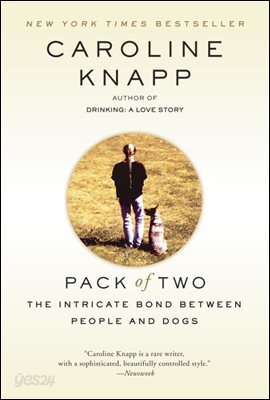
At the age of 36, Caroline Knapp, author of the acclaimed bestseller Drinking:A Love Story, found herself confronted with a monumental task: redefining her world. She had faced the loss of both her parents, given up a twenty-year relationship with alcohol, and, as she writes, "I was wandering around in a haze of uncertainty, blinking up at the biggest questions: Who am I without parents and without alcohol? How to form attachments, and where to find comfort, in the face of such daunting vulnerability?" An answer materialized in the most unlikely form: that of a dog. Eighteen months to the day after she quit drinking, Knapp stumbled upon an eight-week-old puppy at a local animal shelter, took her home, and named her Lucille. Now two years old, Lucille has become a central force in Knapp's life: "In her," she writes, "I have found solace, joy, a bridge to the world."
Caroline Knapp has been celebrated as much for her fresh insight into emotional and psychological issues as she has been for her gifts as a writer. In Pack of Two, she brings the same perception and talent to bear on the rich, complicated terrain of human-animal relationships. In addition to mining her own experience with Lucille, Knapp speaks to a wide variety of dog people--from animal behaviorists and psychologists to other owners whose dogs have deeply affected their lives--about this emotionally complex, sometimes daunting, often profoundly healing alliance. Throughout, she explores the shift in canine roles from working partners to intimate companions and looks, too, at how this new kinship, this wordless bond, becomes a template for what we most desire ourselves. From the Trade Paperback edition. |
품목정보
- 발행일
- 2010년 08월 10일
- 이용안내
-
- 배송 없이 구매 후 바로 읽기
- 이용기간 제한없음
- TTS 불가능
- 저작권 보호를 위해 인쇄 기능 제공 안함
- 지원기기
- 크레마,PC(윈도우 - 4K 모니터 미지원),아이폰,아이패드,안드로이드폰,안드로이드패드,PC(Mac)
- 파일/용량
- EPUB(DRM) | 2.49MB ?
- ISBN13
- 9780307759993
출판사 리뷰
|
Family Dog
Scene: a morning in mid-November, about fifteen months after I've gotten Lucille. My boyfriend and I are sitting in a couples therapist's office. I am speaking, near tears. This is our first meeting with the psychologist. We are talking about . . . the dog. "I want to feel like she's mine," I say. "But she is yours," Michael says. "The dog adores you." "But . . . but . . ." I choke, half-formed thoughts about love and trust and exclusivity trapped somewhere between gut and mouth. Lucille, it is safe to say, was an "issue" in our relationship from the beginning. This sounds ridiculous, like something you'd hear on a daytime talk show ("Women Who Love Dogs Too Much"), but it was true. From the day I got her, I was a total hog with Lucille. Mine, mine, mine. The dog is mine. Pre-Lucille, I spent four, five, sometimes six nights a week at Michael's house. Post-Lucille, I started to spend three nights there, maybe only two, and I was starting to feel tense at even that number, compelled to be back in my own home. I had a rationale for this: my house has an enclosed patio, so when Lucille was a puppy, I could take her out to pee in the middle of the night without having to get dressed and put on shoes, whereas Michael lived in an apartment, with no access to fenced-in space. It was therefore more practical to stay at my house. But in truth I wanted the dog to myself. I wanted her to bond with me and me alone, and the ferocity of this possessiveness took me completely by surprise. I wanted her to follow me and not him, to sleep on my side of the bed, not his. If we were all sitting on the sofa and she put her head on his leg or curled up against him, I'd get a horrible, mean-spirited little stab of jealousy, and I found this so painful and embarrassing I couldn't even talk about it. Instead I started angling for more time alone. "I could use a night to myself," I'd say. Or, "I think I'll stay at my house tonight," and neither Michael nor I chose to comment on the fact that I didn't ask him to stay there with us. This made me feel horribly small and mean and tense, all this orchestrating of distance, but I couldn't help it; the reaction was so visceral it overpowered me. Michael is probably the nicest man I've ever known, and by the time we started seeing the couples therapist, I'd known him for seven years. He'd been my primary caretaker all that time, and without question my best friend. I met him just after I'd stopped living with my old boyfriend, who was not a nice man at all, and Michael literally held my hand through that breakup, which dragged on for several years. I remember calling him up from work one day, just after I'd left Julian and moved into a new apartment, and weeping into the phone, telling him I thought I was having a nervous breakdown. He said he'd meet me for a walk in the Boston Common, and we sat on a bench in the sun. I cried and cried and talked about how miserable I felt about the breakup with Julian, and Michael listened, his arm around my shoulders. That's how he always was: a man who'd listen and hold you even when you talked about things that should, by all accounts, have hurt or dismayed or warned him away. Sometimes I thought this was a sign of deep generosity, and sometimes I saw it as an inability on his part to set limits, but whatever the motive, Michael is nothing if not steadfast. He saw me through the eleven months my father was dying, and a year later he saw me through the death of my mother, and eight months after that he saw me through my decision to quit drinking and go to rehab. He cooked a million homey dinners for me through that time, rigatoni with red sauce, and chicken with dumplings, and Italian sausages with mashed potatoes, and he almost never called me on the fact that I didn't give nearly enough back. |
