
소개
목차
|
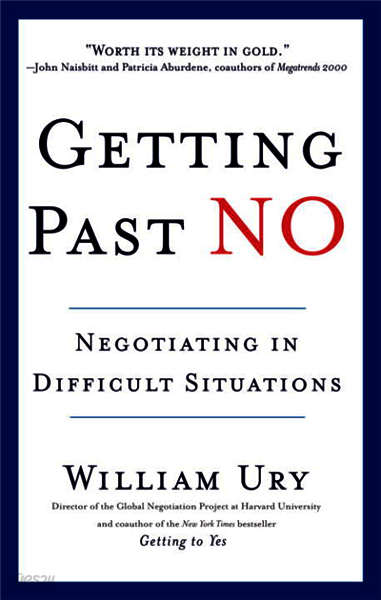
We all want to get to yes, but what happens when the other person keeps saying no?
How can you negotiate successfully with a stubborn boss, an irate customer, or a deceitful coworker? In Getting Past No, William Ury of Harvard Law School’s Program on Negotiation offers a proven breakthrough strategy for turning adversaries into negotiating partners. You’ll learn how to: • Stay in control under pressure • Defuse anger and hostility • Find out what the other side really wants • Counter dirty tricks • Use power to bring the other side back to the table • Reach agreements that satisfies both sides' needs Getting Past No is the state-of-the-art book on negotiation for the twenty-first century. It will help you deal with tough times, tough people, and tough negotiations. You don’t have to get mad or get even. Instead, you can get what you want! From the Trade Paperback edition. |
품목정보
- 발행일
- 2007년 04월 17일
- 이용안내
-
- 배송 없이 구매 후 바로 읽기
- 이용기간 제한없음
- TTS 불가능
- 저작권 보호를 위해 인쇄 기능 제공 안함
- 지원기기
- 크레마,PC(윈도우 - 4K 모니터 미지원),아이폰,아이패드,안드로이드폰,안드로이드패드,PC(Mac)
- 파일/용량
- EPUB(DRM) | 0.44MB ?
- ISBN13
- 9780553903645
출판사 리뷰
|
Overview
Breaking Through Barriers to Cooperation Diplomacy is the art of letting someone else have your way.–Daniele Vare, Italian diplomat We all negotiate every day. Much of our time is spent trying to reach agreement with others. We may try to negotiate in a cooperative spirit but frequently we find ourselves frustrated. We want to get to yes, but often the answer we get back is NO. Think of a typical day: Over breakfast you may get into an argument with your spouse about buying a new car. You think it's time, but your spouse says, "Don't be ridiculous! You know we can't afford it right now." You arrive at work for a morning meeting with your boss. You present a carefully prepared proposal for a new project, but your boss interrupts you after a minute and says: "We already tried that and it didn't work. Next item." During your lunch hour you try to return a defective toaster-oven, but the salesperson refuses to refund your money because you don't have the sales slip: "It's store policy." In the afternoon you bring an already-agreed-upon contract to a client for his signature. You have trumpeted the deal to your associates and made the necessary arrangements with manufacturing. But your client tells you: "I'm sorry. My boss refuses to okay the purchase unless you give us a fifteen percent discount." In the evening you need to return some phone calls, but the line is tied up by your thirteen-year-old. Exasperated, you say, "Get off the phone." The teenager shouts down the hall, "Why don't you get me my own phone line? All my friends have them!" Each of us faces tough negotiations with an irritable spouse, a domineering boss, a rigid salesperson, a tricky customer, or an impossible teenager. Under stress, even nice, reasonable people can turn into angry, intractable opponents. Negotiations can bog down or break down, consuming our time, keeping us awake at night, and giving us ulcers. Broadly defined, negotiation is the process of back-and-forth communication aimed at reaching agreement with others when some of your interests are shared and some are opposed. Negotiation is not limited to the activity of formally sitting across a table discussing a contentious issue; it is the informal activity you engage in whenever you try to get something you want from another person. Think for a moment about how you make important decisions in your life–the decisions that have the greatest impact on your performance at work and your satisfaction at home. How many of those decisions can you make unilaterally and how many do you have to reach with others–through negotiation? Most people I ask this question answer: "I have to negotiate almost all of them." Negotiation is the pre-eminent form of decision-making in personal and professional life. It is also increasingly the most important means of making decisions in the public arena. Even if we aren't personally sitting at the table, our lives are affected by the outcome of negotiations. When talks between the school board and teachers' union break down and the teachers go on strike, our children end up staying home from school. When negotiations between our business and a potential purchaser fall through and the business goes bankrupt, we may lose our jobs. When discussions between our government and its adversaries come to naught, the result may be war. In sum, negotiations shape our lives. Joint Problem-Solving We may all be negotiators, yet many of us don't like to negotiate. We see negotiation as stressful confrontation. We see ourselves faced with an unpleasant choice. If we are "soft" in order to preserve the relationship, we end up giving up our position. If we are "hard" in order to win our position, we strain the relationship or perhaps lose it altogether |
