
소개
목차
|
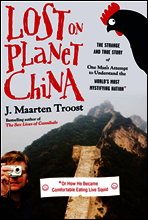
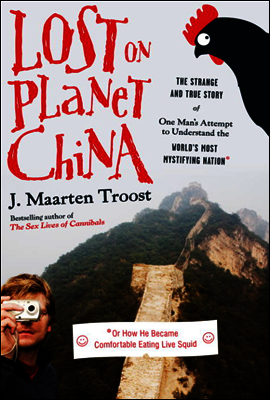
The bestselling author of The Sex Lives of Cannibals returns with a sharply observed, hilarious account of his adventures in China—a complex, fascinating country with enough dangers and delicacies to keep him, and readers, endlessly entertained.
Maarten Troost has charmed legions of readers with his laugh-out-loud tales of wandering the remote islands of the South Pacific. When the travel bug hit again, he decided to go big-time, taking on the world’s most populous and intriguing nation. In Lost on Planet China, Troost escorts readers on a rollicking journey through the new beating heart of the modern world, from the megalopolises of Beijing and Shanghai to the Gobi Desert and the hinterlands of Tibet. Lost on Planet China finds Troost dodging deadly drivers in Shanghai; eating Yak in Tibet; deciphering restaurant menus (offering local favorites such as Cattle Penis with Garlic); visiting with Chairman Mao (still dead, very orange); and hiking (with 80,000 other people) up Tai Shan, China’s most revered mountain. But in addition to his trademark gonzo adventures, the book also delivers a telling look at a vast and complex country on the brink of transformation that will soon shape the way we all work, live, and think. As Troost shows, while we may be familiar with Yao Ming or dim sum or the cheap, plastic products that line the shelves of every store, the real China remains a world—indeed, a planet--unto itself. Maarten Troost brings China to life as you’ve never seen it before, and his insightful, rip-roaringly funny narrative proves that once again he is one of the most entertaining and insightful armchair travel companions around. |
품목정보
- 발행일
- 2008년 07월 08일
- 이용안내
-
- 배송 없이 구매 후 바로 읽기
- 이용기간 제한없음
- TTS 불가능
- 저작권 보호를 위해 인쇄 기능 제공 안함
- 지원기기
- 크레마,PC(윈도우 - 4K 모니터 미지원),아이폰,아이패드,안드로이드폰,안드로이드패드,PC(Mac)
- 파일/용량
- EPUB(DRM) | 2.03MB ?
출판사 리뷰
|
1
There are two kinds of people roaming the far fringes of the world: Mormon missionaries and Chinese businessmen. I know this because for a long while I lived off the map, flitting from island to island in the South Pacific, and invariably, just as I arrived at what surely was the ends of the earth, I would soon find myself in the company of Elder Ryan and Elder Leviticus, twenty year old kids from suburban Provo, who faced the challenging task of convincing islanders that they were not native islanders at all, but lost Israelites. Not just lost Israelites mind you, but lost and wicked Israelites. One would think that this would be a hard thing to convince people of, but the Mormons are persistent and today they can be found on even the most remote of islands. On Onotoa, an atoll of trifling size in the southern Gilbert group, and about as far as one can be on this planet without quite leaving it, I was startled to discover two Mormon missionaries, wearing their customary black pants and white short-sleeved dress shirts, complete with name tags, biking up and down the island's lonesome dirt path, searching for wayward souls to rescue. I also found them in Tonga, on the arresting islets of Vava'u, and even in the rugged hills of Vanuatu. Whenever I encountered them, I immediately reached for a dose of caffeine, nicotine, or alcohol, something to demonstrate that conversion was a hopeless cause with me, and soon they were on their way, hustling errant Israelites. Eventually, I grew accustomed to their presence. Missionaries, after all, have long been found in the world's most distant corners. Where else would one find a tribe of lost and forgotten Hebrews? But as one year on the far side of the world passed into another, and then another, and another, until it seemed likely that my time on the islands would outlast Robinson Crusoe's, I began to notice a different visitor--the Chinese businessman. This, frankly, surprised me to no end, possibly because news travels slowly on the coconut wireless. No doubt in other parts of the world the presence of Chinese businessmen--Capitalists!--would elicit nary a reaction. Mao Zedong had been dead for thirty years. China had moved on, changed, adapted, and eventually become the world's factory. But if you live on an island where prices are still quoted in pigs, and where the news of the day is likely to involve two chiefs disputing each other's lineage, you might not know this. You might, in fact, still believe that the Chinese peddle ancient black bicycles to their designated work unit, which is part of a cadre, though you're not quite sure what a cadre is. When you envision China you might imagine factory workers, each waving a Little Red Book, marching in sync past enormous portraits of the Heroes of the Revolution. You can almost hear the loudspeakers, the voices exhorting the proletariat to strive ever further, so that the goals of the Five Year Plan are attained. You can imagine little children, all wearing red handkerchiefs around their necks, learning to despise imperialist dogs and debauched class enemies. This is what happens when you live in a place far, far away, thousands of miles from a continent. Nothing ever changes on an island, and you assume that the continental world too has resolved to cease spinning. But it hasn't, of course, and one day you discover that you're sharing an odd, faraway island with a businessman from China. Consider Onotoa, an atoll in the southern Gilbert Islands. Go on. Take out the atlas. You can't find it, can you? This is because it is a mere speck of an island, not more than a hundred yards across. If you were a tribe of ancient, wicked Israelites with a pressing need to disappear, you could not do better than to set forth for Onotoa. It wasn't until a whaling ship alighted upon the island in 1826 that the outside world was made to learn of its existence, a fact that was quickly and thoroughly forgotten by all. |