
소개
목차
|
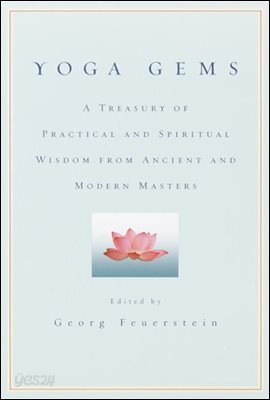
Here is an inspirational and accessible introduction to the deep inner wisdom of yoga gathered from sources both ancient and modern by one of America’s most respected yoga scholars.
YOGA GEMS For the millions of Americans who now practice yoga regularly, here is the perfect introduction to the rich philosophical and spiritual tradition behind the exercises. George Feuerstein has drawn short, memorable quotations from the key texts of this five-thousand-year-old legacy, with an emphasis on the wisdom of modern yoga masters.The quotations have been selected and arranged to address the needs of yoga practitioners in the twenty-first century. Among the many themes touched on in this treasure of a book: the process of inner growth; the value of silence; how to meditate; how to infuse everyday life with joy; universal kinship; overcoming suffering; dealing with grief, loss, anger, and jealousy; remembering and cultivating one’s true inner self; developing self-discipline; and bringing out the good in all you say and do. For both new and experienced yoga students alike, Yoga Gems is the perfect travel companion on the road to inner peace. From the Trade Paperback edition. |
품목정보
- 발행일
- 2008년 12월 10일
- 이용안내
-
- 배송 없이 구매 후 바로 읽기
- 이용기간 제한없음
- TTS 불가능
- 저작권 보호를 위해 인쇄 기능 제공 안함
- 지원기기
- 크레마,PC(윈도우 - 4K 모니터 미지원),아이폰,아이패드,안드로이드폰,안드로이드패드,PC(Mac)
- 파일/용량
- EPUB(DRM) | 1.85MB ?
- ISBN13
- 9780307493491
출판사 리뷰
|
Chapter 1
MIND--MAKER OF DESTINY The human mind is a wondrous thing. It can create disease or heal us. It can hurl us into hell (suffering) or elevate us into heaven (happiness). If we look at life closely, with a mind free from preconceptions and delusions, we quickly realize our days are filled with experiences that can be summed up in one word: suffering. As long as we look at life through the rose-colored glasses of wishful thinking and pretense, however, we are bound to tell ourselves and others that, in the words of Voltaire, this is the best of all possible worlds. In contrast, the Indian sages have always been realistic in their assessment of human existence and the world as a whole. Apart from some fleeting moments of pleasure, which must not be confused with real happiness, ours is not an enviable lot. This wisdom of the ancient Indian sages was given exquisite expression by the enlightened master Gautama, later to be known as "the Buddha" or "Awakened One." Like many of the sages remembered in history, Gautama was born into a royal family, but he abandoned his comfortable court life at the age of twenty-nine to take up the most challenging yogic practices. Six years later, after many years of exploring the dead end of severe asceticism, he opted for the middle path by restoring his physical well-being and mental balance. In a single night of concentrated self-inquiry, leading him to ever-higher states of consciousness, he attained full enlightenment. He felt moved to share the path he had discovered with others, and in his very first sermon he explained: "Life is suffering; suffering results from egoic desire which is rooted in spiritual ignorance; the elimination of egoic desire and thus of spiritual ignorance brings the end of suffering; the way of terminating egoic desire and spiritual ignorance is the noble eightfold path." The eightfold path consists of right view, right resolve, right speech, right action, right livelihood, right effort, right mindfulness, and right concentration, and leads to the extinction of suffering. Gautama arrived at this penetrating insight because he clearly saw that everything is impermanent and lacking a stable center (or "self" or "ego"). Hundreds of great sages before and after him have testified to the same truth; yet we continue to behave as if our life lasts forever and as if everything revolves around us--the ego-personality. As long as we cling to these mistaken notions, we set ourselves up for suffering. We must not, however, confuse suffering with pain. Our body, for instance, may be in great condition, but we may still be suffering. Conversely, we may have a piercing toothache but not suffer at all. Suffering is something we place on top of pain, and it is also something that, on closer inspection, lies hidden within pleasure. At root, we all know that however great our pleasure may be, it is still limited and cannot last. The Sanskrit word for suffering is duhkha, which means literally "bad axle hole." With a bad or warped axle hole, the wheel will not turn smoothly. The word duhkha also can be translated as "bad space." When we are out of touch with our higher nature, we are indeed in bad space, and whether we are in or out of touch is all a matter of the mind. Although the Yoga masters are very sensitive to the omnipresence of suffering, they are not pessimists. On the contrary, you might call them the greatest optimists alive, for they firmly believe that all suffering can be completely overcome. That is, in fact, the purpose of Yoga. The very possibility of suffering is perfectly eliminated through enlightenment. And enlightenment occurs when we discover our true Identity--the eternal, supraconscious Self. As I noted at the beginning of this introduction, whether we enjoy enlightenment or endure bondage is a matter of mind. As the |
