
소개
목차
|
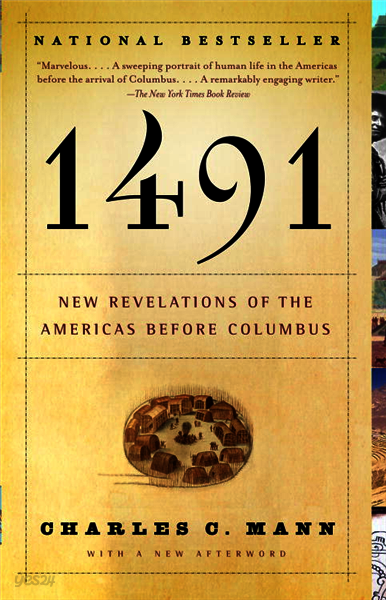
In this groundbreaking work of science, history, and archaeology, Charles C. Mann radically alters our understanding of the Americas before the arrival of Columbus in 1492. From the Trade Paperback edition. |
품목정보
- 발행일
- 2006년 10월 10일
- 이용안내
-
- 배송 없이 구매 후 바로 읽기
- 이용기간 제한없음
- TTS 불가능
- 저작권 보호를 위해 인쇄 기능 제공 안함
- 지원기기
- 크레마,PC(윈도우 - 4K 모니터 미지원),아이폰,아이패드,안드로이드폰,안드로이드패드,PC(Mac)
- 파일/용량
- EPUB(DRM) | 7.31MB ?
출판사 리뷰
|
Why Billington Survived
THE FRIENDLY INDIAN On March 22, 1621, an official Native American delegation walked through what is now southern New England to negotiate with a group of foreigners who had taken over a recently deserted Indian settlement. At the head of the party was an uneasy triumvirate: Massasoit, the sachem (political-military leader) of the Wampanoag confederation, a loose coalition of several dozen villages that controlled most of what is now southeastern Massachusetts; Samoset, sachem of an allied group to the north; and Tisquantum, a distrusted captive, whom Massasoit had reluctantly brought along as an interpreter. Massasoit was an adroit politician, but the dilemma he faced would have tested Machiavelli. About five years before, most of his subjects had fallen before a terrible calamity. Whole villages had been depopulated—indeed, the foreigners ahead now occupied one of the empty sites. It was all he could do to hold together the remnants of his people. Adding to his problems, the disaster had not touched the Wampanoag’s longtime enemies, the Narragansett alliance to the west. Soon, Massasoit feared, they would take advantage of the Wampanoag’s weakness and overrun them. Desperate threats require desperate countermeasures. In a gamble, Massasoit intended to abandon, even reverse, a long-standing policy. Europeans had been visiting New England for at least a century. Shorter than the natives, oddly dressed, and often unbearably dirty, the pallid foreigners had peculiar blue eyes that peeped out of the masks of bristly, animal-like hair that encased their faces. They were irritatingly garrulous, prone to fits of chicanery, and often surprisingly incompetent at what seemed to Indians like basic tasks. But they also made useful and beautiful goods—copper kettles, glittering colored glass, and steel knives and hatchets—unlike anything else in New England. Moreover, they would exchange these valuable items for cheap furs of the sort used by Indians as blankets. It was like happening upon a dingy kiosk that would swap fancy electronic goods for customers’ used socks—almost anyone would be willing to overlook the shopkeeper’s peculiarities. Over time, the Wampanoag, like other native societies in coastal New England, had learned how to manage the European presence. They encouraged the exchange of goods, but would only allow their visitors to stay ashore for brief, carefully controlled excursions. Those who overstayed their welcome were forcefully reminded of the limited duration of Indian hospitality. At the same time, the Wampanoag fended off Indians from the interior, preventing them from trading directly with the foreigners. In this way the shoreline groups put themselves in the position of classic middlemen, overseeing both European access to Indian products and Indian access to European products. Now Massasoit was visiting a group of British with the intent of changing the rules. He would permit the newcomers to stay for an unlimited time—provided that they formally allied with the Wampanoag against the Narragansett. Tisquantum, the interpreter, had shown up alone at Massasoit’s home a year and a half before. He spoke fluent English, because he had lived for several years in Britain. But Massasoit didn’t trust him. He seems to have been in Massasoit’s eyes a man without anchor, out for himself. In a conflict, Tisquantum might even side with the foreigners. Massasoit had kept Tisquantum in a kind of captivity since his arrival, monitoring his actions closely. And he refused to use him to negotiate with the colonists until he had another, independent means of communication with them. That March Samoset—the third member of the triumvirate—appeared, having hitched a ride from his home in Maine on an English ship that wa |