
소개
목차
|
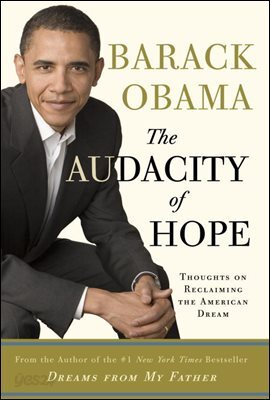
In July 2004, Barack Obama electrified the Democratic National Convention with an address that spoke to Americans across the political spectrum. One phrase in particular anchored itself in listeners’ minds, a reminder that for all the discord and struggle to be found in our history as a nation, we have always been guided by a dogged optimism in the future, or what Obama called “the audacity of hope.”
The Audacity of Hope is Barack Obama’s call for a different brand of politics—a politics for those weary of bitter partisanship and alienated by the “endless clash of armies” we see in congress and on the campaign trail; a politics rooted in the faith, inclusiveness, and nobility of spirit at the heart of “our improbable experiment in democracy.” He explores those forces—from the fear of losing to the perpetual need to raise money to the power of the media—that can stifle even the best-intentioned politician. He also writes, with surprising intimacy and self-deprecating humor, about settling in as a senator, seeking to balance the demands of public service and family life, and his own deepening religious commitment. At the heart of this book is Barack Obama’s vision of how we can move beyond our divisions to tackle concrete problems. He examines the growing economic insecurity of American families, the racial and religious tensions within the body politic, and the transnational threats—from terrorism to pandemic—that gather beyond our shores. And he grapples with the role that faith plays in a democracy—where it is vital and where it must never intrude. Underlying his stories about family, friends, and members of the Senate is a vigorous search for connection: the foundation for a radically hopeful political consensus. A public servant and a lawyer, a professor and a father, a Christian and a skeptic, and above all a student of history and human nature, Barack Obama has written a book of transforming power. Only by returning to the principles that gave birth to our Constitution, he says, can Americans repair a political process that is broken, and restore to working order a government that has fallen dangerously out of touch with millions of ordinary Americans. Those Americans are out there, he writes—“waiting for Republicans and Democrats to catch up with them.” From the Hardcover edition. |
품목정보
- 발행일
- 2006년 10월 17일
- 이용안내
-
- 배송 없이 구매 후 바로 읽기
- 이용기간 제한없음
- TTS 불가능
- 저작권 보호를 위해 인쇄 기능 제공 안함
- 지원기기
- 크레마,PC(윈도우 - 4K 모니터 미지원),아이폰,아이패드,안드로이드폰,안드로이드패드,PC(Mac)
- 파일/용량
- EPUB(DRM) | 0.42MB ?
- ISBN13
- 9780307382092
출판사 리뷰
|
Prologue
It’s been almost ten years since I first ran for political office. I was thirty-five at the time, four years out of law school, recently married, and generally impatient with life. A seat in the Illinois legislature had opened up, and several friends suggested that I run, thinking that my work as a civil rights lawyer, and contacts from my days as a community organizer, would make me a viable candidate. After discussing it with my wife, I entered the race and proceeded to do what every first-time candidate does: I talked to anyone who would listen. I went to block club meetings and church socials, beauty shops and barbershops. If two guys were standing on a corner, I would cross the street to hand them campaign literature. And everywhere I went, I’d get some version of the same two questions. “Where’d you get that funny name?” And then: “You seem like a nice enough guy. Why do you want to go into something dirty and nasty like politics?” I was familiar with the question, a variant on the questions asked of me years earlier, when I’d first arrived in Chicago to work in low-income neighborhoods. It signaled a cynicism not simply with politics but with the very notion of a public life, a cynicism that–at least in the South Side neighborhoods I sought to represent–had been nourished by a generation of broken promises. In response, I would usually smile and nod and say that I understood the skepticism, but that there was–and always had been–another tradition to politics, a tradition that stretched from the days of the country’s founding to the glory of the civil rights movement, a tradition based on the simple idea that we have a stake in one another, and that what binds us together is greater than what drives us apart, and that if enough people believe in the truth of that proposition and act on it, then we might not solve every problem, but we can get something meaningful done. It was a pretty convincing speech, I thought. And although I’m not sure that the people who heard me deliver it were similarly impressed, enough of them appreciated my earnestness and youthful swagger that I made it to the Illinois legislature. Six years later, when I decided to run for the United States Senate, I wasn’t so sure of myself. By all appearances, my choice of careers seemed to have worked out. After spending my two terms during which I labored in the minority, Democrats had gained control of the state senate, and I had subsequently passed a slew of bills, from reforms of the Illinois death penalty system to an expansion of the state’s health program for kids. I had continued to teach at the University of Chicago Law School, a job I enjoyed, and was frequently invited to speak around town. I had preserved my independence, my good name, and my marriage, all of which, statistically speaking, had been placed at risk the moment I set foot in the state capital. But the years had also taken their toll. Some of it was just a function of my getting older, I suppose, for if you are paying attention, each successive year will make you more intimately acquainted with all of your flaws–the blind spots, the recurring habits of thought that may be genetic or may be environmental, but that will almost certainly worsen with time, as surely as the hitch in your walk turns to pain in your hip. In me, one of those flaws had proven to be a chronic restlessness; an inability to appreciate, no matter how well things were going, those blessings that were right there in front of me. It’s a flaw that is endemic to modern life, I think–endemic, too, in the American character–and one that is nowhere more evident than in the field of politics. Whether politics actually encourages the trait or simply attracts those who possess it is unclear. Lyndon Johnson, who knew much about both politics and re |