
소개
목차
|
Selected by the Modern Library as one of the 100 best nonfiction books of all time
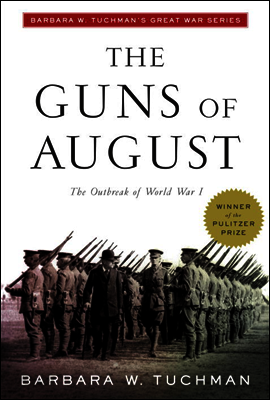
The Proud Tower, the Pulitzer Prize–winning The Guns of August, and The Zimmerman Telegram comprise Barbara W. Tuchman’s classic histories of the First World War era In this landmark, Pulitzer Prize–winning account, renowned historian Barbara W. Tuchman re-creates the first month of World War I: thirty days in the summer of 1914 that determined the course of the conflict, the century, and ultimately our present world. Beginning with the funeral of Edward VII, Tuchman traces each step that led to the inevitable clash. And inevitable it was, with all sides plotting their war for a generation. Dizzyingly comprehensive and spectacularly portrayed with her famous talent for evoking the characters of the war’s key players, Tuchman’s magnum opus is a classic for the ages. Praise for The Guns of August “A brilliant piece of military history which proves up to the hilt the force of Winston Churchill’s statement that the first month of World War I was ‘a drama never surpassed.’”—Newsweek “More dramatic than fiction . . . a magnificent narrative—beautifully organized, elegantly phrased, skillfully paced and sustained.”—Chicago Tribune “A fine demonstration that with sufficient art rather specialized history can be raised to the level of literature.”—The New York Times “[The Guns of August] has a vitality that transcends its narrative virtues, which are considerable, and its feel for characterizations, which is excellent.”—The Wall Street Journal From the Trade Paperback edition. |
품목정보
- 발행일
- 2009년 07월 22일
- 이용안내
-
- 배송 없이 구매 후 바로 읽기
- 이용기간 제한없음
- TTS 불가능
- 저작권 보호를 위해 인쇄 기능 제공 안함
- 지원기기
- 크레마,PC(윈도우 - 4K 모니터 미지원),아이폰,아이패드,안드로이드폰,안드로이드패드,PC(Mac)
- 파일/용량
- EPUB(DRM) | 8.53MB ?
출판사 리뷰
|
1
A Funeral So gorgeous was the spectacle on the May morning of 1910 when nine kings rode in the funeral of Edward VII of England that the crowd, waiting in hushed and black-clad awe, could not keep back gasps of admiration. In scarlet and blue and green and purple, three by three the sovereigns rode through the palace gates, with plumed helmets, gold braid, crimson sashes, and jeweled orders flashing in the sun. After them came five heirs apparent, forty more imperial or royal highnesses, seven queens—four dowager and three regnant—and a scattering of special ambassadors from uncrowned countries. Together they represented seventy nations in the greatest assemblage of royalty and rank ever gathered in one place and, of its kind, the last. The muffled tongue of Big Ben tolled nine by the clock as the cortege left the palace, but on history’s clock it was sunset, and the sun of the old world was setting in a dying blaze of splendor never to be seen again. In the center of the front row rode the new king, George V, flanked on his left by the Duke of Connaught, the late king’s only surviving brother, and on his right by a personage to whom, acknowledged The Times, “belongs the first place among all the foreign mourners,” who “even when relations are most strained has never lost his popularity amongst us”—William II, the German Emperor. Mounted on a gray horse, wearing the scarlet uniform of a British Field Marshal, carrying the baton of that rank, the Kaiser had composed his features behind the famous upturned mustache in an expression “grave even to severity.” Of the several emotions churning his susceptible breast, some hints exist in his letters. “I am proud to call this place my home and to be a member of this royal family,” he wrote home after spending the night in Windsor Castle in the former apartments of his mother. Sentiment and nostalgia induced by these melancholy occasions with his English relatives jostled with pride in his supremacy among the assembled potentates and with a fierce relish in the disappearance of his uncle from the European scene. He had come to bury Edward his bane; Edward the arch plotter, as William conceived it, of Germany’s encirclement; Edward his mother’s brother whom he could neither bully nor impress, whose fat figure cast a shadow between Germany and the sun. “He is Satan. You cannot imagine what a Satan he is!” This verdict, announced by the Kaiser before a dinner of three hundred guests in Berlin in 1907, was occasioned by one of Edward’s continental tours undertaken with clearly diabolical designs at encirclement. He had spent a provocative week in Paris, visited for no good reason the King of Spain (who had just married his niece), and finished with a visit to the King of Italy with obvious intent to seduce him from his Triple Alliance with Germany and Austria. The Kaiser, possessor of the least inhibited tongue in Europe, had worked himself into a frenzy ending in another of those comments that had periodically over the past twenty years of his reign shattered the nerves of diplomats. Happily the Encircler was now dead and replaced by George who, the Kaiser told Theodore Roosevelt a few days before the funeral, was “a very nice boy” (of forty-five, six years younger than the Kaiser). “He is a thorough Englishman and hates all foreigners but I do not mind that as long as he does not hate Germans more than other foreigners.” Alongside George, William now rode confidently, saluting as he passed the regimental colors of the 1st Royal Dragoons of which he was honorary colonel. Once he had distributed photographs of himself wearing their uniform with the Delphic inscription written above his signature, “I bide my time.” Today his time had come; he was supreme in Europe. Behind him rode the widowed Queen Alexan |