
소득공제
정가제 Free
EPUB
eBook
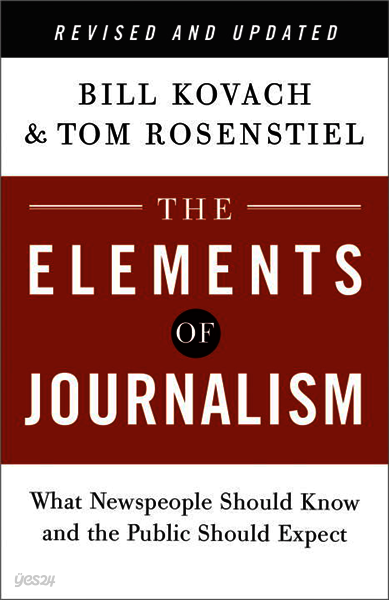
The Elements of Journalism, Revised and Updated 3rd Edition
EPUB
Crown/Archetype
2014.04.01.
소개
목차
|
The Book That Every Citizen and Journalist Should Read
“What this book does better than any single book on media history, ethics, or practice is weave . . . [together] why media audiences have fled and why new technology and megacorporate ownership are putting good journalism at risk.” —Rasmi Simhan, Boston Globe “Kovach and Rosenstiel’s essays on each [element] are concise gems, filled with insights worthy of becoming axiomatic. . . . The book should become essential reading for journalism professionals and students and for the citizens they aim to serve.” —Carl Sessions Stepp, American Journalism Review “If you think journalists have no idea what you want . . . here is a book that agrees with you. Better—it has solutions. The Elements of Journalism is written for journalists, but any citizen who wonders why the news seems trivial or uninspiring should read it.” —Marta Salij, Detroit Free Press The elements of journalism are: * Journalism’s first obligation is to the truth. * Its first loyalty is to citizens. * Its essence is a discipline of verification. * Its practitioners must maintain an independence from those they cover. * It must serve as an independent monitor of power. * It must provide a forum for public criticism and compromise. * It must strive to make the significant interesting and relevant. * It must keep the news comprehensive and proportional. * Its practitioners must be allowed to exercise their personal conscience. |
품목정보
- 발행일
- 2014년 04월 01일
- 이용안내
-
- 배송 없이 구매 후 바로 읽기
- 이용기간 제한없음
- TTS 불가능
- 저작권 보호를 위해 인쇄 기능 제공 안함
- 지원기기
- 크레마,PC(윈도우 - 4K 모니터 미지원),아이폰,아이패드,안드로이드폰,안드로이드패드,PC(Mac)
- 파일/용량
- EPUB(DRM) | 2.08MB ?
- ISBN13
- 9780804136792
출판사 리뷰
|
Excerpted from Chapter 1
What Is Journalism For? On a gray December morning in 1981, Anna Semborska woke up and flipped on the radio to hear her favorite program, Sixty Minutes Per Hour. Semborska, who was seventeen, loved the way the comedy revue pushed the boundaries of what people in Poland could say out loud. Though it had been on the air for some years, with the rise of the labor union Solidarity, 60MPH had become much more bold. Sketches like one about a dim-witted Communist doctor looking vainly to find a cure for extremism were an inspiration to Anna and her teenage friends in Warsaw. The program showed her that other people felt about the world the way she did, but had never dared express. "We felt that if things like these can be said on the radio then we are free," she would remember nearly twenty years later. (1) But when Anna ran to the radio to tune in the show on December 13, 1981, she heard only static. She tried another station, then another. Nothing. She tried to call a friend and found no dial tone. Her mother called her to the window. Tanks were rolling by. The Polish military government had declared martial law, outlawed Solidarity, and put the clamps back on the media and on speech. The Polish experiment with liberalization was over. Within hours, Anna and her friends began to hear stories that suggested something this time was different. In a little town called 'Swidnik near the Czech border, there were the dogwalkers. Every night at 7:30, when the state-run television news came on, nearly everyone in 'Swidnik went out and walked his dog in a little park in the center of town. It became a daily silent act of protest and solidarity. We refuse to watch. We reject your version of truth. In Gdansk, there were the black TV screens. People there began moving their television sets to the windows-with the screens pointed out to the street. They were sending a sign to one another, and the government. We, too, refuse to watch. We also reject your version of truth. An underground press began to grow, on ancient hand-crank equipment. People began carrying video cameras and making private documentaries, which they showed secretly in church basements. Soon, Poland's leaders acknowledged they were facing a new phenomenon, something they had to go west to name. It was the rise of Polish public opinion. In 1983, the government created the first of several institutes to study it. It mostly conducted public opinion surveys. Others would sprout up throughout Eastern Europe as well. This new phenomenon was something totalitarian officials could not dictate. At best, they could try to understand it and then manipulate it, not unlike Western democratic politicians. They would not succeed. Afterward, leaders of the movement toward freedom would look back and think the end of Communism owed a good deal to the coming of new information technology and the effect it had on human souls. In the winter of 1989, the man who shortly would be elected Poland's new president visited with journalists in Washington. "Is it possible for a new Stalin to appear today who could murder people?" Lech Walesa asked rhetorically. No, he answered himself. In the age of computers, satellites, faxes, VCRs, "it's impossible." Technology now made information available to too many people, too quickly. And information created democracy. (2) What is journalism for? For the Poles and others in emerging democracies the question was answered with action. Journalism was for building community. Journalism was for citizenship. Journalism was for democracy. Millions of people, empowered by a free flow of information, became directly involved in creating a new government and new rules for the political, social, and economic life of their country. Is that always journalism's purpose? Or was that true for one moment, in one place? In the United Stat |