
소득공제
PDF
eBook
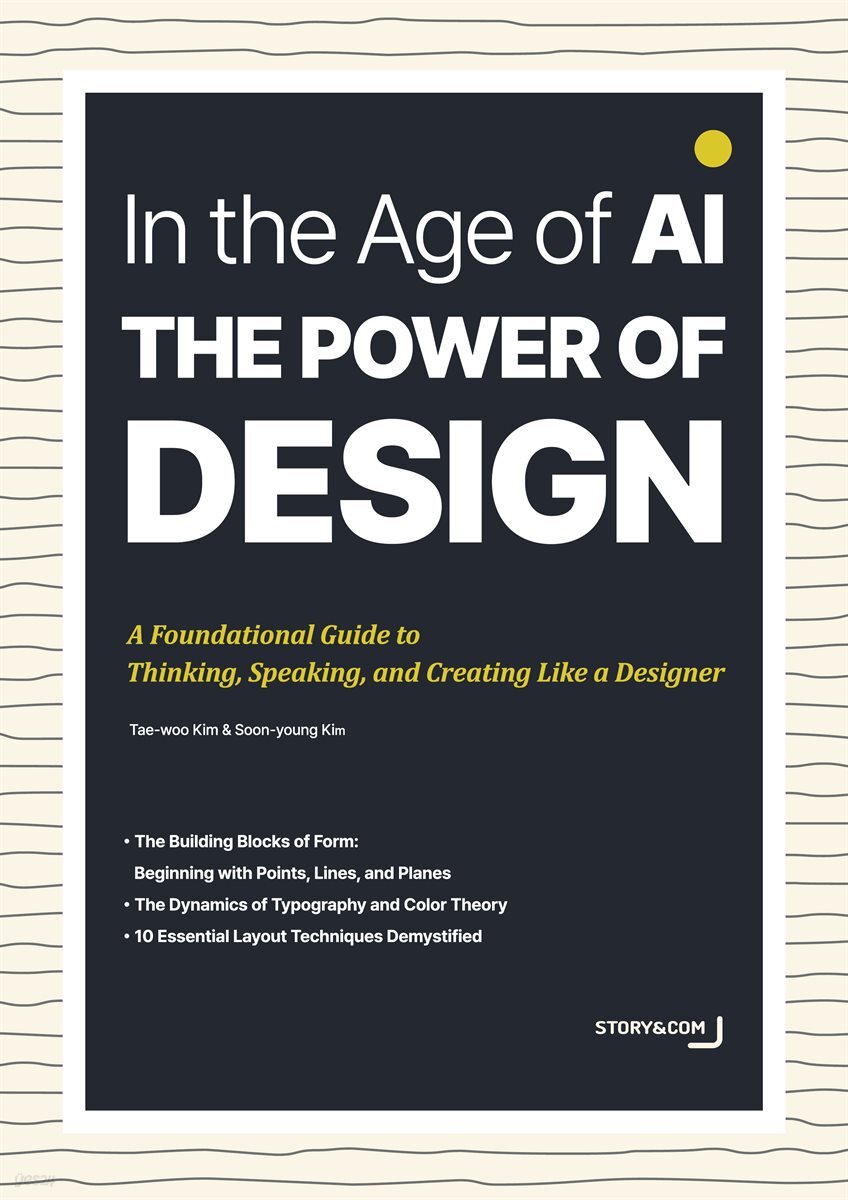
In the Age of AI THE POWER OF DESIGN
A Foundational Guide to Thinking, Speaking, and Creating Like a Designer
스마트한 PDF 필기 기능을 사용해 보세요!
Story & Com
2026.08.07.
- PDF 안내
-
이 상품은 구매 후 지원 기기에서 예스24 eBook앱 설치 후 바로 이용 가능한 상품입니다.
소개
목차
|
[Prologue] ? 4p
Why Does Your Design Feel Empty? [PART 0] Diagnosis...Where Does Your Visual Intuition Stand? ? 17p "Can you articulate what exactly feels off about an AI’s output?" ? Design Self-Diagnosis: Where is your eye tracking right now? ? 18p ? Bad Design Follows a Pattern ? 22p ? "Good vs. Bad" is a Mere Impression; "Why" is True Expertise ? 26p [PART 1] The Solid Foundation of Form...The Basics ? 31p "Every design is built from these raw ingredients." Chapter 1. Visual and Graphic Elements ? 32p ? Points, Lines, and Planes...Where Every Design Begins ? Form Has a Voice...The Emotional Shift Created by a Single Geometric Shape ? Gaze is Never Random...You Can Engineer the Movement of the Human Eye Chapter 2. Typography: Type Has a Voice ? 48p ? Type is Felt Long Before It is Read ? Between the Letters...How Invisible Spacing Creates the Mood ? Where AI Ultimately Fails...The Human Intuition of Visual Equilibrium ? Hangeul Governed by Western Blueprints...What Happens When You Copy-Paste English Metrics Chapter 3. Color: Color is Emotion ? 72p ? Faster Than Words...The Three Axes of Designing Emotion ? Determine the Ratio Before Choosing Colors...The 60:30:10 Rule ? Sophisticated Design Doesn't Add Color... It Subtracts ? Why AI Color Suggestions Look Convincing?and Why They Are Dangerous [PART 2] The Aesthetics of Order...The Grid & Layout ? 95p "An invisible skeleton dictates the premium quality of design." Chapter 4. The Grid System ? 96p ? Behind Every Great Design, There is Always an Invisible Line ? Order Creates Credibility...How Mathematics Creates Visual Impact ? AI is Not Incapable of Layout...The Problem is the Absence of a Baseline Chapter 5. The 10 Modern Design Layout Techniques ? 114p Layout 01. Mondrian...How to Logically Divide the Screen Layout 02. Picture-Window...When a Single Asset Speaks Volumes Layout 03. Big-Type...When Typography Becomes the Visual Asset Layout 04. Circus...What Appears to Be Chaos Is Actually Meticulously Engineered Layout 05. Multi-Panel...The Strategic Architecture of Split-Frame Storytelling Layout 06. Silhouette...The Raw Power of Aggressive Subtraction Layout 07. Copy-Heavy...How to Engineer Extreme Readability for Dense Text Layout 08. Alphabet-Source...Engineering Intuitive Visual Paths Layout 09. Frame...The Art of Enclosing the Gaze Layout 10. Rebus...When Imagery Replaces Words, the Viewer Joins the Narrative [PART 3] Practical Application ? 189p "Now I Design" Chapter 6. Combining and Mutating Layouts ? 190p ? The Art of Synthesis...Combining Techniques is a Strategic Blueprint, Not Mere Addition ? Unlocking the Canvas...True Deconstruction is Evolution, Not Destruction ? The Currency of Mastery...Mutation is Just Another Name for Solid Fundamentals Chapter 7. From the Fundamentals to the Portfolio ? 211p ? The Blueprint of Execution...A Single Page Changes Everything ? The Curation of Identity...A Portfolio is Not a Storage Unit, It is a Statement of Perspective ? The Final Audit...7 Critical Questions to Ask Before You Push "Publish" [PART 4] Coexisting with AI...Pushing Beyond the Machine ? 230p "AI is Strictly a Tool. The Caliber of the Director Dictates the Caliber of the Asset." Chapter 8. Commanding AI Design Platforms ? 231p ? Engineering the Prompt...Visual Precision Dictates Generative Quality ? AI is Your Starting Point...Never Your Destination ? Clear Boundaries, Zero Fear...What AI Can and Cannot Execute Chapter 9. The Rituals of Design Preservation ? 250p ? Use It or Lose It...How 10 Minutes a Day Transforms Your Year ? If You Can’t Articulate It, You Can’t Execute It...How Language Hardens Creative Instinct ? Aesthetic Instinct is Not a Genetic Gift...The Compound Effect of Daily Discipline [Epilogue] ? 276p It's the 'judgmental human' that survives the AI era APPENDIX. The Execution Toolkit ? 283p ? The Design Self-Correction Checklist...Visual Curation vs. Visual Noise ? 284p ? Keyboard Shortcuts & Optimization Workflows...Accelerating Execution to Expand Strategic Thinking ? 292p ? Curated Reference Libraries & Visual Archives...You Must Know Where Taste Resides to Build Its ?301p ? A Lexicon of 30 Core Design Concepts...To Execute Flawlessly, You Must First Articulate Precisely ? 313p |
저자 소개
Having spent over three decades on the front lines of design, advertising, PR,
and promotions?collaborating with entities ranging from major conglomerates
to small enterprises?we have witnessed a definitive shift. The democratization
of AI design tools has empowered anyone to churn out sleek visuals.
Yet, paradoxically, this has also unleashed a flood of generic, poorly structured content.
While our tools have become faster, the overall quality of design has arguably declined.
The fault lies not with AI, but with our willingness to outsource human judgment to it.
This book is born out of that very realization. We set out to demystify design in the simplest
terms, equipping anyone without a design background with the visual intuition to judge form
and structure. We write this not as rigid instructors, but as seasoned mentors looking
over your shoulder and gently asking, "Hey, doesn't this look a bit off?"
Technology is a commodity granted equally to all. A true sense of design, however, is a craft earned only by those who cultivate it. Through this book, we hope to provide the ultimate launching pad for non-designers to develop that very instinct.
and promotions?collaborating with entities ranging from major conglomerates
to small enterprises?we have witnessed a definitive shift. The democratization
of AI design tools has empowered anyone to churn out sleek visuals.
Yet, paradoxically, this has also unleashed a flood of generic, poorly structured content.
While our tools have become faster, the overall quality of design has arguably declined.
The fault lies not with AI, but with our willingness to outsource human judgment to it.
This book is born out of that very realization. We set out to demystify design in the simplest
terms, equipping anyone without a design background with the visual intuition to judge form
and structure. We write this not as rigid instructors, but as seasoned mentors looking
over your shoulder and gently asking, "Hey, doesn't this look a bit off?"
Technology is a commodity granted equally to all. A true sense of design, however, is a craft earned only by those who cultivate it. Through this book, we hope to provide the ultimate launching pad for non-designers to develop that very instinct.
품목정보
- 발행일
- 2026년 08월 07일
- 지원기기
- 크레마, PC(윈도우 - 4K 모니터 미지원), 아이폰, 아이패드, 안드로이드폰, 안드로이드패드, 전자책단말기(저사양 기기 사용 불가), PC(Mac)
- 파일/용량
- PDF(DRM) | 8.83MB ?
- 글자 수/ 페이지 수
- 약 330쪽 ?
- ISBN13
- 9791194943396
출판사 리뷰
|
In the Age of AI THE POWER OF DESIGN
A Foundational Guide to Thinking, Speaking, and Creating Like a Designer The Era of Asking AI to "Make It Look Pretty" Is Over?The Decision-Makers Win. "This isn’t just another dry technical manual. From the very first page, it feels like having a seasoned senior designer by your side, quietly pointing at the screen and asking, 'Doesn’t this look a bit off?'" The core premise of this book is beautifully simple: 1. AI tools are not the problem. 2. Leaving the critical design decisions to AI is. 3. To make those decisions, you must understand the fundamentals of design. What makes this book stand out is its tone. It doesn't lecture, nor does it blindly vilify AI. Instead, it coolly defines the boundaries of what AI can and cannot do, precisely highlighting where human intuition must step in. As you read, the logic feels entirely effortless and convincing. Inside the Book ? PART 0. Self-Diagnosis Before diving in, assess your current design instincts. The book analyzes five chronic habits of bad design?conceptless arrangement, font overuse, color clashes, collapsed hierarchy, and whitespace anxiety?using real-world AI output comparisons. ? PART 1. Fundamentals of Form and Shape Back to the building blocks. Starting from points, lines, and planes to typography and color theory. What sounds complex becomes surprisingly intuitive, leaving readers with frequent "Aha!" moments. Notably, the insights on Korean typography versus Western design rules offer a fascinating look into how language shapes visual structure. ? PART 2. The Core: Layout Systems Deep dive into 10 fundamental layout techniques: Mondrian, Picture-Window, Big-Type, Circus, Multi-Panel, Silhouette, Copy-Heavy, Alphabet-Source, Frame, and Reverse. Comparing raw AI outputs with human-refined results vividly illustrates how subtle judgment completely alters a final product. ? PART 3. Hands-On Execution Putting theory into practice. From designing a single-page personal bio to crafting a 3-page portfolio. Includes a compressed checklist of 7 vital self-feedback questions to ask before finalizing any project. ? PART 4. Coexisting with AI Mastering the modern workflow. How to write prompts using formal design terminology, leverage AI for preliminary drafts, and execute a 4-step workflow (Generate → Judge → Refine → Finalize). Includes a daily 10-minute habit to build reference libraries and articulate design choices. Standout Highlights The breakdown of the "Alphabet-Source" Layout is a game-changer. It details how to guide the viewer’s eye using Z, F, and S shapes?suddenly making every advertisement and graphic you encounter in daily life make total sense. Equally impactful is the 4-step AI workflow. It provides an actionable framework you can implement immediately: stop submitting raw AI outputs, and start using them as a launching pad for your own creative judgment. Recommended For ? Professionals frustrated by empty-looking AI designs. ? Solopreneurs and workers without a dedicated design team. ? Anyone tired of typing vague prompts like "make it pretty" and getting disappointing results. ? Readers who find heavy design theory books too abstract and quick YouTube tutorials too superficial. This book lands perfectly in the sweet spot: accessible yet deep, practical yet rooted in theory. Final Thoughts One quote from the prologue stays with you long after closing the cover: "Right now, you are following what AI dictates. After reading this book, you will be the one commanding AI." It is no exaggeration. Once you start noticing visual hierarchy, limiting your color palettes, and prompting AI with precise design language, your work fundamentally transforms. Technology is given to everyone?design sense belongs to those who build it. We highly recommend this book as the fastest starting point for building that competitive edge. |
