
소개
목차
|
Preface xv Introduction xvii Chapter 1. Graph-Theoretic Foundations for Semantic Network Construction Through Transformer-based Feature Learning and Multi-Lingual Entity-Relation Graph Modeling 1 1.1. Introduction 2 Chapter 2. Sparse Tucker Decomposition with L1 Regularization: Matrix Completion in Tensor Networks 17 2.1. Introduction 17 Chapter 3. Principal Component Analysis (PCA) and t-SNE Combined with Autoencoder Embeddings for Graph-based Feature Engineering and Dimensionality Reduction 31 3.1. Introduction 32 Chapter 4. Instrumental Variable Regression and Double Machine Learning for Causal Effect Estimation in Graph-based Business Analytics 47 4.1. Introduction 48 Chapter 5. Gradient Boosting Machines (XGBoost, LightGBM) with Stacked Generalization for Multi-Task Learning in Graph-based Predictive Analytics 63 5.1. Introduction 64 Chapter 6. Spectral Graph Convolutional Networks for IoT Device Clustering and Anomalous Node Detection in Complex Network Topologies 79 6.1. Introduction 79 Chapter 7. Graph Neural Networks with Attention Mechanisms for Customer Segmentation and Churn Prediction in E-Commerce Platforms 95 7.1. Introduction 95 Chapter 8. Domain Adaptation via Maximum Mean Discrepancy (MMD) and Adversarial Domain Discriminators for Graph Neural Network Transfer Learning 111 8.1. Introduction 112 Chapter 9. Graph Intelligence-driven Reinforcement Learning Architecture for Modeling and Control of Microfluidic Transport Phenomena and Nonlinear Heat–Mass Coupled Nanofluid Flows 127 9.1. Introduction 128 Chapter 10. Graph Intelligence-based Numerical Solutions using Runge–Kutta and Caputo Fractional Derivatives for Nonlinear Biological Transport Equations 143 10.1. Introduction 143 Chapter 11. Mixed-Integer Linear Programming (MILP) with Column Generation for Vehicle Routing Problems with Time Windows Using Graph-based Route Optimization 159 11.1. Introduction 160 Chapter 12. Differential Evolution and Grey Wolf Optimization: Hybrid Metaheuristics for Constrained Non-Convex Problems in Graph-based Network Optimization 175 12.1. Introduction 176 Chapter 13. Stackelberg Game Theory with Nash Equilibrium Computation: Algorithmic Applications in Graph-based Resource Competition and Network Optimization 191 13.1. Introduction 191 Chapter 14. Graph Intelligence-enabled Quantum–Classical Hybrid Framework for Advanced Cybersecurity Threat Detection and Analytics 207 14.1. Introduction 208 Chapter 15. Graph Intelligence-driven DevOps Analytics: A Multi-Modal AI Platform for Predictive Performance Optimization 223 15.1. Introduction 224 Chapter 16. Graph Intelligence-driven Automated Software Deployment System with Integrated Testing Pipelines for Continuous Delivery 237 16.1. Introduction 238 List of Authors 249 |
저자 소개
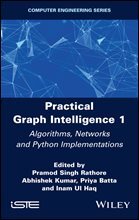
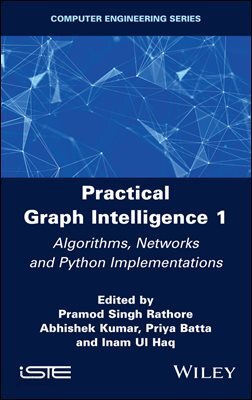
Pramod Singh Rathore is an Assistant Professor at Manipal University Jaipur, India. His expertise includes NS2, networks, data mining and DBMS.
Abhishek Kumar is a Professor at Chandigarh University, India. His expertise includes AI, renewable energy and image processing.
Priya Batta is an Associate Professor at Amity School of Engineering and Technology, Amity University Punjab, Mohali, India. Her expertise includes AI, blockchain and IoT.
Inam Ul Haq is an Assistant Professor at the School of Engineering and Technology (SET), CGC University Mohali, Punjab, India. His expertise includes AI, machine learning and quantum computing.
품목정보
- 발행일
- 2026년 09월 10일
- 지원기기
- 크레마,PC(윈도우 - 4K 모니터 미지원),아이폰,아이패드,안드로이드폰,안드로이드패드,PC(Mac)
- 파일/용량
- EPUB(DRM) | 20.70MB ?
- ISBN13
- 9781394479825
- ECN