
- PDF 안내
-
이 상품은 구매 후 지원 기기에서 예스24 eBook앱 설치 후 바로 이용 가능한 상품입니다.
소개
목차
|
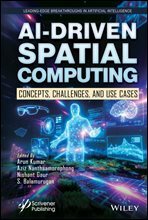
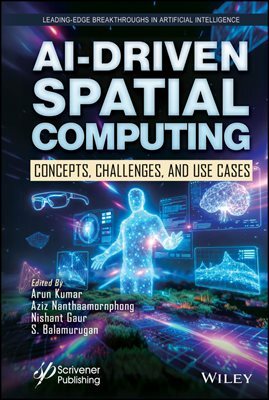
Series Preface xxiii Part I: AI-Driven Spatial Computing: Concepts 1 1 Sustainability and Environmental Impact of Digital Twins and the Metaverse 3 1.1 Introduction 4 2 AI for Climate Modeling and Disaster Management 41 2.1 Introduction 42 3 AI-Powered Language Learning Tools: A Study of Efficacy in ESL Classrooms 75 3.1 Introduction 76 4 Evolution of 5G Networks: Key Technologies, Spectrum Utilization, and Future Prospects 95 4.1 Introduction 96 5 Design and Implementation of a Neuro-Controlled Robot Using Neural Communication Interface 111 5.1 Introduction 111 Part II: Driven Spatial Computing: Challenges 123 6 Smart Water Cities in the Brahmaputra Basin: AI Applications for Climate-Resilient Water Governance in Guwahati 125 6.1 Introduction 126 6.2 Literature Review 128 7 The Impact of Artificial Intelligence on Human Identity: A Humanist–Posthumanist Perspective 159 7.1 Introduction 160 8 Secure Data Handling in AI-Driven Spatial Computing 175 8.1 Introduction (The Intersection of Artificial Intelligence, Spatial Computing, and Data Security) 176 9 Stochastic Planning Approaches and Ecological Footprint for Sustainable EV Charging Infrastructure 191 9.1 Introduction 192 10 Synergistic Roles of Edge AI and Cloud AI in Advancing Spatial Intelligence: Architectures, Applications, and Challenges 221 10.1 Introduction 222 11 Balancing Privacy and Efficiency in Indoor Localization: A SafeLoc-Inspired Model Compression Approach 265 11.1 Introduction 266 Part III: AI-Driven Spatial Computing: Use Cases 285 12 Federated and Edge-Enabled Spatial AI for Privacy-Preserving Climate Resilience and Disaster Management 287 12.1 Introduction 288 13 Spatial AI in Literature Teaching: Redefining Pedagogical Space through Immersive Technologies 305 13.1 Introduction 306 14 Artificial Intelligence in Smart Cities: Toward Sustainable and Intelligent Urban Ecosystems 323 14.1 Introduction 324 15 Artificial Intelligence in Agriculture: Current Applications, Challenges, and Future Prospects 347 15.1 Introduction 348 16 Benefits and Efficiency Combination of Blockchain and 6G Wireless Communication Network Technology 373 16.1 Introduction 374 References 386 |
저자 소개
Arun Kumar, PhD is an Assistant Professor of Electronics and Communication Engineering, Sikkim Manipal, Institute of Technology, Sikkim Manipal University, Rangpo, Sikkim, India. He has published more than 200 research articles in national and international journals of repute. His research includes advanced waveforms for 5G mobile communication systems, 5G-based smart hospitals, and spectrum sensing techniques.
Aziz Nanthaamornphong, PhD is the Dean of the College of Computing at the Prince of Songkla University, Phuket, Thailand. He has published more than 150 research articles in international journals and is known for structured thinking, strategic execution, and the ability to translate complex ideas into practical outcomes. His expertise spans artificial intelligence, data science, and advanced communication systems, with applied work in smart tourism, healthcare, and digital transformation.
Nishant Gaur, PhD is an Associate Professor in the Department of Physics at JECRC University, Jaipur, India, with more than 25 years of experience. He has published more than 80 publications in international journals and conferences of repute. His research focuses on advanced 5G and beyond-5G technologies, exploring areas like hybrid machine learning algorithms for enhancing signal detection, reducing peak-to-average power ratios, and optimizing power efficiency.
S. Balamurugan, PhD is the Director of Research at iRCS, an Indian Technological Research and Consulting Firm. He has published 100 books, 300 papers in international journals and conferences, and 300 patents. With 20 years of research on various cutting-edge technologies, he provides expert guidance in technology forecasting and decision-making for leading companies and startups.
품목정보
- 발행일
- 2026년 09월 22일
- 지원기기
- 크레마, PC(윈도우 - 4K 모니터 미지원), 아이폰, 아이패드, 안드로이드폰, 안드로이드패드, PC(Mac)
- 파일/용량
- PDF(DRM) | 7.72MB ?
- 글자 수/ 페이지 수
- 약 429쪽 ?
- ISBN13
- 9781394422548