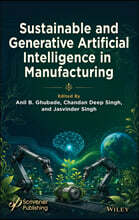

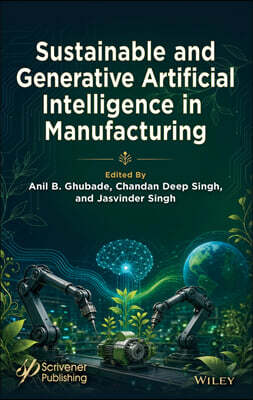
- 국내배송만 가능
- 예약도서와 함께 주문 시 도서 출간일에 함께 배송됩니다. (출판사의 사정으로 출간 지연 가능)
- 해외 거래처 사정에 의하여 품절/지연 가능
- 도서 정보 중 미표기 사항 안내?
- 문화비소득공제 가능
책소개
목차
|
Preface xiii 1 Introduction to AI in Manufacturing 1 Mandeep Singh and Chandan Deep Singh 1.1 Introduction 2 1.2 Evolution of AI in Manufacturing and the Industry 4.0 Paradigm 3 1.3 Big Data and Cloud Computing: Foundations for AI in Manufacturing 5 1.4 AI Techniques and Applications in Smart Manufacturing 7 1.5 Integration of AI with Enabling Technologies 10 1.6 Challenges and Open Issues in AI-Driven Manufacturing 12 1.7 Future Research Directions and Opportunities 14 1.8 Conclusion 16 2 Sustainable Challenges of Industry 5.0 Adoption in Manufacturing 19 Kumud Tiwari, Rekha Goyat and Mahipal Singh 2.1 Introduction 19 2.2 Application in Industry 5.0 22 2.3 Roadblocks to Industry 5.0 Adoption 23 2.4 Future Research Agenda of Sustainable AI in Industry 5.0 29 2.5 Result and Discussion 31 2.6 Conclusion 35 3 Principles of Sustainable AI: Concepts, Challenges, and Governance 39 Chandra Tivrakrishna Panday, Ankur Srivastava and Vineet Pandey 3.1 Introduction 39 3.2 Key Principles of Sustainable AI 41 3.3 Challenges and Trade‑Offs 44 3.4 Future Directions and Open Research Questions 48 3.5 Conclusion 53 3.6 Recommendations 53 3.7 Final Thoughts on Envisioning Sustainable AI 53 4 Synergistic Use of AI and Smart Materials in Energy-Efficient Structural Design 61 Ankur Gupta, Lakshmi Narayanan V., T. Dhilip Kumar and Pratiksha Sarma 4.1 Introduction to the Growing Need for Energy Optimization 62 4.2 Overview of Smart Structures 65 4.3 Introduction to Smart Materials 65 4.4 The Role of AI in Smart Structures and Smart Material 74viii Contents 4.5 AI-Driven Energy Generation and Distribution in Smart Structures 78 4.6 Optimizing Renewable Energy Generation 81 4.7 Smart Grids and AI in Energy Distribution 82 4.8 Energy Storage and AI Optimization 84 4.9 Dynamic Energy Distribution Systems within Smart Buildings 85 4.10 Conclusion 87 5 Predictive Maintenance and Sustainable Operations: A Paradigm Shift in Modern Industry 93 Mandeep Singh Rayat, Chandan Deep Singh, Jasvinder Singh and Mukhtiar Singh 5.1 Introduction 94 5.2 Literature Review 99 5.3 Discussion 102 5.4 Conclusion 104 6 Integrating Artificial Intelligence in Sustainable Supply Chain Management: Concepts and Frameworks 107 Anil Ghubade, Basant Singh Sikarwar, Ankur Gupta, Adam Jacso and Rajeev Kumar Singh 6.1 Introduction 108 6.2 Supply Chain Management 109Contents ix 6.3 Sustainability 111 6.4 Enhancing Supply Chain Sustainability through Industry 4.0 112 6.5 Smart Manufacturing and Supply Chain Sustainability 114 6.6 Blockchain Technology and Supply Chains 115 6.7 IoT in Sustainable Supply Chain Management 116 6.8 The AII Framework in SCM 118 6.9 Digital Twins in Sustainable Supply Chains 120 6.10 Real-World Effects and Interdisciplinary Coordination for AI in SCM 122 6.11 Achieving Carbon Neutrality through Sustainable Supply Chains 123 6.12 Conflicts, Challenges, and Unexpected Outcomes in Sustainable Supply Chain Strategies 125 6.13 Challenges to Sustainable Supply Chain in Using AI 126 6.14 Conclusion 127 7 Generative AI in Product Design and Prototyping 131 Minesh Vohra 7.1 Introduction 132 7.2 Deep Generative Models for Product Design 133 7.3 Generative AI in Product Design and Prototyping Pipelines 136 7.4 Human–AI Co‑Creation in Design and Prototyping 138 7.5 Opportunities and Challenges 142x Contents 7.6 Conclusion 143 8 Additive Manufacturing and AI Optimization 147 Rehan Ahmed and Anil Ghubade 8.1 Introduction 148 8.2 Fundamentals of Additive Manufacturing 148 8.3 Artificial Intelligence in Additive Manufacturing 150 8.4 Optimization Techniques Using AI 151 8.5 Sustainability Considerations 153 8.6 Case Studies and Industrial Applications 155 8.7 Challenges and Limitations 156 8.8 Future Outlook and Research Directions 157 8.9 Conclusion 158 9 Regulatory Frameworks: Rules, Ethics, and Compliance for Sustainable AI in Industry 161 Swastik Pradhan, Abhishek Barua and Manisha Priyadarshini 9.1 Introduction to AI Regulations in Manufacturing 162 9.2 Global Regulatory Landscape 167 9.3 Ethical Principles for Sustainable AI 171 9.4 Compliance in Sustainable Manufacturing 175 9.5 Generative AI-Specific Regulatory Challenges 176 9.6 Future Outlook for a Harmonized Global Framework 178 9.7 Conclusion 180 10 Future of Sustainable AI in Industry 5.0 185 Mahipal Singh and Rekha Goyat 10.1 Introduction 186 10.2 Evolution of Industry from 1.0 to 5.0 187 10.3 Role of Sustainable AI in Industry 5.0 187 10.4 Role of AI-Maintained Sustainability in Industry 5.0 189 10.5 Roadmap for the Future of Sustainable AI in Industry 5.0 199 References 202 Index 205 |
저자 소개
Anil B. Ghubade is an Assistant Professor in the School of Mechanical Engineering, Lovely Professional University, Punjab, India. He has published more than 15 research papers in national and international journals, two book chapters, and two patents. His areas of interest include manufacturing processes, machining, non-traditional machining, Bio-MEMS, and product design and development.
Chandan Deep Singh, PhD is an Assistant Professor in the Department of Mechanical Engineering, Punjabi University, Patiala. He has published more than 150 papers in peer-reviewed international journals and conferences, 59 reference books, four edited books, and more than 20 book chapters. His research focuses on computer-aided design, computer-aided manufacturing, and production and industrial engineering.
Jasvinder Singh, PhD is an Assistant Professor in the School of Mechanical Engineering at Lovely Professional University, Jalandhar. He has more than 35 publications in national and international journals and conferences of repute. His research interests include welding and fabrication, non-traditional machining processes, and general manufacturing.
관련 분류
- 카테고리 분류
품목정보
- 발행일
- 2026년 12월 03일
- 쪽수, 무게, 크기
- 240쪽 | 크기확인중
- ISBN13
- 9781394403226
사락 별점0
혜택 및 유의사항밑줄0
혜택 및 유의사항상품정보안내
(판형과 판수 등이 다양한 도서는 찾으시는 도서의 ISBN을 알려 주시면 보다 빠르고 정확한 안내가 가능합니다.)
해외거래처에서 품절인 경우, 2차 거래선을 통해 유럽과 미국 출판사로 직접 수입이 진행될 수 있습니다.
수입 진행 시점으로 부터 2~3주가 추가로 소요되며, 해외에서도 유통이 원활하지 않은 도서는 품절 안내가 지연될 수 있습니다.
해당 경우, 문자와 메일로 별도 안내를 드리고 있사오니 마이페이지에서 휴대전화번호와 메일주소를 다시 한번 확인해주시기 바랍니다.