

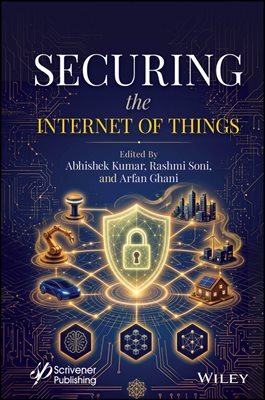
소개
목차
|
Preface xxv 1 Ensemble Machine Learning for High-Accuracy Prediction of IoT Privacy Compliance (TC) Metrics: A Comparative Regression Analysis 1 1.1 Problem Statement 2 2 AI and Machine Learning-Enabled Adaptive Security Framework for IoT Networks 19 2.1 Introduction 20 3 Analyzing the Performance of Big Data Clustering Based on Augmented Cat Swarm Optimization Method Using Evolutionary Computing 49 3.1 Introduction 50 4 Architectural Paradigms of Edge Artificial Intelligence: A Comprehensive Framework for Intelligent Computing at the Edge 71 4.1 Introduction 72 5 Artificial Intelligence and Machine Learning in IoT Security 93 5.1 Introduction 93 6 Blockchain-Enabled Edge Computing for IoT Security and Data Processing 103 6.1 Introduction 104 7 Internet of Things: Architectures, Protocols, and Enabling Technologies 131 7.1 Introduction 132 8 Securing the Internet of Things: IoT in Network Security 151 8.1 Introduction to IoT Network Security 152 9 Energy-Aware IoT Secure Communication Protocol 195 9.1 Introduction 196 10 A Comprehensive Review of Security Architectures and Protocols for Ensuring Trust in Internet of Things Ecosystems 215 10.1 Introduction 216 11 Artificial Intelligence and Machine Learning for Adaptive IoT Security 235 11.1 Introduction 236 12 Leveraging Explainable AI for the Health Sector 283 12.1 Introduction 284 13 Smart Bin Overflow Management Using GPS-GSM 329 13.1 Introduction 329 14 Secure Communication Protocols for IoT 341 14.1 Introduction 342 15 AI-Driven IoT Security: Intelligent Frameworks for Threat Detection and Adaptive Defense 389 15.1 Introduction 390 16 Evolving Intelligence: AI and ML Approaches for Securing IoT Ecosystems 405 16.1 Introduction 405 17 Zero Trust Architecture for IoT Security 417 17.1 Introduction 417 References 431 |
저자 소개
Abhishek Kumar, PhD is an Associate Professor in the School of Electronics and Electrical Engineering at Lovely Professional University, India. He has authored one book, edited three books, and published more than 50 research papers in refereed journals and conferences, and more than 30 Indian patents and copyrights. His research interests include FPGA system design, hardware security, low-power CMOS circuits, and the combination of VLSI designs and machine learning.
Rashmi Soni, PhD is a Postdoctoral Researcher in the Computer Science and Engineering Department at Amity University, Dubai, and an Associate Professor in the Information Science and Engineering Department at the Dayananda Sagar Academy of Technology and Management, Bengaluru. She has published ten patents and a number of chapters and books, and serves as an editor for several book series. Her research interests include cloud computing, IoT, bioinformatics, AI, AR and VR, and image processing.
Arfan Ghani, PhD is a Professor of Computer Engineering at the American University of Ras Al Khaimah in the United Arab Emirates, with more than 18 years of experience. He has published more than 80 research papers and collaborates with research groups in the UK, Pakistan, Germany, India, and the United Arab Emirates. He is an academic and technologist specialising in AI hardware accelerators, IoT, neuromorphic engineering, computer vision, and precision neurotechnology.
품목정보
- 발행일
- 2026년 11월 17일
- 지원기기
- 크레마,PC(윈도우 - 4K 모니터 미지원),아이폰,아이패드,안드로이드폰,안드로이드패드,PC(Mac)
- 파일/용량
- EPUB(DRM) | 28.48MB ?
- ISBN13
- 9781394466672
- ECN
