
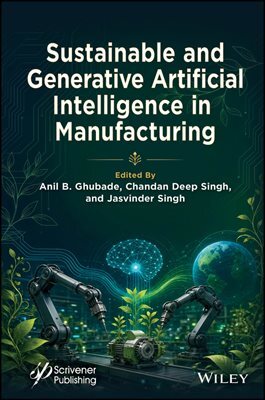
소개
목차
|
Preface xiii 1 Introduction to AI in Manufacturing 1 1.1 Introduction 2 2 Sustainable Challenges of Industry 5.0 Adoption in Manufacturing 19 2.1 Introduction 19 3 Principles of Sustainable AI: Concepts, Challenges, and Governance 39 3.1 Introduction 39 4 Synergistic Use of AI and Smart Materials in Energy-Efficient Structural Design 61 4.1 Introduction to the Growing Need for Energy Optimization 62 5 Predictive Maintenance and Sustainable Operations: A Paradigm Shift in Modern Industry 93 5.1 Introduction 94 6 Integrating Artificial Intelligence in Sustainable Supply Chain Management: Concepts and Frameworks 107 6.1 Introduction 108 7 Generative AI in Product Design and Prototyping 131 7.1 Introduction 132 8 Additive Manufacturing and AI Optimization 147 8.1 Introduction 148 9 Regulatory Frameworks: Rules, Ethics, and Compliance for Sustainable AI in Industry 161 9.1 Introduction to AI Regulations in Manufacturing 162 10 Future of Sustainable AI in Industry 5.0 185 10.1 Introduction 186 References 202 |
저자 소개
Anil B. Ghubade is an Assistant Professor in the School of Mechanical Engineering, Lovely Professional University, Punjab, India. He has published more than 15 research papers in national and international journals, two book chapters, and two patents. His areas of interest include manufacturing processes, machining, non-traditional machining, Bio-MEMS, and product design and development.
Chandan Deep Singh, PhD is an Assistant Professor in the Department of Mechanical Engineering, Punjabi University, Patiala. He has published more than 150 papers in peer-reviewed international journals and conferences, 59 reference books, four edited books, and more than 20 book chapters. His research focuses on computer-aided design, computer-aided manufacturing, and production and industrial engineering.
Jasvinder Singh, PhD is an Assistant Professor in the School of Mechanical Engineering at Lovely Professional University, Jalandhar. He has more than 35 publications in national and international journals and conferences of repute. His research interests include welding and fabrication, non-traditional machining processes, and general manufacturing.
품목정보
- 발행일
- 2026년 11월 20일
- 지원기기
- 크레마,PC(윈도우 - 4K 모니터 미지원),아이폰,아이패드,안드로이드폰,안드로이드패드,PC(Mac)
- 파일/용량
- EPUB(DRM) | 20.48MB ?
- ISBN13
- 9781394403233
