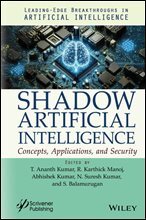

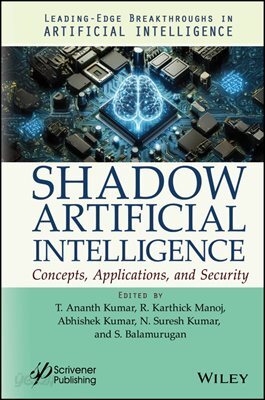
- PDF 안내
-
이 상품은 구매 후 지원 기기에서 예스24 eBook앱 설치 후 바로 이용 가능한 상품입니다.
소개
목차
|
Series Editor's Preface xxi Part 1: Foundations and Emerging Systems of Shadow AI 1 1 Empowering Continuous Learning with AIRSim: AI-Enabled Dynamic Feedback Approaches 3 1.1 Introduction 4 2 ShadowSkinNet: A Lightweight Shadow AI Framework for Autonomous and Explainable Skin Disease Detection 23 2.1 Introduction 24 3 Optimized Deep Learning Pipeline for Breast Cancer Classification from Histopathology Using CSBO and SAC-LSTM 45 3.1 Introduction 46 4 Progressive Residual Feedback Cosine Convolutional Neural Network–Based Enhanced Security in Wireless Body Sensor Networks 85 4.1 Introduction 86 5 Cognitive Deep Learning Based Ovarian Cancer Diagnosis: A Shadow AI Framework 111 5.1 Introduction 112 Part 2: Applications and Impacts Across Sectors 135 6 Shadow AI in Specialized Medical Areas: Transformations, Triumphs, and Trials 137 6.1 Introduction 138 7 Shadow AI–Driven Explainable Ensemble Framework for Customer Churn Prediction in Banking 169 7.1 Introduction 170 8 Shadow AI–Based Finger Vein Authentication Using Deep Learning and Feature Optimization 197 8.1 Introduction 198 9 Shadow AI–Driven Energy Demand Prediction for Sustainable Power Systems 221 9.1 Introduction 222 10 Shadow AI in Education Ecosystems: Implications for Academic Integrity, Policy, and Learning Innovation 247 10.1 Introduction 248 Part 3: Risks, Security, and Critical Infrastructure Challenges 285 11 AI in the Shadows: Securing IoT Networks from Botnet Intrusions 287 11.1 Introduction 288 12 Detecting and Controlling Shadow AI in Wind Power Systems 307 12.1 Introduction 308 13 Shadow AI and the Rise of Unregulated Intelligence in Security-Centric Rogue AI Systems within Critical Infrastructure 335 13.1 Introduction 336 14 Adaptive Hybrid KNN Framework for Malware Detection Using Dynamic Feature Selection and Deep Embedding Models 353 14.1 Introduction 354 15 Efficient Pattern Mining in Educational Data for Scalable Fraud Detection and Risk Mitigation 371 15.1 Introduction 372 Part 4: Governance, Detection, and Ethical Management 391 16 Shadow AI in Healthcare: Risks, Challenges, and Governance Strategies for Secure Medical Systems 393 16.1 Introduction 394 17 Shadow AI: Managing and Governing Shadow AI 413 17.1 Introduction 414 18 Detecting and Identifying Shadow AI—Techniques for Organizations to Recognize Unauthorized AI 439 18.1 Understanding Shadow AI 441 19 Exploring the Cybersecurity Challenges and Ethical Implications Arising from the Growth of Shadow AI in Digital Ecosystems 465 19.1 Introduction 466 20 Shadow AI in Healthcare: The Use of Unauthorized AI Tools for Medical Diagnostics and Patient Data 483 20.1 Introduction 484 21 Data Privacy Violations: How Unauthorized AI Models Process and Expose Sensitive Information 503 21.1 Introduction to Shadow AI 504 22 Shadow AI–Based Brain Tumor Detection and Classification Using Deep Learning Techniques 541 22.1 Introduction 542 References 562 |
저자 소개
T. Ananth Kumar, PhD is an Associate Professor and Research Head at the Indo French Education Trust College of Engineering, Villupuram Tamil Nadu, India. He has authored one book, several book chapters, and various papers in national and international conferences and journals. His fields of interest are networks-on-chips, computer architecture, and ASIC design.
R. Karthick Manoj, PhD is an Associate Professor at the Academy of Maritime Education and Training, Chennai, India with more than 13 years of combined academic and industry experience. He has published three books, twelve book chapters, more than 23 journal articles, and 26 conference papers, and holds four granted and two published patents. He has contributed significantly to research in smart agriculture, sustainable marine systems, and computer vision-based automation.
Abhishek Kumar, PhD is an Assistant Director and Professor in the Computer Science and Engineering Department at Chandigarh University, Punjab, India. With over 13 years of teaching experience, he has published more than 170 peer-reviewed papers, seven authored books, 51 edited volumes, and one patent. His research interests span artificial intelligence, renewable energy systems, image processing, and data mining.
N. Suresh Kumar, PhD is a Professor of Computer Science and Engineering, Chettinad Institute of Technology, Chetinad Academy of Research and Education, Tamil Nadu, India. He has published four books and more than 60 research articles, and has filed four patents. He is a dedicated educator with expertise in image processing for healthcare and remote sensing.
S. Balamurugan, PhD is the Director of Research at iRCS, an Indian Technological Research and Consulting Firm. He has published 75 books, 300 papers in international journals and conferences, and 300 patents. With 20 years of research on various cutting-edge technologies, he provides expert guidance in technology forecasting and decision making for leading companies and startups.
품목정보
- 발행일
- 2026년 11월 25일
- 지원기기
- 크레마, PC(윈도우 - 4K 모니터 미지원), 아이폰, 아이패드, 안드로이드폰, 안드로이드패드, PC(Mac)
- 파일/용량
- PDF(DRM) | 59.24MB ?
- 글자 수/ 페이지 수
- 약 612쪽 ?
- ISBN13
- 9781394423101
- ECN