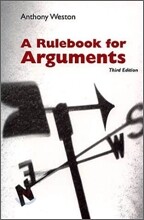

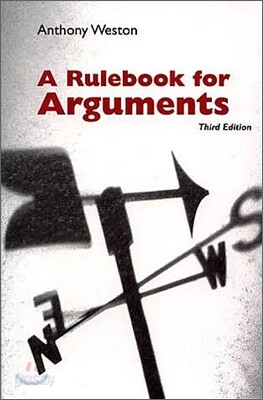
이미 소장하고 있다면 판매해 보세요.
- 국내배송만 가능
- 해외 거래처 사정에 의하여 품절/지연 가능
- 도서 정보 중 미표기 사항 안내?
- 문화비소득공제 가능
목차
|
Table of Contents
Preface ix Introduction xi I. Composing a Short Argument: Some General Rules 1 1. Distinguish premises and conclusion 1 2. Present your ideas in a natural order 3 3. Start from reliable premises 4 4. Be concrete and concise 5 5. Avoid loaded language 6 6. Use consistent terms 7 7. Stick to one meaning for each term 8 II. Arguments by Example 10 8. Give more than one example 11 9. Use representative examples 12 10. Background information is crucial 14 11. Consider counterexamples 17 III. Arguments by Analogy 19 12. Analogy requires a relevantly similar example 21 IV. Arguments from Authority 24 13. Sources should be cited 25 14. Seek informed sources 26 15. Seek impartial sources 28 16. Cross-check sources 30 17. Personal attacks do not disqualify a source 30 V. Arguments about Causes 32 18. Explain how cause leads to effect 33 19. Propose the most likely cause 35 20. Correlated events are not necessarily related 36 21. Correlated events may have a common cause 36 22. Either of two correlated events may cause the other 38 23. Causes may be complex 38 VI. Deductive Arguments 40 24. Modus Ponens 41 25. Modus Tollens 42 26. Hypothetical Syllogism 44 27. Disjunctive Syllogism 46 28. Dilemma 47 29. Reductio ad absurdum 48 30. Deductive arguments in several steps 50 VII. Composing an Argumentative Essay A. Exploring the Issue 53 A1. Explore the arguments on all sides of the issue 54 A2. Question and defend each argument's premises 56 A3. Revise and rethink arguments as they emerge 57 VIII. Composing an Argumentative Essay B. Main Points of the Essay 59 B1. Explain the question 59 B2. Make a definite claim or proposal 60 B3. Develop your arguments fully 61 B4. Consider objections 62 B5. Consider alternatives 63 IX. Composing an Argumentative Essay C. Writing 64 C1. Follow your outline 64 C2. Keep the introduction brief 65 C3. Give your arguments one at a time 65 C4. Clarify, clarify, clarify 67 C5. Support objections with arguments 68 C6. Don't claim more than you have shown 69 X. Fallacies 71 The Two Great Fallacies 71 Some Classical Fallacies 73 Appendix Definition 79 D1. When terms are unclear, get specific 80 D2. When terms are contested, work from the clear cases 82 D3. Don't expect definitions to do the work of arguments 84 Next Steps 86 |
품목정보
- 발행일
- 2007년 05월 29일
- 쪽수, 무게, 크기
- 쪽수확인중 | 크기확인중
- ISBN13
- 9780872205529
사락 별점0
혜택 및 유의사항밑줄0
혜택 및 유의사항상품정보안내
직수입외서의 경우, 해외거래처에서 제공하는 정보가 부족하여 제목, 표지, 가격, 유통상태 등의 정보가 미비하거나 변경되는 경우가 있습니다. 정확한 확인을 원하시는 경우, 일대일 상담으로 문의하여 주시면 답변 드리겠습니다.
(판형과 판수 등이 다양한 도서는 찾으시는 도서의 ISBN을 알려 주시면 보다 빠르고 정확한 안내가 가능합니다.)
해외거래처에서 품절인 경우, 2차 거래선을 통해 유럽과 미국 출판사로 직접 수입이 진행될 수 있습니다.
수입 진행 시점으로 부터 2~3주가 추가로 소요되며, 해외에서도 유통이 원활하지 않은 도서는 품절 안내가 지연될 수 있습니다.
해당 경우, 문자와 메일로 별도 안내를 드리고 있사오니 마이페이지에서 휴대전화번호와 메일주소를 다시 한번 확인해주시기 바랍니다.
(판형과 판수 등이 다양한 도서는 찾으시는 도서의 ISBN을 알려 주시면 보다 빠르고 정확한 안내가 가능합니다.)
해외거래처에서 품절인 경우, 2차 거래선을 통해 유럽과 미국 출판사로 직접 수입이 진행될 수 있습니다.
수입 진행 시점으로 부터 2~3주가 추가로 소요되며, 해외에서도 유통이 원활하지 않은 도서는 품절 안내가 지연될 수 있습니다.
해당 경우, 문자와 메일로 별도 안내를 드리고 있사오니 마이페이지에서 휴대전화번호와 메일주소를 다시 한번 확인해주시기 바랍니다.
