
![[Mankiw]Principles of Economics : An Asian Edition, 1/E](https://image.yes24.com/Goods/3031464/S)
![[Mankiw]Principles of Economics : An Asian Edition, 1/E](https://image.yes24.com/goods/3031464/XL)
이미 소장하고 있다면 판매해 보세요.
- 국내배송만 가능
- 문화비소득공제 가능
책소개
목차
|
PART 1. INTRODUCTION
1. Ten Principles of Economics. 2. Thinking Like an Economist. 3. Interdependence and the Gains from Trade. PART 2. SUPPLY AND DEMAND I: HOW MARKETS WORK 4. The Market Forces of Supply and Demand. 5. Elasticity and Its Application. 6. Supply, Demand, and Government Policies. PART 3. SUPPLY AND DEMAND II: MARKETS AND WELFARE 7. Consumers, Producers, and the Efficiency of Markets. 8. Application: The Costs of Taxation. 9. Application: International Trade. PART 4. THE ECONOMICS OF PUBLIC SECTOR 10. Externalities. 11. Public Goods and Common Resources. 12. The Design of the Tax System. PART 5. FIRM BEHAVIOR AND THE ORGANIZATION OF INDUSTRY 13. The Costs of Production. 14. Firms in Competitive Markets. 15. Monopoly. 16. Oligopoly. 17. Monopolistic Competition. PART 6. THE ECONOMICS OF LABOR MARKETS 18. The Markets for the Factors of Production. 19. Earnings and Discrimination. 20. Income Inequality and Poverty. PART 7. TOPICS FOR FURTHER STUDY 21. The Theory of Consumer Choice. 22. Frontiers in Microeconomics. PART 8. THE DATA OF MACROECONOMICS 23. Measuring a Nation’s Income. 24. Measuring the Cost of Living. PART 9. THE REAL ECONOMY IN THE LONG RUN 25. Production and Growth. 26. Saving, Investment, and the Financial System. 27. The Basic Tools of Finance. 28. Unemployment and Its Natural Rate. PART 10. MONEY AND PRICES IN THE LONG RUN 29. The Monetary System. 30. Money Growth and Inflation. PART 11. THE MACROECONOMICS OF OPEN ECONOMIES 31. Open-Economy Macroeconomics: Basic Concepts. 32. A Macroeconomic Theory of the Open Economy. PART 12. SHORT-RUN ECONOMIC FLUCTUATIONS 33. Aggregate Demand and Aggregate Supply. 34. The Influence of Monetary and Fiscal Policy on Aggregate Demand. 35. The Short-Run Tradeoff between Inflation and Unemployment. PART 13. FINAL THOUGHTS 36. Five Debates over Macroeconomic Policy. |
관련 분류
- 카테고리 분류
품목정보
- 발행일
- 2008년 03월 01일
- 쪽수, 무게, 크기
- 890쪽 | 216*254mm
- ISBN13
- 9789814227872
출판사 리뷰
|
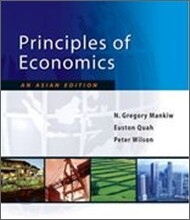
Contains a wealth of Asian examples, case studies and news articles to make the material more relevant to Asian students. Issues covered include:
- income inequality in Asia - China’s attempt to control the price of grain - externality effect of noise pollution in Bangkok - elasticity of taxi demand in Singapore - repeal of the Rent Control Act in Malaysia and its impact - financial crisis in Asia in 1997?98 - currency boards in Hong Kong and Singapore - Philippine government debt - deflation in Japan - unemployment rate in Singapore The classic “Ten Principles of Economics,” introduced in Chapter One and incorporated throughout the text, help students to reinforce their understanding of key economic principles. A clear, conversational writing style to present economic concepts in a way that is very accessible for students. A quick quiz after each major section allows students to check their comprehension before they move on to the next section. Each chapter ends with a variety of problems and applications to provide students with an opportunity to apply the material that they have learned. |
사락 별점0
혜택 및 유의사항밑줄0
혜택 및 유의사항상품정보안내
직수입외서의 경우, 해외거래처에서 제공하는 정보가 부족하여 제목, 표지, 가격, 유통상태 등의 정보가 미비하거나 변경되는 경우가 있습니다. 정확한 확인을 원하시는 경우, 일대일 상담으로 문의하여 주시면 답변 드리겠습니다.
(판형과 판수 등이 다양한 도서는 찾으시는 도서의 ISBN을 알려 주시면 보다 빠르고 정확한 안내가 가능합니다.)
해외거래처에서 품절인 경우, 2차 거래선을 통해 유럽과 미국 출판사로 직접 수입이 진행될 수 있습니다.
수입 진행 시점으로 부터 2~3주가 추가로 소요되며, 해외에서도 유통이 원활하지 않은 도서는 품절 안내가 지연될 수 있습니다.
해당 경우, 문자와 메일로 별도 안내를 드리고 있사오니 마이페이지에서 휴대전화번호와 메일주소를 다시 한번 확인해주시기 바랍니다.
(판형과 판수 등이 다양한 도서는 찾으시는 도서의 ISBN을 알려 주시면 보다 빠르고 정확한 안내가 가능합니다.)
해외거래처에서 품절인 경우, 2차 거래선을 통해 유럽과 미국 출판사로 직접 수입이 진행될 수 있습니다.
수입 진행 시점으로 부터 2~3주가 추가로 소요되며, 해외에서도 유통이 원활하지 않은 도서는 품절 안내가 지연될 수 있습니다.
해당 경우, 문자와 메일로 별도 안내를 드리고 있사오니 마이페이지에서 휴대전화번호와 메일주소를 다시 한번 확인해주시기 바랍니다.