
소개
목차
|
A gripping investigation in the vein of the podcast Serial—a summer nonfiction pick by Entertainment Weekly and The Wall Street Journal
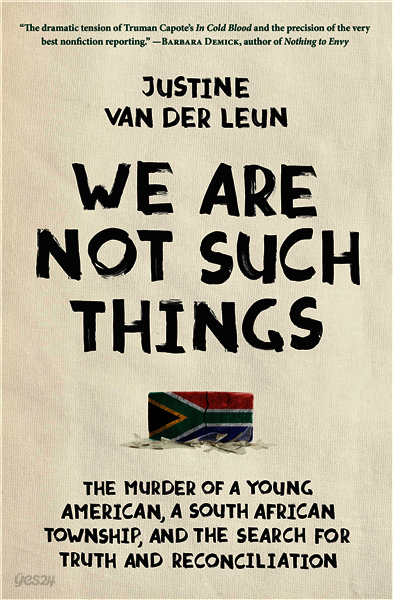
Justine van der Leun reopens the murder of a young American woman in South Africa, an iconic case that calls into question our understanding of truth and reconciliation, loyalty, justice, race, and class. “Timely . . . gripping, explosive . . . the kind of obsessive forensic investigation—of the clues, and into the soul of society—that is the legacy of highbrow sleuths from Truman Capote to Janet Malcolm.”—The New York Times Book Review “A masterpiece of reported nonfiction . . . Justine van der Leun’s account of a South African murder is destined to be a classic.”—Newsday The story of Amy Biehl is well known in South Africa: The twenty-six-year-old white American Fulbright scholar was brutally murdered on August 25, 1993, during the final, fiery days of apartheid by a mob of young black men in a township outside Cape Town. Her parents’ forgiveness of two of her killers became a symbol of the Truth and Reconciliation process in South Africa. Justine van der Leun decided to introduce the story to an American audience. But as she delved into the case, the prevailing narrative started to unravel. Why didn’t the eyewitness reports agree on who killed Amy Biehl? Were the men convicted of the murder actually responsible for her death? And then van der Leun stumbled upon another brutal crime committed on the same day, in the very same area. The true story of Amy Biehl’s death, it turned out, was not only a story of forgiveness but a reflection of the complicated history of a troubled country. We Are Not Such Things is the result of van der Leun’s four-year investigation into this strange, knotted tale of injustice, violence, and compassion. The bizarre twists and turns of this case and its aftermath—and the story that emerges of what happened on that fateful day in 1993 and in the decades that followed—come together in an unsparing account of life in South Africa today. Van der Leun immerses herself in the lives of her subjects and paints a stark, moving portrait of a township and its residents. We come to understand that the issues at the heart of her investigation are universal in scope and powerful in resonance. We Are Not Such Things reveals how reconciliation is impossible without an acknowledgment of the past, a lesson as relevant to America today as to a South Africa still struggling with the long shadow of its history. Praise for We Are Not Such Things “[Van der] Leun probes the characterization of [Amy] Biehl as a martyr to the cause of black South African liberation, and examines the murder, the trials, and the afterlives of witnesses, detectives, and the accused. She displays exquisite insights into the inner lives of those involved, the erasure of shameful histories, and the stresses of absolution without accountability.”—The New Yorker “Moving . . . a very necessary and occasionally confounding account of a small slice of post-apartheid, post-Mandela South Africa, a country that has largely been forgotten in the international maelstrom of terrorism and mass migration. It is a story of frustrated expectations, broken dreams, endemic greed and corruption, but also indomitable human spirit, told against the backdrop of one of the world’s most beautiful natural settings.”—Minneapolis Star Tribune “Unforgettable . . . a gripping narrative that examines the messiness of truth, the illusory nature of reconciliation, [and] the all too often false promise of justice.”—The Boston Globe From the Hardcover edition. |
관련 분류
- 카테고리 분류
품목정보
- 발행일
- 2016년 06월 28일
- 이용안내
-
- 배송 없이 구매 후 바로 읽기
- 이용기간 제한없음
- TTS 불가능
- 저작권 보호를 위해 인쇄 기능 제공 안함
- 지원기기
- 크레마,PC(윈도우 - 4K 모니터 미지원),아이폰,아이패드,안드로이드폰,안드로이드패드,PC(Mac)
- 파일/용량
- EPUB(DRM) | 12.32MB ?
출판사 리뷰
|
1.
Some stories are true that never happened. —Elie Wiesel The journalists and documentarians and small-time film producers filed out of the van and toward St. Columba Anglican Church, a gray-brick building on the corner of NY1 and NY109 in Gugulethu, a township eleven miles outside Cape Town city center. Easy and I stayed behind, he in the driver’s seat and me on the passenger’s side. Easy was a short, compact man with butterscotch skin and a large, round, clean-shaven head. At forty-two, he had this weird ability to shape-shift. Did he look like a hardened old gangster? Yes, some days. Did he look like an adorable, harmless child? Yes, some days. In one of the photos I’ve snapped of him over the years, he is menacing, crouching on the ground with a cigarette between his thumb and forefinger, his band of brothers behind him, one of them holding up a disembodied sheep’s head. But in the next, he’s curled on a small stool, cradling his infant son and smiling as his ten-year-old daughter drapes herself over his shoulder. Easy laughed generously, from the belly, and moved in quick spurts. His features were framed by a constellation of small dark scars: from a knife fight, a stick fight, an adolescent bout with acne, that time he crashed a van into a horse in the middle of the night and then fled, that time the taxi he was riding in collided with a hatchback, and a recent incident involving a scorned ex-girlfriend with long nails and a vendetta. His arms were dotted with fading ballpoint-pen tattoos—one pledging devotion to a long-defunct street gang, one to a prominent prison gang, and one to an old flame named Pinky. The first one had become infected immediately, when he was fifteen, and his mom had spent months tending to it. After that, for a few years at least, Easy felt like it made him look particularly tough. I liked Easy very much. I won’t pretend otherwise. But then again: precisely twenty years before our meeting in the van, on August 25, 1993, and approximately fifteen yards away, Easy had been part of a mob that had hunted down a young white American woman. If you plucked her out of that moment in history and slotted me in, my fate would have likely been the same. Easy chased her through the streets, chanting the slogan “One settler, one bullet,” and hurled jagged bricks at her. He stabbed at her as she begged for her life. She died, bleeding from her head and her chest, on the pavement just across the road. At least this is the crime Easy repeatedly claimed to have committed. He was convicted of her murder, and sentenced to eighteen years in jail. He’d done it, he publicly stated, because “during that time my spirit just says I must kill the white.” The dead woman was named Amy Biehl, and she was twenty-six years old. Once we finished our conversation, Easy and I hopped out of the van. He locked the door and patted the hood. The vehicle was a shiny silver donation from a local auto dealership that said across the side in bold letters: the amy biehl foundation. We walked toward the church together, but as I stepped toward the door, Easy lingered in the winter sunshine. “I’m coming now,” he said. This was South Africanese for “I’ll be right back.” I went on without him. A sorry-eyed man in an ill-fitting suit motioned me into a pew. I slid in and scanned the room, its high ceilings, its tall burning votives. On a portrait nailed high above on the wall, a white Jesus, as lithe and glossy as a Hollywood star, reclined among a small herd of angelic lambs. Behind the pulpit hung an enormous cross. I could see Amy Biehl’s mother, Linda, sitting several rows ahead, her sharp platinum bob distinct in a dark sea of cornrows, weaves, wraps, curls, and towering church hats. Linda was the sort of woman who swept into town, and then swept into |
