


소득공제
수입
직수입양서
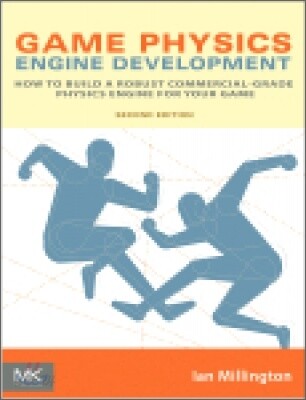
Game Physics Engine Development
How to Build a Robust Commercial-Grade Physics Engine for your Game
Paperback, 2nd Edition
Millington, Ian
CRC Press
2010.07.23.
- 주문 제작 (POD) 도서로 제본 및 인쇄 품질이 다소 미흡할 수 있습니다 (해당 사유 반품 불가)
이미 소장하고 있다면 판매해 보세요.
- 국내배송만 가능
- 해외 거래처 사정에 의하여 품절/지연 가능
- 도서 정보 중 미표기 사항 안내?
- 문화비소득공제 가능
책소개
목차
|
List Of Figures
Preface To The Second Edition Preface To The First Edition Acknowledgments About The Author Chapter 1 Introduction 1 1.1 What Is Game Physics? 2 1.2 What Is A Physics Engine? 2 1.2.1 Advantages Of A Physics Engine 3 1.2.2 Weaknesses Of A Physics Engine 4 1.3 Approaches To Physics Engines 5 1.3.1 Types Of Objects 5 1.3.2 Contact Resolution 6 1.3.3 Impulses And Forces 6 1.3.4 What We're Building 7 1.4 The Mathematics Of Physics Engines 8 1.4.1 The Math You Need To Know 8 1.4.2 The Math We'll Review 9 1.4.3 The Math I'll Introduce 10 1.5 The Source Code In The Book 10 1.6 How The Book Is Structured 11 1.6.1 Exercises And Projects 12 Part I Particle Physics 15 Chapter 2 The Mathematics Of Particles 17 2.1 Vectors 17 2.1.1 The Handedness Of Space 21 2.1.2 Vectors And Directions 23 2.1.3 Scalar And Vector Multiplication 25 2.1.4 Vector Addition And Subtraction 27 2.1.5 Multiplying Vectors 29 2.1.6 The Component Product 30 2.1.7 The Scalar Product 31 2.1.8 The Vector Product 33 2.1.9 The Orthonormal Basis 37 2.2 Calculus 38 2.2.1 Differential Calculus 38 2.2.2 Integral Calculus 43 2.3 Summary 44 2.4 Exercises 45 Chapter 3 The Laws Of Motion 47 3.1 The Particle 48 3.2 The First Two Laws 49 3.2.1 The Force Equations 50 3.2.2 Adding Mass To Particles 51 3.2.3 Momentum And Velocity 52 3.2.4 The Force Of Gravity 53 3.3 The Integrator 55 3.3.1 The Update Equations 55 3.3.2 The Complete Integrator 57 3.4 Summary 58 3.5 Exercises 59 Chapter 4 The Particle Physics Engine 61 4.1 Ballistics 61 4.1.1 Setting Projectile Properties 62 4.1.2 Implementation 63 4.2 Fireworks 66 4.2.1 The Fireworks Data 66 4.2.2 Firework Rules 67 4.2.3 The Implementation 69 4.3 Summary 73 4.4 Projects 73 Part II Mass Aggregate Physics 75 Chapter 5 Adding General Forces 77 5.1 D'alembert's Principle 77 5.2 Force Generators 80 5.2.1 Interfaces And Polymorphism 81 5.2.2 Implementation 81 5.2.3 A Gravity Force Generator 84 5.2.4 A Drag Force Generator 85 5.3 Built-In Gravity And Damping 87 5.4 Summary 87 5.5 Exercises 88 Chapter 6 Springs And Spring-Like Things 89 6.1 Hook's Law 89 6.2 Spring-Like Force Generators 92 6.2.1 A Basic Spring Force Generator 92 6.2.2 An Anchored Spring Generator 94 6.2.3 An Elastic Bungee Generator 96 6.2.4 A Buoyancy Force Generator 98 6.3 Stiff Springs 101 6.3.1 The Stiff Springs Problem 102 6.3.2 Faking Stiff Springs 104 6.4 Summary 110 6.5 Exercises 110 Chapter 7 Hard Constraints 113 7.1 Simple Collision Resolution 113 7.1.1 The Closing Velocity 114 7.1.2 The Coefficient Of Restitution 115 7.1.3 The Collision Direction And The Contact Normal 115 7.1.4 Impulses 117 7.2 Collision Processing 118 7.2.1 Collision Detection 121 7.2.2 Resolving Interpenetration 123 7.2.3 Resting Contacts 126 7.3 The Contact Resolver Algorithm 130 7.3.1 Resolution Order 131 7.3.2 Time-Division Engines 135 7.4 Collision-Like Things 136 7.4.1 Cables 137 7.4.2 Rods 140 7.5 Summary 142 7.6 Exercises 142 Chapter 8 The Mass Aggregate Physics Engine 145 8.1 Overview Of The Engine 145 8.2 Using The Physics Engine 151 8.2.1 Rope Bridges And Cables 151 8.2.2 Friction 152 8.2.3 Blob Games 153 8.3 Summary 153 8.4 Projects 154 Part III Rigid-Body Physics 155 Chapter 9 The Mathematics Of Rotations 157 9.1 Rotating Objects In 2d 158 9.1.1 The Mathematics Of Angles 158 9.1.2 Angular Speed 159 9.1.3 The Origin And The Center Of Mass 160 9.2 Orientation In 3d 165 9.2.1 Euler Angles 165 9.2.2 Axis-Angle 167 9.2.3 Rotation Matrices 168 9.2.4 Quaternions 169 9.3 Angular Velocity And Acceleration 172 9.3.1 Velocity Of A Point 173 9.3.2 Angular Acceleration 173 9.4 Implementing The Mathematics 173 9.4.1 The Matrix Classes 174 9.4.2 Matrix Multiplication 175 9.4.3 Matrix Inverse And Transpose 184 9.4.4 Converting A Quaternion To A Matrix 191 9.4.5 Transforming Vectors 193 9.4.6 Changing The Basis Of A Matrix 197 9.4.7 The Quaternion Class 198 9.4.8 Normalizing Quaternions 200 9.4.9 Combining Quaternions 200 9.4.10 Rotating 201 9.4.11 Updating By The Angular Velocity 202 9.5 Summary 203 9.6 Exercises 203 Chapter 10 Laws Of Motion For Rigid Bodies 207 10.1 The Rigid Body 207 10.2 Newton-2 For Rotation 211 10.2.1 Torque 211 10.2.2 The Moment Of Inertia 213 10.2.3 Inertia Tensor In World Coordinates 216 10.3 D'alembert For Rotation 220 10.3.1 Force Generators 223 10.4 The Rigid-Body Integration 226 10.5 Summary 228 10.6 Exercises 228 Chapter 11 The Rigid-Body Physics Engine 231 11.1 Overview Of The Engine 231 11.2 Using The Physics Engine 234 11.2.1 A Flight Simulator 234 11.2.2 A Sailing Simulator 242 11.3 Summary 247 11.4 Projects 248 Part IV Collision Detection 251 Chapter 12 Collision Detection 253 12.1 The Collision Detection Pipeline 254 12.2 Broad-Phase Collision Detection 255 12.2.1 Requirements 256 12.3 Bounding Volume Hierarchies 257 12.3.1 Hierarchies 259 12.3.2 Building The Hierarchy 266 12.3.3 Subobject Hierarchies 275 12.4 Spatial Partitioning 276 12.4.1 Binary Space Partitioning 276 12.4.2 Oct-Trees And Quad-Trees 281 12.4.3 Grids 283 12.4.4 Multiresolution Maps 287 12.5 Summary 288 12.6 Exercises 288 Chapter 13 Generating Contacts 291 13.1 Collision Geometry 292 13.1.1 Primitive Assemblies 293 13.2 Contact Generation 294 13.2.1 Contact Types 295 13.2.2 Contact Data 298 13.2.3 Vertex face Contacts 300 13.2.4 Edge -Edge Contacts 301 13.2.5 Edge face Contacts 301 13.2.6 Face face Contacts 302 13.2.7 Testing Before Generating Contacts 303 13.3 Simple Collision Algorithms 304 13.3.1 Colliding Two Spheres 305 13.3.2 Colliding A Sphere And A Plane 307 13.3.3 Colliding A Box And A Plane 310 13.3.4 Colliding A Box And A Sphere 315 13.4 Separating Axis Tests 319 13.4.1 Generating Contact Data With SATS 320 13.4.2 Colliding Two Boxes 322 13.4.3 Colliding Convex Polyhedra 326 13.5 Coherence 328 13.6 Summary 331 13.7 Exercises 331 Part V Contact Physics 333 Chapter 14 Collision Resolution 335 14.1 Impulse And Impulsive Torque 335 14.1.1 Impulsive Torque 336 14.1.2 Rotating Collisions 338 14.1.3 Handling Rotating Collisions 339 14.2 Collision Impulses 340 14.2.1 Change To Contact Coordinates 340 14.2.2 Velocity Change By Impulse 347 14.2.3 Impulse Change By Velocity 351 14.2.4 Calculating The Desired Velocity Change 351 14.2.5 Calculating The Impulse 353 14.2.6 Applying The Impulse 353 14.3 Resolving Interpenetration 355 14.3.1 Choosing A Resolution Method 355 14.3.2 Implementing Nonlinear Projection 359 14.3.3 Avoiding Overrotation 362 14.4 The Collision Resolution Process 364 14.4.1 The Collision Resolution Pipeline 365 14.4.2 Preparing Contact Data 367 14.4.3 Resolving Penetration 372 14.4.4 Resolving Velocity 379 14.4.5 Alternative Update Algorithms 381 14.5 Summary 384 14.6 Exercises 385 Chapter 15 Resting Contacts And Friction 387 15.1 Resting Forces 388 15.1.1 Force Calculations 389 15.2 Microcollisions 390 15.2.1 Removing Accelerated Velocity 392 15.2.2 Lowering The Restitution 393 15.2.3 The New Velocity Calculation 394 15.3 Types Of Friction 395 15.3.1 Static And Dynamic Friction 395 15.3.2 Isotropic And Anisotropic Friction 398 15.4 Implementing Friction 399 15.4.1 Friction As Impulses 400 15.4.2 Modifying The Velocity Resolution Algorithm 402 15.4.3 Putting It All Together 407 15.5 Friction And Sequential Contact Resolution 410 15.6 Summary 411 15.7 Exercises 412 Chapter 16 Stability And Optimization 413 16.1 Stability 413 16.1.1 Quaternion Drift 414 16.1.2 Interpenetration On Slopes 415 16.1.3 Integration Stability 417 16.1.4 The Benefit Of Pessimistic Collision Detection 419 16.1.5 Changing Mathematical Accuracy 420 16.2 Optimizations 421 16.2.1 Sleep 422 16.2.2 Margins Of Error For Penetration And Velocity 430 16.2.3 Contact Grouping 432 16.2.4 Code Optimizations 434 16.3 Summary 436 Chapter 17 Putting It All Together 437 17.1 Overview Of The Engine 437 17.2 Using The Physics Engine 439 17.2.1 Ragdolls 440 17.2.2 Fracture Physics 445 17.2.3 Explosive Physics 451 17.3 Limitations Of The Engine 458 17.3.1 Stacks 458 17.3.2 Reaction Force Friction 458 17.3.3 Joint Assemblies 459 17.3.4 Stiff Springs 459 17.4 Summary 459 17.5 Projects 459 Part VI Further Topics In Physics 461 Chapter 18 Physics In Two Dimensions 463 18.1 2d Or 3d? 463 18.2 Vector Mathematics 465 18.3 Particle And Mass Aggregate Physics 467 18.4 The Mathematics Of Rotation 467 18.4.1 Representing Rotation 467 18.4.2 Matrices 469 18.5 Rigid-Body Dynamics 469 18.6 Collision Detection 471 18.6.1 Vertex edge Contacts 472 18.6.2 Edge edge Contacts 472 18.6.3 Contact Generation 472 18.7 Collision Response 473 18.8 Summary 473 18.9 Projects 474 Chapter 19 Other Programming Languages 475 19.1 Actionscript 3 475 19.2 C 479 19.3 Java 480 19.4 C# 481 19.5 Other Scripting Languages 482 Chapter 20 Other Types Of Physics 483 20.1 Simultaneous Contact Resolution 483 20.1.1 The Jacobian 484 20.1.2 The Linear-Complementarity Problem 485 20.2 Reduced Coordinate Approaches 488 20.3 Summary 489 Appendix A Useful Inertia Tensors 491 A.1 Discrete Masses 492 A.2 Continuous Masses 492 A.3 Common Shapes 493 A.3.1 Cuboid 493 A.3.2 Sphere 493 A.3.3 Cylinder 494 A.3.4 Cone 494 A.3.5 Hemisphere 495 A.4 Moments Of Inertia In 2d 495 A.4.1 Common 2d Shapes 495 Appendix B Useful Friction Coefficients 497 Appendix C Mathematics Summary 499 C.1 Vectors 499 C.2 Quaternions 500 C.3 Matrices 501 C.4 Integration 502 C.5 Physics 503 C.6 Other Formulas 504 Glossary 505 Bibliography 509 Index 511 |
관련 분류
품목정보
- 발행일
- 2010년 07월 23일
- 쪽수, 무게, 크기
- 552쪽 | 1040g | 190*240mm
- ISBN13
- 9780123819765
사락 별점0
혜택 및 유의사항밑줄0
혜택 및 유의사항상품정보안내
직수입외서의 경우, 해외거래처에서 제공하는 정보가 부족하여 제목, 표지, 가격, 유통상태 등의 정보가 미비하거나 변경되는 경우가 있습니다. 정확한 확인을 원하시는 경우, 일대일 상담으로 문의하여 주시면 답변 드리겠습니다.
(판형과 판수 등이 다양한 도서는 찾으시는 도서의 ISBN을 알려 주시면 보다 빠르고 정확한 안내가 가능합니다.)
해외거래처에서 품절인 경우, 2차 거래선을 통해 유럽과 미국 출판사로 직접 수입이 진행될 수 있습니다.
수입 진행 시점으로 부터 2~3주가 추가로 소요되며, 해외에서도 유통이 원활하지 않은 도서는 품절 안내가 지연될 수 있습니다.
해당 경우, 문자와 메일로 별도 안내를 드리고 있사오니 마이페이지에서 휴대전화번호와 메일주소를 다시 한번 확인해주시기 바랍니다.
(판형과 판수 등이 다양한 도서는 찾으시는 도서의 ISBN을 알려 주시면 보다 빠르고 정확한 안내가 가능합니다.)
해외거래처에서 품절인 경우, 2차 거래선을 통해 유럽과 미국 출판사로 직접 수입이 진행될 수 있습니다.
수입 진행 시점으로 부터 2~3주가 추가로 소요되며, 해외에서도 유통이 원활하지 않은 도서는 품절 안내가 지연될 수 있습니다.
해당 경우, 문자와 메일로 별도 안내를 드리고 있사오니 마이페이지에서 휴대전화번호와 메일주소를 다시 한번 확인해주시기 바랍니다.
127,540원
총 1개
127,540원