
목차
|
A sweeping history of tragic genius, cutting-edge science, and the discovery that changed billions of lives—including your own.
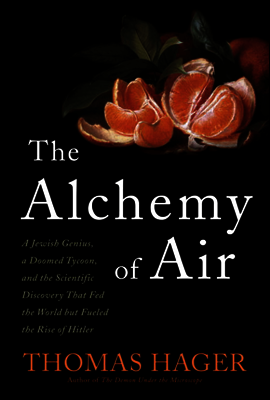
At the dawn of the twentieth century, humanity was facing global disaster. Mass starvation, long predicted for the fast-growing population, was about to become a reality. A call went out to the world’s scientists to find a solution. This is the story of the two enormously gifted, fatally flawed men who found it: the brilliant, self-important Fritz Haber and the reclusive, alcoholic Carl Bosch. Together they discovered a way to make bread out of air, built city-sized factories, controlled world markets, and saved millions of lives. Their invention continues to feed us today; without it, more than two billion people would starve. But their epochal triumph came at a price we are still paying. The Haber-Bosch process was also used to make the gunpowder and high explosives that killed millions during the two world wars. Both men were vilified during their lives; both, disillusioned and disgraced, died tragically. Today we face the other unintended consequences of their discovery—massive nitrogen pollution and a growing pandemic of obesity. The Alchemy of Air is the extraordinary, previously untold story of two master scientists who saved the world only to lose everything and of the unforseen results of a discovery that continues to shape our lives in the most fundamental and dramatic of ways. |
품목정보
- 발행일
- 2008년 09월 09일
- 이용안내
-
- 배송 없이 구매 후 바로 읽기
- 이용기간 제한없음
- TTS 불가능
- 저작권 보호를 위해 인쇄 기능 제공 안함
- 지원기기
- 크레마,PC(윈도우 - 4K 모니터 미지원),아이폰,아이패드,안드로이드폰,안드로이드패드,PC(Mac)
- 파일/용량
- EPUB(DRM) | 0.45MB ?
출판사 리뷰
|
Chapter 1
The prophecy was made in the fall of 1898, in a music hall in Bristol, England, by a thin man with a graying, neatly trimmed beard and a mustache waxed to alarmingly long, needlelike points. His audience, the cream of British science, thousands of formally dressed men and bejeweled women, were seated in a low-rent venue, what Americans would have called a vaudeville palace--a last-minute substitute for an academic auditorium that had burned down--but they dutifully filed in and filled every seat from the orchestra pit to the highest balcony. The hall was uncomfortably hot, especially in the upper seats. Exquisitely gowned women began opening their fans. Evening-coated men began murmuring to their neighbors that it looked as if it were going to be a long evening. The speaker was Sir William Crookes, 1898's incoming president of the British Academy of Sciences. Impeccably dressed, erect and resolute, he looked every inch the triumphant, newly knighted physicist he was: inventor of the Crookes Tube (a predecessor of the cathode ray tubes used later for televisions and computers), recent discoverer of an interesting new addition to the periodic table that he had named thallium, fearless explorer of science, even out to its furthest edges--Crookes was an active researcher in the area of seances and the question of life after death. Inaugural speeches were often deadly dull. The incoming presidents of scientific associations almost always droned long lists of achievements made during the past year, with nods to numerous individual researchers, sprinkled with homilies about the importance of science for the British Empire. Crookes, however, had decided to shake things up. He adjusted his oval glasses, glanced at his notes, looked up, and got right to the point. "England and all civilized nations," he said, "stand in deadly peril." The fans in the balcony stopped fluttering. Crookes's voice was clear but he spoke softly. The hall went silent, the audience straining to hear as the speaker continued. If nothing was done soon, he explained, great numbers of people, especially in the world's most advanced nations, were soon going to begin starving to death. This was a conclusion that he was forced to accept, he said, after considering two simple facts: "As mouths multiply," he said, "food sources dwindle." The number of mouths had been increasing for some time thanks to advances in sanitation and medical care, from the installation of improved water systems to the introduction of antiseptics. These were great triumphs for humanity. But they carried with them a threat. While population increased, land was limited; there were only so many farmable acres on earth. When every one of those acres was under the plow and farmed as well as it could be, the population would keep going up, the farmed and refarmed soil would slowly lose its fertility, and mass starvation would, of necessity, ensue. His research led him to estimate, he said, that humans would begin dying of hunger in large numbers some time around the 1930s. There was only one way to stop it, he said. And then he told them what it was. Every agricultural society in every age has had its own methods, rites, and prayers for ensuring rich crops. Homer sang of farmers gathering heaps of mule and cow dung. The Romans worshipped a god of manure, Stercutius. Rome made an early science of agriculture, ranking various animal excrements (including human), composts, blood, and ashes according to their fertilizing power. Pigeon dung, they found, was the best overall for growing crops, and cattle dung was clearly better than horse manure. Fresh human urine was best for young plants, aged urine for fruit trees. Both the Romans and the ancient Chinese also understood that there was another key to a healthy farm: crop rotation. No one knew why or how it worked, but never planting the same crop twice consecutively in the s |