
소득공제
수입
직수입양서
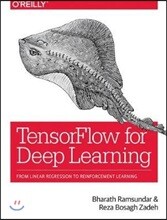
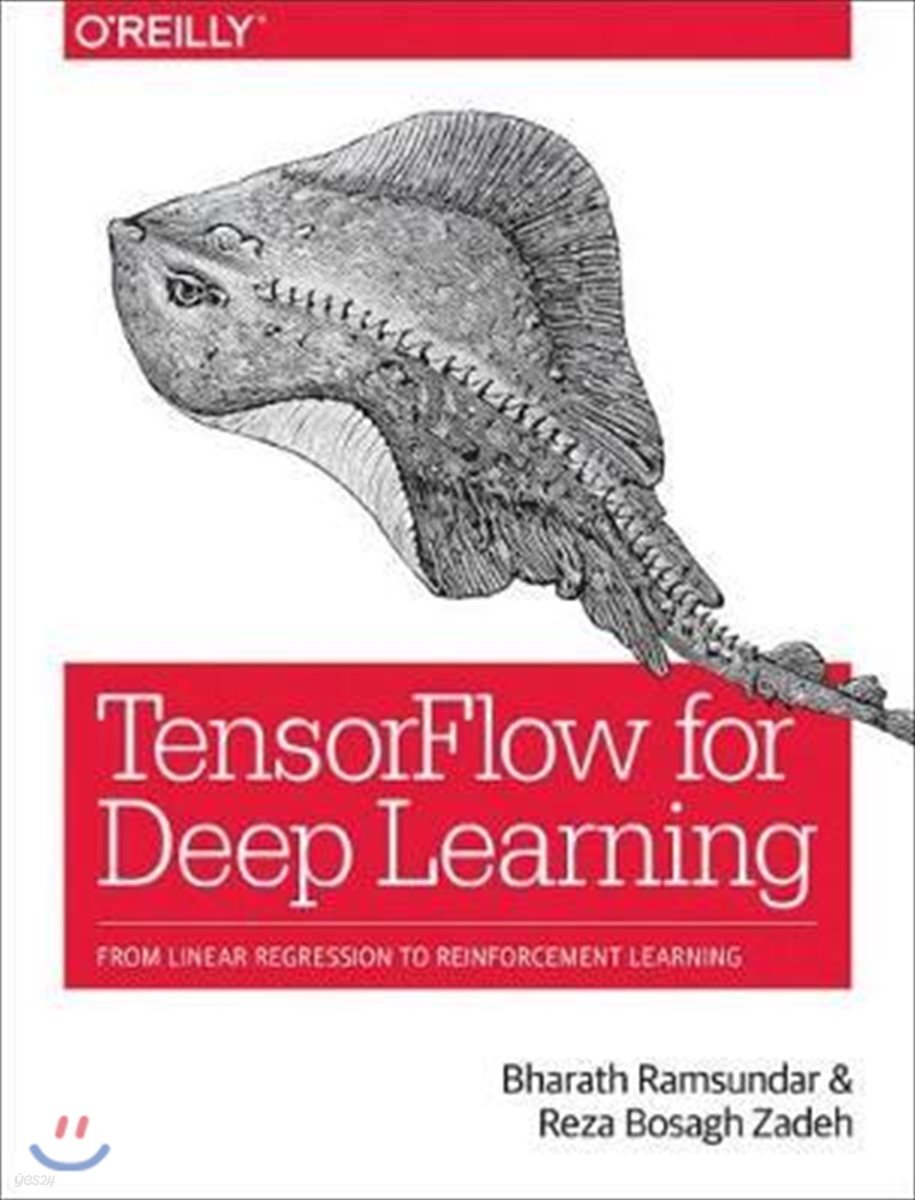
Tensorflow for Deep Learning: From Linear Regression to Reinforcement Learning
From Linear Regression to Reinforcement Learning
Paperback
Ramsundar, Bharath / Zadeh, Reza
O'Reilly Media
2018.03.23.
- 가격
-
122,480원10 110,230
- YES포인트?
-
5,520원 (5%) 마니아추가적립5만원 이상 구매 시 2천원 추가 적립
이미 소장하고 있다면 판매해 보세요.
- 국내배송만 가능
- 해외 거래처 사정에 의하여 품절/지연 가능
- 도서 정보 중 미표기 사항 안내?
- 문화비소득공제 가능
책소개
목차
|
Preface ix
1. Introduction to Deep Learning 1 Machine Learning Eats Computer Science 1 Deep Learning Primitives 3 Fully Connected Layer 3 Convolutional Layer 4 Recurrent Neural Network Layers 4 Long Short-Term Memory Cells 5 Deep Learning Architectures 6 LeNet 6 AlexNet 6 ResNet 7 Neural Captioning Model 8 Google Neural Machine Translation 9 One-Shot Models 10 AlphaGo 12 Generative Adversarial Networks 13 Neural Turing Machines 14 Deep Learning Frameworks 15 Limitations of TensorFlow 16 Review 17 2. Introduction to TensorFlow Primitives 19 Introducing Tensors 19 Scalars, Vectors, and Matrices 20 Matrix Mathematics 24 Tensors 25 Tensors in Physics 27 Mathematical Asides 28 Basic Computations in TensorFlow 29 Installing TensorFlow and Getting Started 29 Initializing Constant Tensors 30 Sampling Random Tensors 31 Tensor Addition and Scaling 32 Matrix Operations 33 Tensor Types 35 Tensor Shape Manipulations 35 Introduction to Broadcasting 37 Imperative and Declarative Programming 37 TensorFlow Graphs 39 TensorFlow Sessions 39 TensorFlow Variables 40 Review 42 3. Linear and Logistic Regression with TensorFlow 43 Mathematical Review 43 Functions and Differentiability 44 Loss Functions 45 Gradient Descent 50 Automatic Differentiation Systems 53 Learning with TensorFlow 55 Creating Toy Datasets 55 New TensorFlow Concepts 60 Training Linear and Logistic Models in TensorFlow 64 Linear Regression in TensorFlow 64 Logistic Regression in TensorFlow 73 Review 79 4. Fully Connected Deep Networks 81 What Is a Fully Connected Deep Network? 81 "Neurons" in Fully Connected Networks 83 Learning Fully Connected Networks with Backpropagation 85 Universal Convergence Theorem 87 Why Deep Networks? 88 Training Fully Connected Neural Networks 89 Learnable Representations 89 Activations 89 Fully Connected Networks Memorize 90 Regularization 90 Training Fully Connected Networks 94 Implementation in TensorFlow 94 Installing DeepChem 94 Tox21 Dataset 95 Accepting Minibatches of Placeholders 96 Implementing a Hidden Layer 96 Adding Dropout to a Hidden Layer 97 Implementing Minibatching 98 Evaluating Model Accuracy 98 Using TensorBoard to Track Model Convergence 99 Review 101 5. Hyperparameter Optimization 103 Model Evaluation and Hyperparameter Optimization 104 Metrics, Metrics, Metrics 105 Binary Classification Metrics 106 Multiclass Classification Metrics 108 Regression Metrics 110 Hyperparameter Optimization Algorithms 110 Setting Up a Baseline 111 Graduate Student Descent 113 Grid Search 114 Random Hyperparameter Search 115 Challenge for the Reader 116 Review 117 6. Convolutional Neural Networks 119 Introduction to Convolutional Architectures 120 Local Receptive Fields 120 Convolutional Kernels 122 Pooling Layers 125 Constructing Convolutional Networks 125 Dilated Convolutions 126 Applications of Convolutional Networks 127 Object Detection and Localization 127 Image Segmentation 128 Graph Convolutions 129 Generating Images with Variational Autoencoders 131 Training a Convolutional Network in TensorFlow 134 The MNIST Dataset 134 Loading MNIST 135 TensorFlow Convolutional Primitives 138 The Convolutional Architecture 140 Evaluating Trained Models 144 Challenge for the Reader 146 Review 146 7. Recurrent Neural Networks 149 Overview of Recurrent Architectures 150 Recurrent Cells 152 Long Short-Term Memory (LSTM) 152 Gated Recurrent Units (GRU) 154 Applications of Recurrent Models 154 Sampling from Recurrent Networks 154 Seq2seq Models 155 Neural Turing Machines 157 Working with Recurrent Neural Networks in Practice 159 Processing the Penn Treebank Corpus 159 Code for Preprocessing 160 Loading Data into TensorFlow 162 The Basic Recurrent Architecture 164 Challenge for the Reader 166 Review 166 8. Reinforcement Learning 169 Markov Decision Processes 173 Reinforcement Learning Algorithms 175 Q-Learning 176 Policy Learning 177 Asynchronous Training 179 Limits of Reinforcement Learning 179 Playing Tic-Tac-Toe 181 Object Orientation 181 Abstract Environment 182 Tic-Tac-Toe Environment 182 The Layer Abstraction 185 Defining a Graph of Layers 188 The A3C Algorithm 192 The A3C Loss Function 196 Defining Workers 198 Training the Policy 201 Challenge for the Reader 203 Review 203 9. Training Large Deep Networks 205 Custom Hardware for Deep Networks 205 CPU Training 206 GPU Training 207 Tensor Processing Units 209 Field Programmable Gate Arrays 211 Neuromorphic Chips 211 Distributed Deep Network Training 212 Data Parallelism 213 Model Parallelism 214 Data Parallel Training with Multiple GPUs on Cifar10 215 Downloading and Loading the DATA 216 Deep Dive on the Architecture 218 Training on Multiple GPUs 220 Challenge for the Reader 223 Review 223 10. The Future of Deep Learning 225 Deep Learning Outside the Tech Industry 226 Deep Learning in the Pharmaceutical Industry 226 Deep Learning in Law 227 Deep Learning for Robotics 227 Deep Learning in Agriculture 228 Using Deep Learning Ethically 228 Is Artificial General Intelligence Imminent? 230 Where to Go from Here? 231 Index 233 |
관련 분류
품목정보
- 발행일
- 2018년 03월 23일
- 쪽수, 무게, 크기
- 256쪽 | 360g | 175*231*13mm
- ISBN13
- 9781491980453
리뷰/한줄평0
상품정보안내
직수입외서의 경우, 해외거래처에서 제공하는 정보가 부족하여 제목, 표지, 가격, 유통상태 등의 정보가 미비하거나 변경되는 경우가 있습니다. 정확한 확인을 원하시는 경우, 일대일 상담으로 문의하여 주시면 답변 드리겠습니다.
(판형과 판수 등이 다양한 도서는 찾으시는 도서의 ISBN을 알려 주시면 보다 빠르고 정확한 안내가 가능합니다.)
해외거래처에서 품절인 경우, 2차 거래선을 통해 유럽과 미국 출판사로 직접 수입이 진행될 수 있습니다.
수입 진행 시점으로 부터 2~3주가 추가로 소요되며, 해외에서도 유통이 원활하지 않은 도서는 품절 안내가 지연될 수 있습니다.
해당 경우, 문자와 메일로 별도 안내를 드리고 있사오니 마이페이지에서 휴대전화번호와 메일주소를 다시 한번 확인해주시기 바랍니다.
(판형과 판수 등이 다양한 도서는 찾으시는 도서의 ISBN을 알려 주시면 보다 빠르고 정확한 안내가 가능합니다.)
해외거래처에서 품절인 경우, 2차 거래선을 통해 유럽과 미국 출판사로 직접 수입이 진행될 수 있습니다.
수입 진행 시점으로 부터 2~3주가 추가로 소요되며, 해외에서도 유통이 원활하지 않은 도서는 품절 안내가 지연될 수 있습니다.
해당 경우, 문자와 메일로 별도 안내를 드리고 있사오니 마이페이지에서 휴대전화번호와 메일주소를 다시 한번 확인해주시기 바랍니다.
110,230원
총 1개
110,230원
