

소개
목차
|
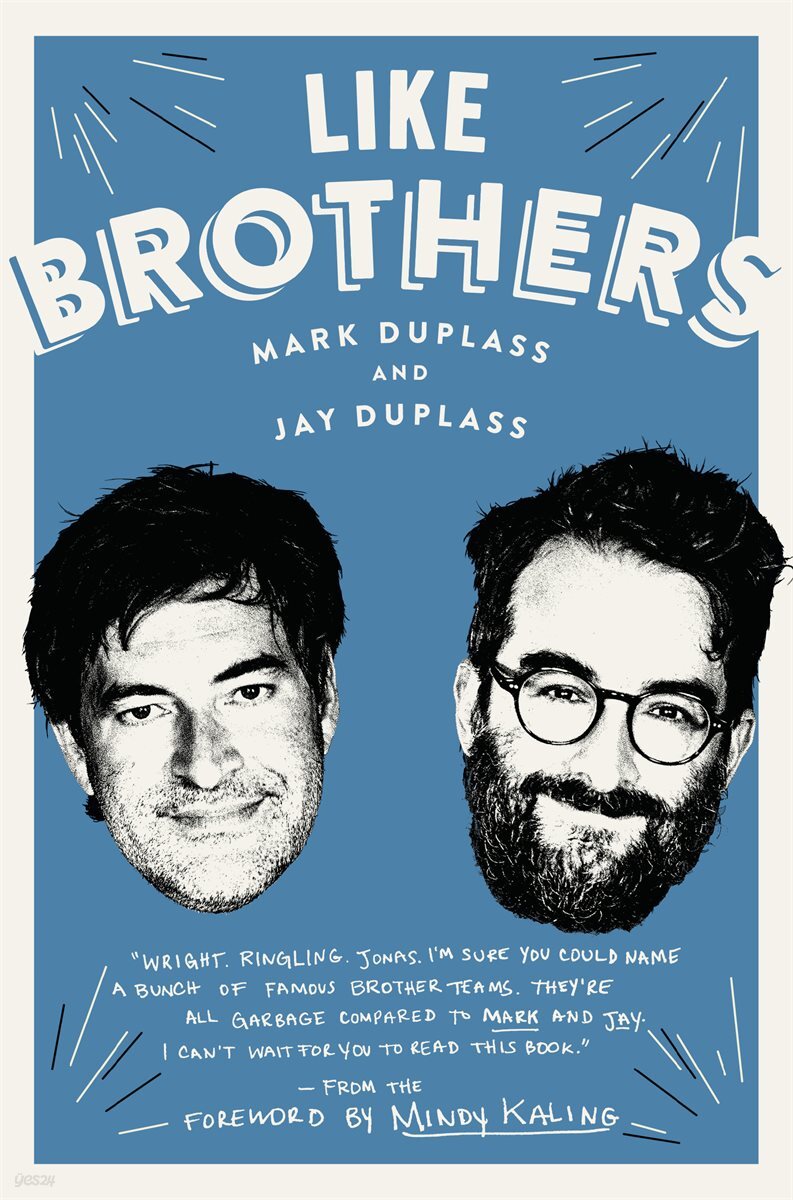
The multitalented writers, directors, producers, and actors (as seen on The League, Transparent, and The Mindy Project) share the secrets of their lifelong partnership in this unique memoir.
“A book that anyone will love . . . You can enjoy it even if you have no idea who the Duplass brothers are.”—Janet Maslin, The New York Times (17 Refreshing Books to Read This Summer) Whether producing, writing, directing, or acting, the Duplass Brothers have made their mark in the world of independent film and television on the strength of their quirky and empathetic approach to storytelling. Now, for the first time, Mark and Jay take readers on a tour of their lifelong partnership in this unique memoir told in essays that share the secrets of their success, the joys and frustrations of intimate collaboration, and the lessons they’ve learned the hard way. From a childhood spent wielding an oversized home video camera in the suburbs of New Orleans to their shared years at the University of Texas in early-nineties Austin, and from the breakthrough short they made on a three-dollar budget to the night their feature film Baghead became the center of a Sundance bidding war, Mark and Jay tell the story of a bond that’s resilient, affectionate, mutually empowering, and only mildly dysfunctional. They are brutally honest about how their closeness sabotaged their youthful romantic relationships, about the jealousy each felt when the other stole the spotlight as an actor (Mark in The League, Jay in Transparent), and about the challenges they faced on the set of their HBO series Togetherness—namely, too much togetherness. But Like Brothers is also a surprisingly practical road map to a rewarding creative partnership. Rather than split all their responsibilities fifty-fifty, the brothers learned to capitalize on each other’s strengths. They’re not afraid to call each other out, because they’re also not afraid to compromise. Most relationships aren’t—and frankly shouldn’t be—as intense as Mark and Jay’s, but their brand of trust, validation, and healthy disagreement has taken them far. Part coming-of-age memoir, part underdog story, and part insider account of succeeding in Hollywood on their own terms, Like Brothers is as openhearted and lovably offbeat as Mark and Jay themselves. “Wright. Ringling. Jonas. I’m sure you could name a bunch of famous brother teams. They’re all garbage compared to Mark and Jay. I can’t wait for you to read this book.”—from the foreword by Mindy Kaling |
품목정보
- 발행일
- 2018년 05월 08일
- 지원기기
- 크레마,PC(윈도우 - 4K 모니터 미지원),아이폰,아이패드,안드로이드폰,안드로이드패드,PC(Mac)
- 파일/용량
- EPUB(DRM) | 9.35MB ?
- ISBN13
- 9781101967720
출판사 리뷰
|
I.
It is dark. It is late. It is 1984. We are lying next to each other in one of our twin beds. But, predictably, we are not asleep. We are talking about life. And our dreams. And the great mystery of cable television. “Jay?” “Yes, Mark?” (Silence. Mark has always loved the dramatic silence. I am older by four years and should find this annoying, but I love this about him.) “When is it coming?” “Soon.” “How soon?” (I take a moment to mitigate expectations and not get my seven--year--old baby brother too excited.) “Dad said by next week it’ll be here.” “What does it look like?” (I actually do not know, but I have a few theories.) “I’m not sure.” “Is it, like ... a big cable?” “I think so?” “Do they just drag it down the street and plug it into the house?” “I don’t think that’s how it works.” “How does it work?” “I don’t know.” (Mark thinks on this. Wide--eyed. Young mind grappling with what it all means.) “What is going to happen to us, Jay?” “Nothing crazy. I don’t think. Or maybe everything.” “I’m so excited.” “Yeah, me too.” (Pause.) “Jay?” “Yes, Mark.” “I have something to confess.” “What?” (Again, the dramatic pause.) “I don’t know what cable is.” (I try extremely hard not to laugh. I am careful never to condescend, because he is smart and very sensitive. Still, I am an older brother and can’t help myself. ... ) “If you don’t know what it is, then why are you so excited about it?” “I don’t know. I just ... I heard you talking about it to your friends. And ... I can tell how excited you are about it. So ... I got excited about it.” (Not an extremely eloquent response, but quite prophetic in many ways as to the nature of our unique brotherly bond and complex relationship to come.) “It’s going to be bringing a lot of movies, and TV shows, and a bunch of new channels into the neighborhood.” “Do you think it’s gonna change everything?” “I don’t know.” (Pause.) “Jay?” “Yes, Mark.” “When we grow up do you want to get houses next to each other?” “Definitely.” (Mark considers this.) “Do you think ... we could share the same cable? Or do we have to get different cables for each house?” “I could probably figure out how to share one.” (Mark believes me. He believes that I am very good at this kind of thing. Good at everything, actually, if you asked Mark in 1984. This was a huge part of building my confidence.) “What happens if we wanna watch different movies but we share the same cable?” “I think we’d have to watch the same movie.” “So what do we do if we ever want to watch a different movie at the same time?” (We both consider this question. It’s a troublesome thought. Might there come a time when our interests, and therefore our lives, diverge? The question hangs over us like a fat black cloud for a moment. But then we smile. Because this is a ridiculous thought. We will always want to watch the same movie. We will always live right next to each other. We will always lie in bed at night and talk about our lives and our dreams.) Two weeks later, cable arrives at our home. And everything changes.< |
