


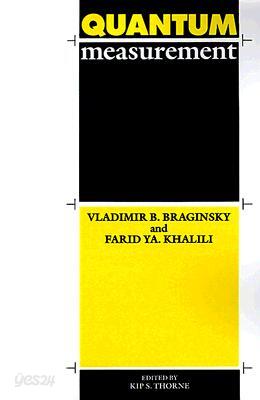
- 주문 제작 (POD) 도서로 제본 및 인쇄 품질이 다소 미흡할 수 있습니다 (해당 사유 반품 불가)
이미 소장하고 있다면 판매해 보세요.
- 국내배송만 가능
- 해외 거래처 사정에 의하여 품절/지연 가능
- 도서 정보 중 미표기 사항 안내?
- 문화비소득공제 가능
책소개
목차
|
Editor's Foreword xiii
Notation xvii Chapter I Historical introduction: photons and measurements using photons 1 1.1 The discovery of photons 2 1.2 The wave and particle properties of photons 4 1.3 The Heisenberg uncertainty relations 7 1.4 When do macroscopic objects behave quantum mechanically? 12 1.5 Overview of this book 15 Chapter II The main principles of quantum mechanics 17 2.1 The wave function 17 2.2 Probabilistic interpretation of the wave function 19 2.3 Single measurements and ensembles of measurements 21 2.4 Reduction of a quantum state 24 2.5 von Neumann's postulate of reduction 27 2.6 Orthogonal measurements 30 2.7 Nonorthogonal measurements 32 2.8 Back action of the measuring device on the measured object 35 Chapter III Indirect measurements 38 3.1 The two main types of quantum measurements 38 3.2 An electron as the quantum probe 41 3.3 Electron probe -- detailed analysis 44 3.4 Formal description of an indirect measurement 46 Chapter IV Quantum nondemolition measurements 50 4.1 The standard quantum limit for the energy of an oscillator 50 4.2 How can one overcome the standard quantum limit? 53 4.3 The ponderomotive probe for energy 57 4.4 Criteria for QND measurements 60 Chapter V Linear measurements 64 5.1 The measurement process and the uncertainty relation 64 5.2 Measurement accuracy and perturbations for linear measurements 67 5.3 Sequences of linear measurements 70 Chapter VI Continuous linear measurements 76 6.1 Discrete and continuous measurements 76 6.2 Uncertainty relations for continuous linear measurements 77 6.3 Uncertainty relations for continuous linear measurements--rigorous analysis 82 6.4 Linear, quantum 2N-pole systems 84 6.5 The spectral representation 87 6.6 Internal fluctuations of a linear measuring device 89 Chapter VII Nonlinear systems for continuous measurements 93 7.1 Fluctuational and dynamical back action of the measuring device 93 7.2 Quantum Zeno paradox for exact measurements 95 7.3 The equation of motion for the density operator during a continuous monitoring 97 7.4 Quantum Zeno paradox for approximate measurements 101 Chapter VIII Detection of classical forces 105 8.1 Aspects of quantum limits for the detection of a classical force 105 8.2 Quantum probe oscillator 109 8.3 Continuous quantum nondemolition monitoring 112 8.4 Standard quantum limit for an oscillator 115 8.5 Optimal detection of a classical force 118 8.6 A probe oscillator coupled to a sensor that continuously monitors its number of quanta 122 Chapter IX Energetic quantum limitations 125 9.1 The energy of the probe and the minimum detectable force 125 9.2 Energetic limits on sensitivity: general analysis 129 9.3 Distinguishing evolutionary paths of a quantum object from each other 132 Chapter X Devices for measuring small mechanical displacements 136 10.1 Parametric transducer for mechanical displacements 136 10.2 Capacity transducer 139 10.3 Fluctuations in a capacity transducer in the stationary regime 143 10.4 Capacity transducer used to detect weak forces: stationary regime 148 10.5 Capacity transducer: nonstationary regime 151 10.6 Frequency upconverter 154 10.7 Capacity transducer with two-side-band pumping 157 Chapter XI Quantum nondemolition measurements of a resonator's energy 160 11.1 Review of methods of measurement 160 11.2 Measuring device based on cubic dielectric nonlinearity 162 11.3 The role of dissipation 165 11.4 Resonator coupled to a waveguide 167 Chapter XII Nonclassical states of electromagnetic waves as tools for quantum measurements 172 12.1 Quantum properties of a traveling electromagnetic wave 172 12.2 QND measurements of the energy of a traveling electromagnetic wave 175 12.3 Frequency-anticorrelated quantum state 178 12.4 Doppler measurements with frequency-anticorrelated photons 180 12.5 Statistical properties of a wave packet with a definite number of quanta 183 Conclusion 186 References 188 Subject Index 192 |
저자 소개 1
Kip S. Thorne
미국의 이론물리학자. 1962년 캘리포니아공과대학교를 졸업하고 1965년 프린스턴대학교에서 박사학위를 받았다. 1967년부터 캘리포니아공과대학교에서 조교수로 일했고 석좌교수를 거쳐 현재 이론물리학 명예교수로 있다. 연구 분야는 아인슈타인의 일반상대성 이론과 천체물리학이며 특히 블랙홀, 중력파를 다룬다. 중력파 검출기를 건설하는 LIGO 프로젝트를 이끌었으며 2016년 2월 중력파의 존재를 탐지해 ‘제2의 노벨상’이라 불리는 카블리상Kavli Prize을 받았고 2017년 같은 공로로 노벨 물리학상을 받았다. 지난 2014년에는 SF영화 〈인터스텔라〉의 과학자문위원 겸 총괄제작자로
미국의 이론물리학자. 1962년 캘리포니아공과대학교를 졸업하고 1965년 프린스턴대학교에서 박사학위를 받았다. 1967년부터 캘리포니아공과대학교에서 조교수로 일했고 석좌교수를 거쳐 현재 이론물리학 명예교수로 있다. 연구 분야는 아인슈타인의 일반상대성 이론과 천체물리학이며 특히 블랙홀, 중력파를 다룬다. 중력파 검출기를 건설하는 LIGO 프로젝트를 이끌었으며 2016년 2월 중력파의 존재를 탐지해 ‘제2의 노벨상’이라 불리는 카블리상Kavli Prize을 받았고 2017년 같은 공로로 노벨 물리학상을 받았다. 지난 2014년에는 SF영화 〈인터스텔라〉의 과학자문위원 겸 총괄제작자로 참여하기도 했다. 저서로는 1973년에 쓴 《Gravitation》(공저)이 지금까지 과학도들에게 일반상대성 이론의 교과서로 사랑받고 있으며, 이 외에 《인터스텔라의 과학》, 《시공간의 미래》(공저) 등이 있다.
킵손의 다른 상품
-
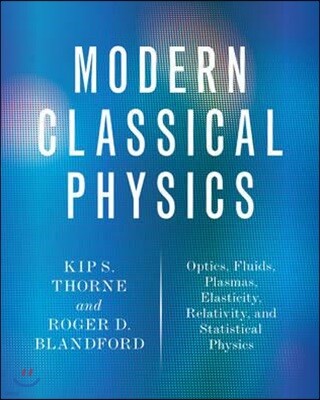
Modern Classical Physics: Optics, Fluids, Plasmas, Elasticity, Relativity, and Statistical Physics 이동Modern Classical Physics: Optics, Fluids, Plasmas, Elasticity, Relativity, and Statistical Physics226,120원 10%
-
Black Holes & Time Warps: Einstein's Outrageous Legacy 이동Black Holes & Time Warps: Einstein's Outrageous Legacy27,450원 18%

품목정보
- 발행일
- 1995년 05월 01일
- 쪽수, 무게, 크기
- 212쪽 | 299g | 150*230*12mm
- ISBN13
- 9780521484138
사락 별점0
혜택 및 유의사항밑줄0
혜택 및 유의사항상품정보안내
직수입외서의 경우, 해외거래처에서 제공하는 정보가 부족하여 제목, 표지, 가격, 유통상태 등의 정보가 미비하거나 변경되는 경우가 있습니다. 정확한 확인을 원하시는 경우, 일대일 상담으로 문의하여 주시면 답변 드리겠습니다.
(판형과 판수 등이 다양한 도서는 찾으시는 도서의 ISBN을 알려 주시면 보다 빠르고 정확한 안내가 가능합니다.)
해외거래처에서 품절인 경우, 2차 거래선을 통해 유럽과 미국 출판사로 직접 수입이 진행될 수 있습니다.
수입 진행 시점으로 부터 2~3주가 추가로 소요되며, 해외에서도 유통이 원활하지 않은 도서는 품절 안내가 지연될 수 있습니다.
해당 경우, 문자와 메일로 별도 안내를 드리고 있사오니 마이페이지에서 휴대전화번호와 메일주소를 다시 한번 확인해주시기 바랍니다.
(판형과 판수 등이 다양한 도서는 찾으시는 도서의 ISBN을 알려 주시면 보다 빠르고 정확한 안내가 가능합니다.)
해외거래처에서 품절인 경우, 2차 거래선을 통해 유럽과 미국 출판사로 직접 수입이 진행될 수 있습니다.
수입 진행 시점으로 부터 2~3주가 추가로 소요되며, 해외에서도 유통이 원활하지 않은 도서는 품절 안내가 지연될 수 있습니다.
해당 경우, 문자와 메일로 별도 안내를 드리고 있사오니 마이페이지에서 휴대전화번호와 메일주소를 다시 한번 확인해주시기 바랍니다.
145,720원
총 1개
145,720원
