

소득공제
외서
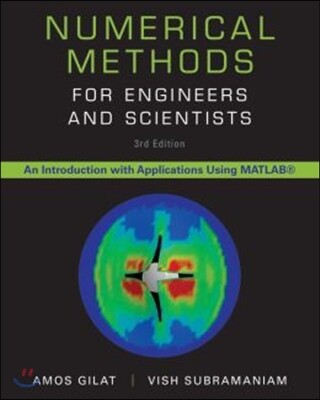
Numerical Methods for Engineers and Scientists: An Introduction with Applications Using MATLAB
An Introduction With Applications Using MATLAB
Hardcover, 3rd Edition
Gilat, Amos / Subramaniam, Vish
Wiley
2013.10.14.
이미 소장하고 있다면 판매해 보세요.
- 국내배송만 가능
- 문화비소득공제 가능
책소개
목차
|
Preface iii
Chapter 1 "Introduction" 1 1.1 Background 1 1.2 Representation of Numbers on a Computer 4 1.3 Errors in Numerical Solutions 10 1.4 Computers and Programming 15 1.5 Problems 18 Chapter 2 "Mathematical Background" 23 2.1 Background 23 2.2 Concepts from Pre-Calculus and Calculus 24 2.3 Vectors 28 2.4 Matrices and Linear Algebra 32 2.5 Ordinary Differential Equations (ODE) 41 2.6 Functions of Two or More Independent Variables 44 2.7 Taylor Series Expansion of Functions 47 2.8 Inner Product and Orthogonality 50 2.9 Problems 51 Chapter 3 "Solving Nonlinear Equations" 57 3.1 Background 57 3.2 Estimation of Errors in Numerical Solutions 59 3.3 Bisection Method 61 3.4 Regula Falsi Method 64 3.5 Newton's Method 66 3.6 Secant Method 71 3.7 Fixed-Point Iteration Method 74 3.8 Use of MATLAB Built-In Functions for Solving Nonlinear Equations 77 3.9 Equations with Multiple Solutions 79 3.10 Systems of Nonlinear Equations 81 3.11 Problems 88 Chapter 4 "Solving a System of Linear Equations" 99 4.1 Background 99 4.2 Gauss Elimination Method 102 4.3 Gauss Elimination with Pivoting 112 4.4 Gauss-Jordan Elimination Method 115 4.5 LU Decomposition Method 118 4.6 Inverse of a Matrix 128 4.7 Iterative Methods 132 4.8 Use of MATLAB Built-In Functions for Solving a System of Linear Equations 136 4.9 Tridiagonal Systems of Equations 141 4.10 Error, Residual, Norms, and Condition Number 146 4.11 Ill-Conditioned Systems 151 4.12 Problems 155 Chapter 5 "Eigenvalues and Eigenvectors" 165 5.1 Background 165 5.2 The Characteristic Equation 167 5.3 The Basic Power Method 167 5.4 The Inverse Power Method 172 5.5 The Shifted Power Method 173 5.6 The QR Factorization and Iteration Method 174 5.7 Use of MATLAB Built-In Functions for Determining Eigenvalues and Eigenvectors 184 5.8 Problems 186 Chapter 6 "Curve Fitting and Interpolation" 193 6.1 Background 193 6.2 Curve Fitting with a Linear Equation 195 6.3 Curve Fitting with Nonlinear Equation by Writing the Equation in a Linear Form 201 6.4 Curve Fitting with Quadratic and Higher-Order Polynomials 205 6.5 Interpolation Using a Single Polynomial 210 6.6 Piecewise (Spline) Interpolation 223 6.7 Use of MATLAB Built-In Functions for Curve Fitting and Interpolation 236 6.8 Curve Fitting with a Linear Combination of Nonlinear Functions 238 6.9 Problems 241 Chapter 7 "Fourier Methods" 251 7.1 Background 251 7.2 Approximating a Square Wave by a Series of sine functions 254 7.3 General (Infinite) Fourier Series 257 7.4 Complex Form of the Fourier Series 262 7.5 The Discrete Fourier Series and Discrete Fourier transform 263 7.6 Complex Discrete Fourier Transform 269 7.7 Power (Energy) Spectrum 272 7.8 Aliasing and Nyquist Frequency 273 7.9 Alternative Forms of the Discrete Fourier Transform 278 7.10 Use of MATLAB Built-In Functions for Calculating Discrete Fourier Transform 279 7.11 Leakage and Windowing 284 7.12 Bandwidth and Filters 286 7.13 The Fast Fourier Transform (FFT) 288 7.14 Problems 298 Chapter 8 "Numerical Differentiation" 303 8.1 Background 303 8.2 Finite Difference Approximation of the Derivative 305 8.3 Finite Difference Formulas Using Taylor Series Expansion 310 8.4 Summary of Finite Difference Formulas for Numerical Differentiation 317 8.5 Differentiation Formulas Using Lagrange Polynomials 319 8.6 Differentiation Using Curve Fitting 320 8.7 Use of MATLAB Built-In Functions for Numerical Differentiation 320 8.8 Richardson's Extrapolation 322 8.9 Error in Numerical Differentiation 325 8.10 Numerical Partial Differentiation 327 8.11 Problems 330 Chapter 9 "Numerical Integration" 341 9.1 Background 341 "9.1.1 Overview of Approaches in Numerical Integration" 342 9.2 Rectangle and Midpoint Methods 344 9.3 Trapezoidal Method 346 9.4 Simpson's Methods 350 9.5 Gauss Quadrature 355 9.6 Evaluation of Multiple Integrals 360 9.7 Use of MATLAB Built-In Functions for Integration 362 9.8 Estimation of Error in Numerical Integration 364 9.9 Richardson's Extrapolation 366 9.10 Romberg Integration 369 9.11 Improper Integrals 372 9.12 Problems 374 Chapter 10 "Ordinary Differential Equations: Initial-Value" "Problems" 385 10.1 Background 385 10.2 Euler's Methods 390 10.3 Modified Euler's Method 401 10.4 Midpoint Method 404 10.5 Runge-Kutta Methods 405 10.6 Multistep Methods 417 "10.6.1 Adams-Bashforth Method" 418 "10.6.2 Adams-Moulton Method" 419 10.7 Predictor-Corrector Methods 420 10.8 System of First-Order Ordinary Differential Equations 422 10.9 Solving a Higher-Order Initial Value Problem 432 10.10 Use of MATLAB Built-In Functions for Solving Initial-Value Problems 437 10.11 Local Truncation Error in Second-Order Range-Kutta Method 447 10.12 Step Size for Desired Accuracy 448 10.13 Stability 452 10.14 Stiff Ordinary Differential Equations 454 10.15 Problems 457 Chapter 11 "Ordinary Differential Equations: Boundary-Value" "Problems" 471 11.1 Background 471 11.2 The Shooting Method 474 11.3 Finite Difference Method 482 11.4 Use of MATLAB Built-In Functions for Solving Boundary Value Problems 492 11.5 Error and Stability in Numerical Solution of Boundary Value Problems 497 11.6 Problems 499 Appendix A "Introductory MATLAB" 509 A.1 Background 509 A.2 Starting with MATLAB 509 A.3 Arrays 514 A.4 Mathematical Operations with Arrays 519 A.5 Script Files 524 A.6 Plotting 526 A.7 User-Defined Functions and Function Files 528 A.8 Anonymous Functions 530 A.9 Function functions 532 A.10 Subfunctions 535 A.11 Programming in MATLAB 537 "A.11.1 Relational and Logical Operators" 537 "A.11.2 Conditional Statements, if-else Structures" 538 "A.11.3 Loops" 541 A.12 Problems 542 Appendix B "MATLAB Programs" 547 Appendix C "Derivation of the Real Discrete Fourier Transform" 551 C.1 Orthogonality of Sines and Cosines for Discrete Points 551 C.2 Determination of the Real DFT 553 Index 555 |
저자 소개
Amos Gilat, Ph.D., is Professor of Mechanical Engineering at The Ohio State University. Dr. Gillat’s main research interests are in plasticity, specifically, in developing experimental techniques for testing materials over a wide range of strain rates and temperatures and in investigating constitutive relations for viscoplasticity. Dr. Gilat's research has been supported by the National Science Foundation, NASA, Federal Aviation Administration, Department of Defense, and various industries.
Vish Subramaniam, Ph.D., is a Professor of Mechanical Engineering & Chemical Physics at The Ohio State University. Dr. Subramaniam’s main research interests are in cancer detection and imaging, plasma and laser physics and processes, particularly those that involve non-equilibirum phenomena. Dr. Subramaniam's research is both experimental and computational, and has been supported by The Department of Defense, National Science Foundation, and numerous industries.
품목정보
- 발행일
- 2013년 10월 14일
- 쪽수, 무게, 크기
- 559쪽 | 1160g | 206*257*35mm
- ISBN13
- 9781118554937
사락 별점0
혜택 및 유의사항밑줄0
혜택 및 유의사항상품정보안내
직수입외서의 경우, 해외거래처에서 제공하는 정보가 부족하여 제목, 표지, 가격, 유통상태 등의 정보가 미비하거나 변경되는 경우가 있습니다. 정확한 확인을 원하시는 경우, 일대일 상담으로 문의하여 주시면 답변 드리겠습니다.
(판형과 판수 등이 다양한 도서는 찾으시는 도서의 ISBN을 알려 주시면 보다 빠르고 정확한 안내가 가능합니다.)
해외거래처에서 품절인 경우, 2차 거래선을 통해 유럽과 미국 출판사로 직접 수입이 진행될 수 있습니다.
수입 진행 시점으로 부터 2~3주가 추가로 소요되며, 해외에서도 유통이 원활하지 않은 도서는 품절 안내가 지연될 수 있습니다.
해당 경우, 문자와 메일로 별도 안내를 드리고 있사오니 마이페이지에서 휴대전화번호와 메일주소를 다시 한번 확인해주시기 바랍니다.
(판형과 판수 등이 다양한 도서는 찾으시는 도서의 ISBN을 알려 주시면 보다 빠르고 정확한 안내가 가능합니다.)
해외거래처에서 품절인 경우, 2차 거래선을 통해 유럽과 미국 출판사로 직접 수입이 진행될 수 있습니다.
수입 진행 시점으로 부터 2~3주가 추가로 소요되며, 해외에서도 유통이 원활하지 않은 도서는 품절 안내가 지연될 수 있습니다.
해당 경우, 문자와 메일로 별도 안내를 드리고 있사오니 마이페이지에서 휴대전화번호와 메일주소를 다시 한번 확인해주시기 바랍니다.
55,000원
총 1개
55,000원