
소득공제
수입
직수입양서
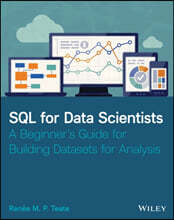
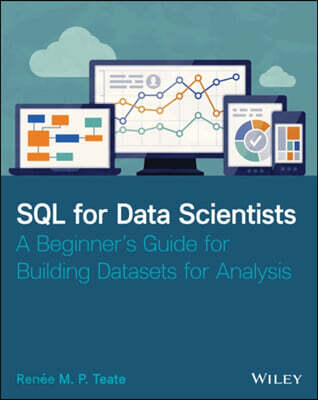
SQL for Data Scientists
A Beginner's Guide for Building Datasets for Analysis
Paperback, 1st Edition
Teate, Renee M. P.
Wiley
2021.09.15.
이미 소장하고 있다면 판매해 보세요.
- 국내배송만 가능
- 해외 거래처 사정에 의하여 품절/지연 가능
- 도서 정보 중 미표기 사항 안내?
- 문화비소득공제 가능
책소개
목차
|
Introduction xix Chapter 1 Data Sources 1 Data Sources 1 Tools for Connecting to Data Sources and Editing SQL 2 Relational Databases 3 Dimensional Data Warehouses 7 Asking Questions About the Data Source 9 Introduction to the Farmer’s Market Database 11 A Note on Machine Learning Dataset Terminology 12 Exercises 13 Chapter 2 The SELECT Statement 15 The SELECT Statement 15 The Fundamental Syntax Structure of a SELECT Query 16 Selecting Columns and Limiting the Number of Rows Returned 16 The ORDER BY Clause: Sorting Results 18 Introduction to Simple Inline Calculations 20 More Inline Calculation Examples: Rounding 22 More Inline Calculation Examples: Concatenating Strings 24 Evaluating Query Output 26 SELECT Statement Summary 29 Exercises Using the Included Database 30 Chapter 3 The WHERE Clause 31 The WHERE Clause 31 Filtering SELECT Statement Results 32 Filtering on Multiple Conditions 34 Multi-Column Conditional Filtering 40 More Ways to Filter 41 BETWEEN 41 IN 42 LIKE 43 IS NULL 44 A Warning About Null Comparisons 44 Filtering Using Subqueries 46 Exercises Using the Included Database 47 Chapter 4 CASE Statements 49 CASE Statement Syntax 50 Creating Binary Flags Using CASE 52 Grouping or Binning Continuous Values Using CASE 53 Categorical Encoding Using CASE 56 CASE Statement Summary 59 Exercises Using the Included Database 60 Chapter 5 SQL JOINs 61 Database Relationships and SQL JOINs 61 A Common Pitfall when Filtering Joined Data 71 JOINs with More than Two Tables 74 Exercises Using the Included Database 76 Chapter 6 Aggregating Results for Analysis 79 GROUP BY Syntax 79 Displaying Group Summaries 80 Performing Calculations Inside Aggregate Functions 84 MIN and MAX 88 COUNT and COUNT DISTINCT 90 Average 91 Filtering with HAVING 93 CASE Statements Inside Aggregate Functions 94 Exercises Using the Included Database 96 Chapter 7 Window Functions and Subqueries 97 ROW NUMBER 98 RANK and DENSE RANK 101 NTILE 102 Aggregate Window Functions 103 LAG and LEAD 108 Exercises Using the Included Database 111 Chapter 8 Date and Time Functions 113 Setting datetime Field Values 114 EXTRACT and DATE_PART 115 DATE_ADD and DATE_SUB 116 DATEDIFF 118 TIMESTAMPDIFF 119 Date Functions in Aggregate Summaries and Window Functions 119 Exercises 126 Chapter 9 Exploratory Data Analysis with SQL 127 Demonstrating Exploratory Data Analysis with SQL 128 Exploring the Products Table 128 Exploring Possible Column Values 131 Exploring Changes Over Time 134 Exploring Multiple Tables Simultaneously 135 Exploring Inventory vs. Sales 138 Exercises 142 Chapter 10 Building SQL Datasets for Analytical Reporting 143 Thinking Through Analytical Dataset Requirements 144 Using Custom Analytical Datasets in SQL: CTEs and Views 149 Taking SQL Reporting Further 153 Exercises 157 Chapter 11 More Advanced Query Structures 159 UNIONs 159 Self-Join to Determine To-Date Maximum 163 Counting New vs. Returning Customers by Week 167 Summary 171 Exercises 171 Chapter 12 Creating Machine Learning Datasets Using SQL 173 Datasets for Time Series Models 174 Datasets for Binary Classification 176 Creating the Dataset 178 Expanding the Feature Set 181 Feature Engineering 185 Taking Things to the Next Level 189 Exercises 189 Chapter 13 Analytical Dataset Development Examples 191 What Factors Correlate with Fresh Produce Sales? 191 How Do Sales Vary by Customer Zip Code, Market Distance, and Demographic Data? 211 How Does Product Price Distribution Affect Market Sales? 217 Chapter 14 Storing and Modifying Data 229 Storing SQL Datasets as Tables and Views 229 Adding a Timestamp Column 232 Inserting Rows and Updating Values in Database Tables 233 Using SQL Inside Scripts 236 In Closing 237 Exercises 238 Appendix Answers to Exercises 239 Index 255 |
저자 소개
RENEE M. P. TEATE is the Director of Data Science at HelioCampus, a higher ed tech startup based in the Washington, DC area. She prepares datasets with SQL, develops predictive models with Python, and designs interactive dashboards in Tableau for university decision-makers. She created the “Becoming a Data Scientist” podcast, helped build the data science learning community on Twitter, and is a sought-after speaker at industry conferences.
품목정보
- 발행일
- 2021년 09월 15일
- 쪽수, 무게, 크기
- 288쪽 | 183*226*20mm
- ISBN13
- 9781119669364
사락 별점0
혜택 및 유의사항밑줄0
혜택 및 유의사항상품정보안내
직수입외서의 경우, 해외거래처에서 제공하는 정보가 부족하여 제목, 표지, 가격, 유통상태 등의 정보가 미비하거나 변경되는 경우가 있습니다. 정확한 확인을 원하시는 경우, 일대일 상담으로 문의하여 주시면 답변 드리겠습니다.
(판형과 판수 등이 다양한 도서는 찾으시는 도서의 ISBN을 알려 주시면 보다 빠르고 정확한 안내가 가능합니다.)
해외거래처에서 품절인 경우, 2차 거래선을 통해 유럽과 미국 출판사로 직접 수입이 진행될 수 있습니다.
수입 진행 시점으로 부터 2~3주가 추가로 소요되며, 해외에서도 유통이 원활하지 않은 도서는 품절 안내가 지연될 수 있습니다.
해당 경우, 문자와 메일로 별도 안내를 드리고 있사오니 마이페이지에서 휴대전화번호와 메일주소를 다시 한번 확인해주시기 바랍니다.
(판형과 판수 등이 다양한 도서는 찾으시는 도서의 ISBN을 알려 주시면 보다 빠르고 정확한 안내가 가능합니다.)
해외거래처에서 품절인 경우, 2차 거래선을 통해 유럽과 미국 출판사로 직접 수입이 진행될 수 있습니다.
수입 진행 시점으로 부터 2~3주가 추가로 소요되며, 해외에서도 유통이 원활하지 않은 도서는 품절 안내가 지연될 수 있습니다.
해당 경우, 문자와 메일로 별도 안내를 드리고 있사오니 마이페이지에서 휴대전화번호와 메일주소를 다시 한번 확인해주시기 바랍니다.
69,700원
총 1개
69,700원