
소득공제
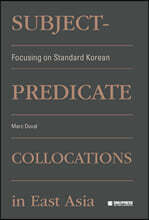
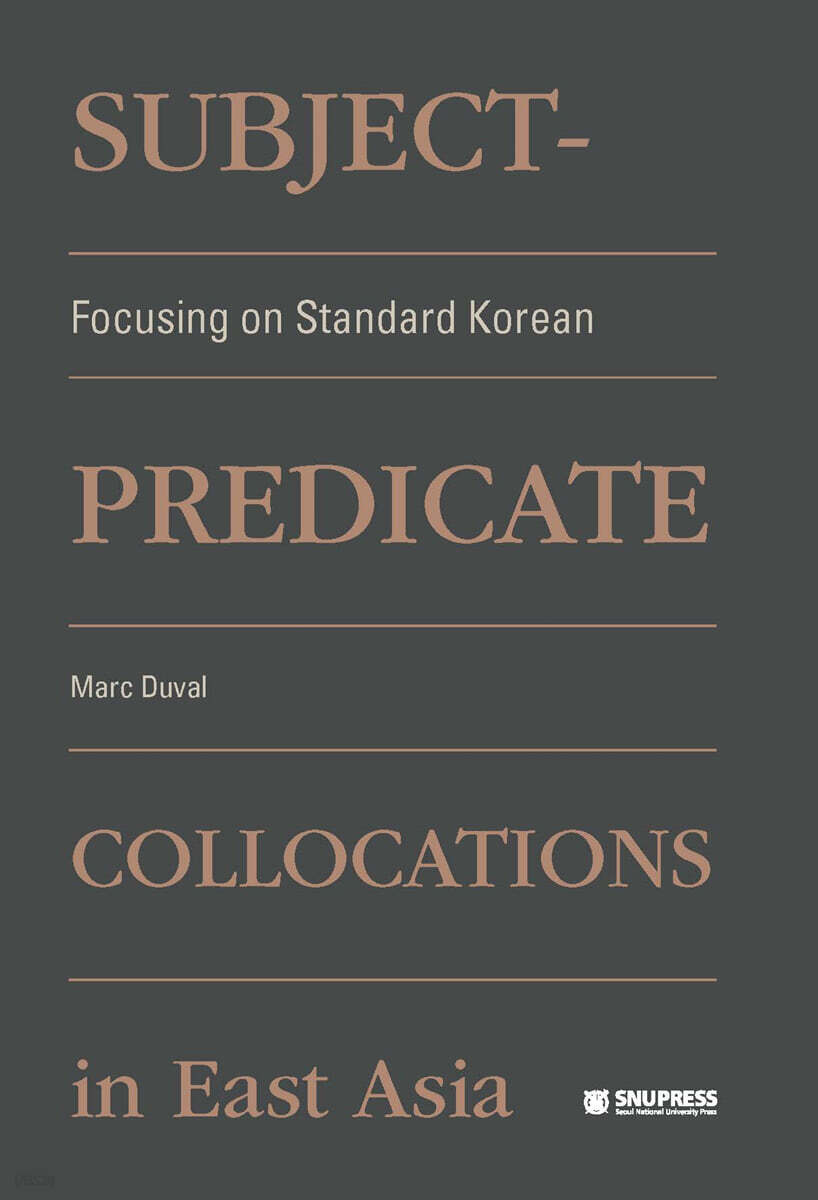
Subject-Predicate Collocations in East Asia
Focusing on Standard Korean
서울대학교출판문화원
2022.01.25.
- 베스트
- 어문학 계열 top100 1주
이미 소장하고 있다면 판매해 보세요.
- 국내배송만 가능
- 문화비소득공제 가능
책소개
목차
|
Preface and Acknowledgments
Notes on transliteration List of abbreviations Introduction ① Scope of the study 1. Preliminaries 2. Compounds, noun incorporation, and idiomatic expressions 3. Subjects in idioms and compounds 4. Problems related to the recognition of verbal compounds in Korean ② Significance of the study 1. Theoretical implications: Subject properties and behavior 2. Descriptive implications: Subject-Predicate Collocations in East Asia 3. Lexicographic applications ③ Organization of this work Chap. 1 On Subjects, Predicates and Compounds in Asian Languages ① Delimiting the frame: S, P, and C 1. Predicates: Verbs, adjectives... and nouns 2. Subjects in Asian languages 3. Loci for subjects in SPC ② Syntactic reversibility in Chinese and SEAn languages ③ Illustration of compound properties in Asian languages 1. Sandhi phenomena and suprasegmental integration in Japanese 2. Morphological and syntactic integration 3. Other criteria and the fuzzy distinction between compounds and collocations Chap. 2 SPC in Standard Korean ① General remarks 1. Subjects in Korean 2. Word-like availability of Subject-Predicate sequences 3. Towards a classification of Korean SPC ② An overview of integration properties 1. Phonological changes 2. Morpho-syntactic integrity 3. Functional hints to wordhood: categorial change ③ Conclusion Chap. 3 Paradigmatic Choice and the Margins of Syntax ① Introduction: Optional arguments and argument-like adjuncts 1. Some diagnostic tests for Spoken French 2. The notion rection large (wide government) 3. Paradigmatic interpretation ② Delimiter particle insertion in Korean and the argument/adjunct~disjunct opposition 1. Nominal functions 2. Adverbial functions 3. Negative proforms ③ Fake arguments in compounds and collocations 1. Introduction: Classic diagnostic tests for compounding 2. Fake arguments in collocational sequences 3. The syllepsis principle 4. Towards a three-leveled syntax Conclusion References Index |
저자 소개 1
Marc Duval is associate professor of linguistics at Sorbonne University. His research interests include Korean linguistics, linguistic typology (with a focus on modality and lexicology), and dialectology (mostly in the Gallo-Roman context). He has published two monographs on modality from a contrastive and typological perspec
Marc Duval is associate professor of linguistics at Sorbonne University. His research interests include Korean linguistics, linguistic typology (with a focus on modality and lexicology), and dialectology (mostly in the Gallo-Roman context). He has published two monographs on modality from a contrastive and typological perspective, L’interrogation indirecte totale en coreen(2009), and Les marques du scenario modal(2017)
품목정보
- 발행일
- 2022년 01월 25일
- 쪽수, 무게, 크기
- 224쪽 | 153*225*20mm
- ISBN13
- 9788952129901
사락 별점0
혜택 및 유의사항밑줄0
혜택 및 유의사항
55,000원
총 1개
55,000원
