
소득공제
수입
직수입양서
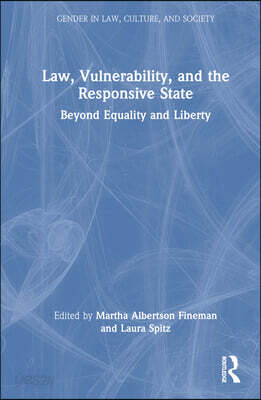
Law, Vulnerability, and the Responsive State
Beyond Equality and Liberty
Hardback, 1st Edition
Fineman, Martha Albertson / Spitz, Laura
Routledge
2023.10.09.
이미 소장하고 있다면 판매해 보세요.
- 국내배송만 가능
- 해외 거래처 사정에 의하여 품절/지연 가능
- 도서 정보 중 미표기 사항 안내?
- 문화비소득공제 가능
Gender in Law, Culture, and Society
-
 Gender, Punishment and the Maternal Subject of Law 이동Gender, Punishment and the Maternal Subject of Law10% 356,010원
 -
Assisted Reproduction, Vulnerability and the Global Market 이동Assisted Reproduction, Vulnerability and the Global Market10% 217,350원
-
Gender, Vulnerability Theory and Public Procurement 이동Gender, Vulnerability Theory and Public Procurement10% 91,050원
-
Law, Vulnerability, and the Responsive State 이동Law, Vulnerability, and the Responsive State10% 86,910원
-
Law, Vulnerability, and the Responsive State 이동Law, Vulnerability, and the Responsive State10% 356,010원
-
Gender, Vulnerability Theory and Public Procurement 이동Gender, Vulnerability Theory and Public Procurement10% 356,010원
-
Vulnerability and the Legal Organization of Work 이동Vulnerability and the Legal Organization of Work10% 132,450원
-
Vulnerability and the Legal Organization of Work 이동Vulnerability and the Legal Organization of Work10% 356,010원
-
Privatization, Vulnerability, and Social Responsibility 이동Privatization, Vulnerability, and Social Responsibility10% 126,240원
-
Privatization, Vulnerability, and Social Responsibility 이동Privatization, Vulnerability, and Social Responsibility10% 356,010원
책소개
목차
|
List of Contributors Introduction: Understanding Vulnerability Martha Albertson Fineman I. The Fallacy and Foibles of Vulnerability as Particular II. Vulnerability Theory A. Reasoning From the Body B. Embedded-The Necessity of Social (and Legal) Arrangements III. Theoretical Implications of “Reasoning From the Body” IV. Conclusion PART I Legal Structures: The Constitution and the Mechanisms of Justice 1 Restructuring the Constitution for Human Resilience Martha T. McCluskey Introduction I. Structural Principles for Constitutional Power II. Contemporary Right-Wing Constitutional Restructuring III. Vulnerability Theory’s Constitutional Reframing IV. Affirming the Administrative State for Human Resilience V. Conclusion 2 Vulnerability Theory and Access to Justice: Elaborating Possibilities for Legal System Design Andrew Pilliar 1. Background on Access to Justice a. What Is “Access to Justice”? b. How Common Are Access to Justice Problems? 2. Situating Vulnerability a. Vulnerability Theory and Responsive Law b. Vulnerability Theory and the Capability Approach 3. Realizing Person-Centred Access to Justice 4. Conclusion PART II Role of Social Movements in Vulnerability Theory 3 Toward a Responsive Landscape: The Role of Social Movements in Vulnerability Theory Kathryn Abrams Introduction I. Learning From Social Movements: Cultivating Resilience in Arizona II. Social Movements and Vulnerability Theory: Three Questions A. Do Social Movements Help to Meet Human Vulnerability? III. How Does the Work of Social Movements Relate to the Activity of the Responsive State? A. Density and Effects of Regulatory Frameworks IV. Directions for Vulnerability Theory 4 Law, Public Policy, and Social Movements to Support and Strengthen Individual and Collective Interests of Labor Risa L. Lieberwitz Introduction I. The Role of the State to Provide for the Public Welfare A. The Vision of the Responsive State B. The Reality of the Unresponsive State in the U.S. II. The Role of the State in the Employment Relationship A. The “Private Welfare” System in the U.S. B. The Liberal Contradictions of the National Labor Relations Act C. Legislative Reforms to Move Toward a Responsive State D. Recent Legal and Social Developments that Resonate With the Reforms of the PRO Act III. Conclusion PART III Organizing the Economic Infrastructure 5 The Corporation, Vulnerability, and Resilience Lua Kamal Yuille Introduction I. Vulnerability, the Human Condition, and the Liberal Legal Subject II. Understanding Resilience III. The Corporation as a Site of Resilience A. Conceiving of the Corporation B. Corporate Resilience IV. Toward a Responsive State Approach to the Corporation 6 Market Citizenship, Resilience Drainage, and the Role of Private Law Hila Keren and Ronit Donyets-Kedar Introduction I. The Private-Public Divide and the Role of Private Law II. Resisting Resilience Drainage via Contract Law A. The Problem: Market Rejections and Humiliation B. A Vulnerability-Based Response III. Resisting Resilience Drainage via Corporate Law A. The Problem of Market Evangelism B. A Vulnerability-Based Response IV. Conclusion PART IV The Public Nature of “Private” Property 7 Housing Trusts and Resilient Cities: Hierarchy, Resources, and Resilience Marc L. Roark Vulnerability and Affordable Housing Resilience Affordable Housing as an Inherent Vulnerability How Cities Sought Resilience in the Form of Housing Trust Funds Scale, Resilience Gaps, and Responsibility 8 Vulnerability, Resilience, and the Fair Housing Act Xiaoqian Hu I. Some Limits of the FHA A. Excessive Deference to Defense B. Illegal Immorality Versus Legal Privilege C. A Vulnerability Evaluation II. Reinterpreting the FHA Through Vulnerability Theory A. A Social-Situational View of Harm and Discrimination B. A Reconceptualized State for Systemic Action III. Conclusion PART V The Ultimate “Private” Space-The Construction of the Family 9 The Elder Catch: Engineering the Future of Caregiving Jessica Dixon Weaver I. Vulnerability Theory and Resistant Assets A. The Taxonomy of Vulnerability Theory B. Resistant Assets and the Non-Responsive State II. The Family as a Resistant Asset III. State and Market Response to the Elder Catch 10 Vulnerability Theory and the Conception of Time June Carbone and Naomi Cahn Part I: The Pandemic Part II: Secure Versus Precarious Family Regimes Part III: Vulnerability Theory PART VI Dimensions of Public and Private in Health Care 11 A Vulnerability Approach to the “Right to Health Care”: Addressing Epistemic Vulnerability Matthew B. Lawrence Introduction A. The “Right to Health Care” and the Challenges of an Entitlement Approach 1. The Popular “Right to Health Care” 2. Operationalizing the “Right to Health Care”: The Role of Theory 3. Entitlement Approach and Its Limitations B. Vulnerability Approach: From Entitlement to Obligation 1. Vulnerability Replaces Individual Entitlement With Collective (or State) Obligation 2. What Is the Content of the State’s Obligation? 3. A Collective, Procedural Right to Priority C. Addressing Epistemic Vulnerability 1. Epistemic Vulnerability 2. Respond or Reject? 3. Separating Stepping Stones From Stumbling Blocks 12 Disability, Vulnerability, and Public Health Emergencies Ani B. Satz Introduction I. Limits of Current Approaches II. Reasoning From the Body III. Disability, the Vulnerable Subject, and Health Law IV. Disability and the Vulnerable Institution: Hospitals and Public Health Authorities V. Disability and Resilience in Public Health Emergencies VI. Conclusion PART VII Vulnerability and Sovereignty 13 Using Vulnerability Theory to Reconceive the Relationships Between Native Nations, the United States, and State Governments Nazune Menka and Laura Spitz Introduction I. (Dependent) Sovereignty a. Background: Sovereignty and Liberalism b. Domestic Dependent Nations II. Using Vulnerability Theory to Reconceptualize Sovereignty and the Doctrines of Plenary Power and Trust Responsibility a. Assertion of Tribal Sovereignty Remains a Critical Component of Inherent Indigenous Power b. Sovereignty Is Inter-Dependent c. Indigenous Peoples Are Not a Vulnerable Population d. Trust Responsibility Can and Should Be Detached From the Doctrine of Plenary Power III. A Contemporary Example: The Indian Child Welfare Act IV. Conclusion: Vulnerability Theory, Tribal Sovereignty and Federal Responsibility Index |
관련 분류
품목정보
- 발행일
- 2023년 10월 09일
- 쪽수, 무게, 크기
- 274쪽 | 700g | 160*230*234mm
- ISBN13
- 9781032346656
리뷰/한줄평0
상품정보안내
직수입외서의 경우, 해외거래처에서 제공하는 정보가 부족하여 제목, 표지, 가격, 유통상태 등의 정보가 미비하거나 변경되는 경우가 있습니다. 정확한 확인을 원하시는 경우, 일대일 상담으로 문의하여 주시면 답변 드리겠습니다.
(판형과 판수 등이 다양한 도서는 찾으시는 도서의 ISBN을 알려 주시면 보다 빠르고 정확한 안내가 가능합니다.)
해외거래처에서 품절인 경우, 2차 거래선을 통해 유럽과 미국 출판사로 직접 수입이 진행될 수 있습니다.
수입 진행 시점으로 부터 2~3주가 추가로 소요되며, 해외에서도 유통이 원활하지 않은 도서는 품절 안내가 지연될 수 있습니다.
해당 경우, 문자와 메일로 별도 안내를 드리고 있사오니 마이페이지에서 휴대전화번호와 메일주소를 다시 한번 확인해주시기 바랍니다.
(판형과 판수 등이 다양한 도서는 찾으시는 도서의 ISBN을 알려 주시면 보다 빠르고 정확한 안내가 가능합니다.)
해외거래처에서 품절인 경우, 2차 거래선을 통해 유럽과 미국 출판사로 직접 수입이 진행될 수 있습니다.
수입 진행 시점으로 부터 2~3주가 추가로 소요되며, 해외에서도 유통이 원활하지 않은 도서는 품절 안내가 지연될 수 있습니다.
해당 경우, 문자와 메일로 별도 안내를 드리고 있사오니 마이페이지에서 휴대전화번호와 메일주소를 다시 한번 확인해주시기 바랍니다.
356,010원
총 1개
356,010원