
소득공제
수입
직수입양서
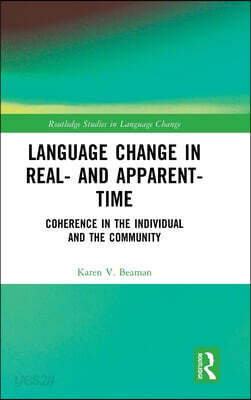
Language Change in Real- and Apparent-Time
Coherence in the Individual and the Community
Hardback, 1st Edition
Beaman, Karen V.
Routledge
2024.03.27.
이미 소장하고 있다면 판매해 보세요.
- 국내배송만 가능
- 해외 거래처 사정에 의하여 품절/지연 가능
- 도서 정보 중 미표기 사항 안내?
- 문화비소득공제 가능
Routledge Studies in Language Change
-
 Expanding Variationist Sociolinguistic Research in Varieties of German 이동Expanding Variationist Sociolinguistic Research in Varieties of German10% 98,790원
-
Connecting the Individual and the Community in Sociolinguistic Panel Research 이동Connecting the Individual and the Community in Sociolinguistic Panel Research15% 334,400원
-
Language Change in Real- and Apparent-Time 이동Language Change in Real- and Apparent-Time10% 98,790원
-
Language Change From Adolescence to Adulthood 이동Language Change From Adolescence to Adulthood10% 236,750원
-
Expanding Variationist Sociolinguistic Research in Varieties of German 이동Expanding Variationist Sociolinguistic Research in Varieties of German10% 300,550원
-
Language Change in Real- and Apparent-Time 이동Language Change in Real- and Apparent-Time10% 354,070원
-
Urban Contact Dialects and Language Change 이동Urban Contact Dialects and Language Change10% 90,550원
-
Language Variation and Language Change Across the Lifespan 이동Language Variation and Language Change Across the Lifespan10% 90,550원
-
Urban Contact Dialects and Language Change 이동Urban Contact Dialects and Language Change10% 354,070원
-
Language variation and change in social networks 이동Language variation and change in social networks10% 102,910원
-
Language Variation and Language Change Across the Lifespan 이동Language Variation and Language Change Across the Lifespan10% 354,070원
-
Language variation and change in social networks 이동Language variation and change in social networks10% 354,070원
책소개
목차
|
Contents List of figures List of tables Acknowledgments Symbols and conventions Codes and abbreviations CHAPTER 1. INTRODUCTION TO LIFESPAN AND COMMUNITY CHANGE 1.1. Introduction 1.2. Challenges to the critical-period hypothesis 1.3. Approaches to studying language change 1.4. Individual and community patterns of linguistic change 1.5. Theoretical underpinnings and methodological framework for this book 1.6. Structure and contributions of this book CHAPTER 2. METHODS FOR THE STUDY OF REAL- AND APPARENT-TIME LANGUAGE CHANGE 2.1. Introduction 2.2. The Swabian language and people 2.3. The corpus 2.4. Data collection and preparation 2.4.1 Step 1: Sample selection 2.4.2 Step 2: Sociolinguistic interview 2.4.3 Step 3: Recording 2.4.4 Step 4: Transcription 2.4.5 Step 5: Validation 2.4.6 Step 6: Annotation 2.5. The linguistic variable(s) 2.5.1 Phonological variables 2.5.1 Morphosyntactic variables 2.6. Measuring dialect density 2.7. Socio-demographic factors of language change 2.7.1 Speaker community 2.7.2 Speaker gender 2.7.3 Speaker age 2.7.4 Speaker education 2.7.5 Speaker social class 2.8. Change in real- and apparent-time 2.9. Change across the lifespan 2.10. Individual and community change 2.11. Summary CHAPTER 3. THE SPEECH COMMUNITY AND URBAN?RURAL DIVIDE 3.1. Introduction 3.2. Speech communities 3.2.1 Stuttgart 3.2.2 Schwabisch Gmund 3.3. Urbanity and rurality 3.3.1 Regionality and dialect use 3.3.2 Community differences over time 3.3.3 The impact of higher education 3.4. The role of social networks 3.5. Coherence in the speech community 3.5.1 Covariation analysis 3.5.2 Measuring community coherence 3.5.3 Variable weightings 3.6. Summary CHAPTER 4. DIALECT CONTACT, LEVELING AND SUPRAREGIONALIZATION 4.1. Introduction 4.2. Dialect contact and leveling 4.3. Rise of supralocal and supraregional varieties 4.4. Standard language convergence 4.5. Dialect levelling in Swabia 4.5.1 Frequency distributional analysis 4.5.2 Lifespan and community change 4.5.3 Interactions between the linguistic and social 4.6. Indexicalities of linguistic variables 4.6.1 Variable family 4.6.2 Variable salience 4.6.3 Variable stigma 4.6.4 Variable status 4.7. Supraregionalization in Swabia 4.8. Summary CHAPTER 5. INDEXICALITIES OF IDENTITY, ACCOMMODATION, AND MOBILITY 5.1. Introduction 5.2. Linguistic accommodation 5.3. Local orientation and identity construction 5.4. Perpetual mobility and humanity 5.5. Cultural indices as indicators of dialect use 5.5.1 Local orientation 5.5.2 Interlocutor accommodation 5.5.3 Speaker mobility 5.6. Multivariate analysis 5.7. Summary CHAPTER 6. LIFESPAN AND COMMUNITY CHANGE ACROSS THE LINGUISTIC ARCHITECTURE 6.1. Introduction 6.2. (ai) diphthong 6.2.1 Background 6.2.2 Measuring diphthong trajectories 6.2.3 Diphthong change in real- and apparent-time 6.2.4 Local orientation and loss of diphthong contrast 6.2.5 Internal linguistic factors and diphthong change 6.2.6 The interaction of the linguistic and social 6.2.7 Discussion 6.3. wo-relatives 6.3.1 Background 6.3.2 The Linguistic variable and the envelope of variation 6.3.3 Frequency distribution of wo-relatives 6.3.4 Multivariate analysis of wo-relatives 6.3.5 Discussion 6.4. Summary CHAPTER 7. CONCLUSIONS AND LOOKING FORWARD 7.1. Introduction 7.2. Compatibility of combined panel and trend studies 7.3. Dialect leveling and supraregionalization in Swabian 7.4. Indexicalities and social meaning 7.5. Methodological and theoretical contributions to the field of sociolinguistics 7.6. Opportunities for future research 7.7. Summary Appendices Appendix A: Interview documents Appendix B: Data transcription conventions Appendix C: E2R data extraction and annotation process Appendix D: Swabian-German Lexicon References Index |
품목정보
- 발행일
- 2024년 03월 27일
- 쪽수, 무게, 크기
- 314쪽 | 780g | 150*230mm
- ISBN13
- 9781032212166
사락 별점0
혜택 및 유의사항밑줄0
혜택 및 유의사항상품정보안내
직수입외서의 경우, 해외거래처에서 제공하는 정보가 부족하여 제목, 표지, 가격, 유통상태 등의 정보가 미비하거나 변경되는 경우가 있습니다. 정확한 확인을 원하시는 경우, 일대일 상담으로 문의하여 주시면 답변 드리겠습니다.
(판형과 판수 등이 다양한 도서는 찾으시는 도서의 ISBN을 알려 주시면 보다 빠르고 정확한 안내가 가능합니다.)
해외거래처에서 품절인 경우, 2차 거래선을 통해 유럽과 미국 출판사로 직접 수입이 진행될 수 있습니다.
수입 진행 시점으로 부터 2~3주가 추가로 소요되며, 해외에서도 유통이 원활하지 않은 도서는 품절 안내가 지연될 수 있습니다.
해당 경우, 문자와 메일로 별도 안내를 드리고 있사오니 마이페이지에서 휴대전화번호와 메일주소를 다시 한번 확인해주시기 바랍니다.
(판형과 판수 등이 다양한 도서는 찾으시는 도서의 ISBN을 알려 주시면 보다 빠르고 정확한 안내가 가능합니다.)
해외거래처에서 품절인 경우, 2차 거래선을 통해 유럽과 미국 출판사로 직접 수입이 진행될 수 있습니다.
수입 진행 시점으로 부터 2~3주가 추가로 소요되며, 해외에서도 유통이 원활하지 않은 도서는 품절 안내가 지연될 수 있습니다.
해당 경우, 문자와 메일로 별도 안내를 드리고 있사오니 마이페이지에서 휴대전화번호와 메일주소를 다시 한번 확인해주시기 바랍니다.
354,070원
총 1개
354,070원
