
소득공제
수입
직수입양서
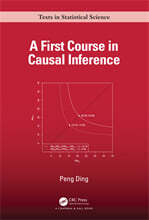
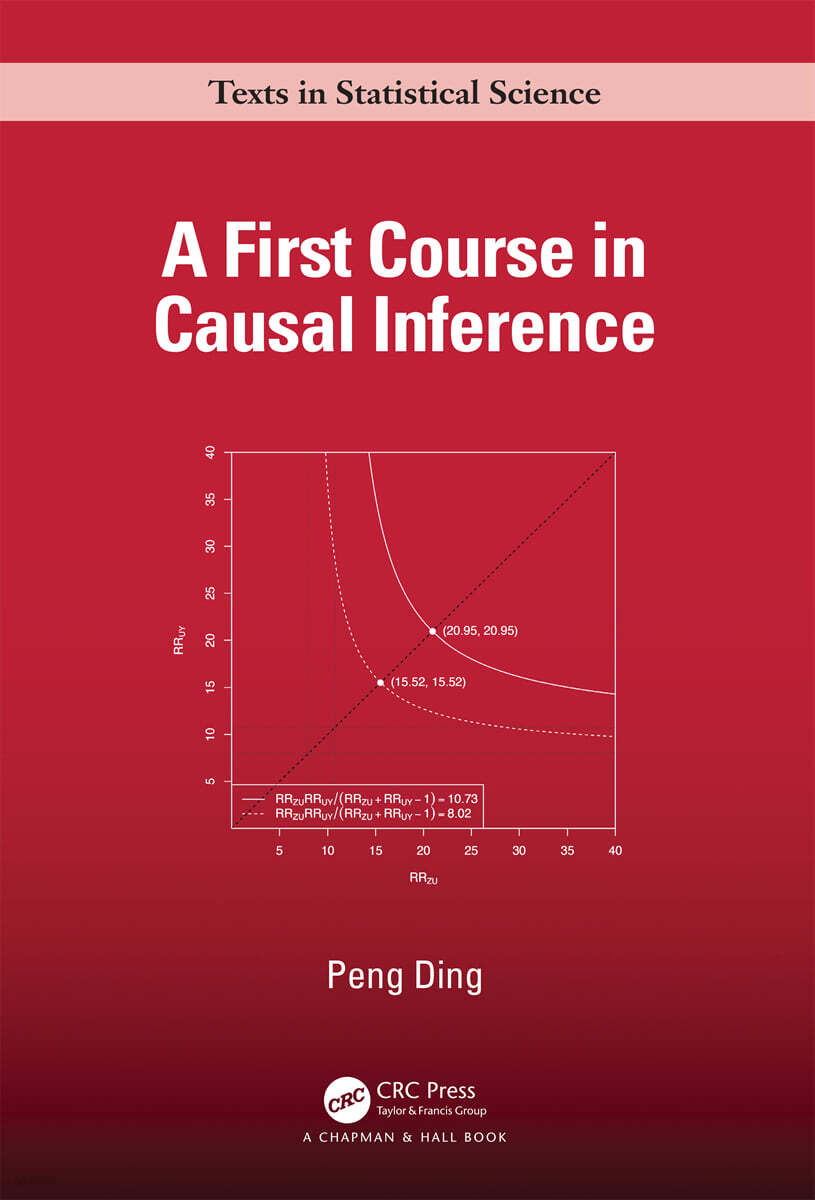
First Course in Causal Inference
Hardback, 1st Edition
Ding, Peng
Chapman and Hall/CRC
2024.07.31.
이미 소장하고 있다면 판매해 보세요.
- 국내배송만 가능
- 해외 거래처 사정에 의하여 품절/지연 가능
- 도서 정보 중 미표기 사항 안내?
- 문화비소득공제 가능
Chapman & Hall/CRC Texts in Statistical Science
-
 Introduction to Modern Randomization-Based Design and Analysis for Causal Inference 이동Introduction to Modern Randomization-Based Design and Analysis for Causal Inference10% 169,120원
 -
Regressions in Covariances, Dependencies and Graphs 이동Regressions in Covariances, Dependencies and Graphs10% 251,690원
-
Course in Large-Sample and High-Dimensional Theory 이동Course in Large-Sample and High-Dimensional Theory10% 209,400원
-
Course in Regression and Smoothing Methods 이동Course in Regression and Smoothing Methods10% 209,400원
-
Foundations of Bayesian Statistics for Data Scientists 이동Foundations of Bayesian Statistics for Data Scientists10% 346,330원
-
Foundations of Bayesian Statistics for Data Scientists 이동Foundations of Bayesian Statistics for Data Scientists10% 126,840원
-
Experimental Design for Data Science and Engineering 이동Experimental Design for Data Science and Engineering10% 209,400원
-
Exercises and Solutions in Probability and Statistics 이동Exercises and Solutions in Probability and Statistics10% 82,530원
-
Exercises and Solutions in Probability and Statistics 이동Exercises and Solutions in Probability and Statistics10% 293,980원
-
Introduction to General and Generalized Linear Models 이동Introduction to General and Generalized Linear Models10% 98,640원
책소개
목차
|
Preface Part1: Introduction 1. Correlation, Association, and the Yule?Simpson Paradox 2. Potential Outcomes Part2: Randomized experiments 3. The Completely Randomized Experiment and the Fisher Randomization Test 4. Neymanian Repeated Sampling Inference in Completely Randomized Experiments 5. Stratification and Post-Stratification in Randomized Experiments 6. Rerandomization and Regression Adjustment 7. Matched-Pairs Experiment 8. Unification of the Fisherian and Neymanian Inferences in Randomized Experiments 9. Bridging Finite and Super Population Causal Inference Part3: Observational studies 10. Observational Studies, Selection Bias, and Nonparametric Identification of Causal Effects 11. The Central Role of the Propensity Score in Observational Studies for Causal Effects 12. The Doubly Robust or the Augmented Inverse Propensity Score Weighting Estimator for the Average Causal Effect 13. The Average Causal Effect on the Treated Units and Other Estimands 14. Using the Propensity Score in Regressions for Causal Effects 15. Matching in Observational Studies Part4: Difficulties and challenges of observational studies 16. Difficulties of Unconfoundedness in Observational Studies for Causal Effects 17. E-Value: Evidence for Causation in Observational Studies with Unmeasured Confounding 18. Sensitivity Analysis for the Average Causal Effect with Unmeasured Confounding 19. Rosenbaum-Style p-Values for Matched Observational Studies with Unmeasured Confounding 20. Overlap in Observational Studies: Difficulties and Opportunities Part5: Instrumental variables 21. An Experimental Perspective of the Instrumental Variable 22. Disentangle Mixture Distributions and Instrumental Variable Inequalities 23. An Econometric Perspective of the Instrumental Variable 24. Application of the Instrumental Variable Method: Fuzzy Regression Discontinuity 25. Application of the Instrumental Variable Method: Mendelian Randomization Part6: Causal Mechanisms with Post-Treatment Variables 26. Principal Stratification 27. Mediation Analysis: Natural Direct and Indirect Effects 28. Controlled Direct Effect 29. Time-Varying Treatment and Confounding Part7: Appendices A. Probability and Statistics B. Linear and Logistic Regressions C. Some Useful Lemmas for Simple Random Sampling From a Finite Population |
품목정보
- 발행일
- 2024년 07월 31일
- 쪽수, 무게, 크기
- 422쪽 | 1080g | 180*250mm
- ISBN13
- 9781032758626
사락 별점0
혜택 및 유의사항밑줄0
혜택 및 유의사항상품정보안내
직수입외서의 경우, 해외거래처에서 제공하는 정보가 부족하여 제목, 표지, 가격, 유통상태 등의 정보가 미비하거나 변경되는 경우가 있습니다. 정확한 확인을 원하시는 경우, 일대일 상담으로 문의하여 주시면 답변 드리겠습니다.
(판형과 판수 등이 다양한 도서는 찾으시는 도서의 ISBN을 알려 주시면 보다 빠르고 정확한 안내가 가능합니다.)
해외거래처에서 품절인 경우, 2차 거래선을 통해 유럽과 미국 출판사로 직접 수입이 진행될 수 있습니다.
수입 진행 시점으로 부터 2~3주가 추가로 소요되며, 해외에서도 유통이 원활하지 않은 도서는 품절 안내가 지연될 수 있습니다.
해당 경우, 문자와 메일로 별도 안내를 드리고 있사오니 마이페이지에서 휴대전화번호와 메일주소를 다시 한번 확인해주시기 바랍니다.
(판형과 판수 등이 다양한 도서는 찾으시는 도서의 ISBN을 알려 주시면 보다 빠르고 정확한 안내가 가능합니다.)
해외거래처에서 품절인 경우, 2차 거래선을 통해 유럽과 미국 출판사로 직접 수입이 진행될 수 있습니다.
수입 진행 시점으로 부터 2~3주가 추가로 소요되며, 해외에서도 유통이 원활하지 않은 도서는 품절 안내가 지연될 수 있습니다.
해당 경우, 문자와 메일로 별도 안내를 드리고 있사오니 마이페이지에서 휴대전화번호와 메일주소를 다시 한번 확인해주시기 바랍니다.
138,920원
총 1개
138,920원