
이미지 검색을 사용해 보세요
검색창 이전화면 이전화면
최근 검색어
인기 검색어

소득공제 수입
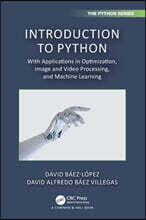
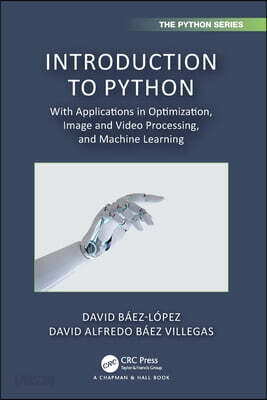
직수입양서 Introduction to Python
With Applications in Optimization, Image and Video Processing, and Machine Learning Paperback, 1st Edition, Illustrations, Color
Báez-López, David / Báez Villegas, David Alfredo
Chapman and Hall/CRC 2024.07.02.
가격
160,020
10 144,010
YES포인트?
7,210원 (5%) 마니아추가적립
5만원 이상 구매 시 2천원 추가 적립
결제혜택
최대 2,000원 즉시할인
배송안내
서울특별시 영등포구 은행로 11(여의도동, 일신빌딩) 변경
배송비?
무료

이미 소장하고 있다면 판매해 보세요.

이 분야의 이벤트

Chapman & Hall/CRC The Python Series

책소개

목차

1. Introduction to Python.
1.1. What is the Python programming language.
1.2. The Python programming language.
1.3. Book organization.
1.4. Algorithms.
1.5. Variables.
1.6. Input and output in Python.
1.7. Programs in Python.
1.8. Comments in a program.
1.9. Functions in Python.
1.10. Modules and libraries.
1.11. Operators.
1.12. Alphanumeric variables.
1.13. Lists.
1.14. Dictionaries.
1.15. Tuples.
1.16. Examples.
1.17. Python instructions for Chapter
1.
1.18. Conclusions.
1.19. Exercises. 2. Conditionals and Loops.
2.1. Introduction.
2.2. Conditionals.
2.3. The conditional if-else.
2.4. Nested Conditionals.
2.5. Exceptions and Errors.
2.6. Loops.
2.7. The while loop.
2.8. The for loop.
2.9. Nested loops.
2.10. The instruction break.
2.11. The instruction continues.
2.12. Additional examples.
2.13. Python instructions for Chapter
2.
2.14. Conclusions.
2.15. Exercises.
2.16. Bibliography. 3. Data Structures: Strings, Lists, Tuples, and Dictionaries.
3.1. Introduction.
3.2. Strings.
3.3. Functions on strings.
3.4. Immutability of strings.
3.5. Lists.
3.6. Tuples.
3.7. Dictionaries.
3.8. Sets.
3.9. Python Instructions for Chapter
3.
3.10. Conclusions.
3.11. Exercises . 4 Arrays.
4.1. Introduction.
4.2. Introduction to array.
4.3. Vectors.
4.4. Examples with vectors in Python.
4.5. Matrices.
4.6. Arrays in Python.
4.7. Matrix operations using linear algebra with numpy.
4.8. Special Matrices.
4.9. Examples.
4.10. Arrays in Pandas.
4.11. Python instructions for Chapter
4.
4.12. Conclusions.
4.13. Exercises. 5. Functions.
5.1. Introduction.
5.2. Subprograms.
5.3. Functions in Python.
5.4. Recursion.
5.5. Anonymous functions or lambda functions.
5.6. Pass by reference.
5.7. Local and global variables.
5.8. Keyword and default arguments.
5.9. Variable-length arguments.
5.10. Additional Examples.
5.11. Python Instructions in Chapter 5
5.12 Conclusions.
5.13. Exercises. 6. Object-Oriented Programming.
6.1. Introduction.
6.2. The Object-Oriented Programming Paradigm.
6.3. Classes in Python.
6.4. Example.
6.5. Python instructions for Chapter
6.
6.6. Conclusions.
6.7. Exercises.
6.8. Selected bibliography. 7. Reading and writing to files.
7.1. Introduction.
7.2. Writing data to a file.
7.3. Writing numerical data to a file.
7.4. Data reading from a file.
7.5. Reading and writing data from and to Excel.
7.6. Reading and writing binary files.
7.7. Python instructions in Chapter
7.
7.8. Conclusions.
7.9. Exercises. 8. Plotting in Python.
8.1. Introduction.
8.2. Plots in two dimensions.
8.3. The package seaborn.
8.4. Other two-dimensional plots.
8.5. Pie charts.
8.6. Multiple figures.
8.7. Three-Dimensional Plots.
8.8. Python instructions for Chapter
8.
8.9. Conclusions.
8.10. Exercises.
8.11. References. 9. Optimization.
9.1. Introduction.
9.2. Optimization Concepts.
9.3. General Format of the Optimization Process.
9.4. Optimization with Python.
9.5. The minimize function.
9.6. Linear programming.
9.7. Quadratic programming.
9.8. Python instructions for Chapter
9.
9.9. Conclusions.
9.10. Selected bibliography. 10. Image Processing with OpenCV.
10.1. Introduction.
10.2. Reading and writing images and videos.
10.3. Video capture and display.
10.4. Binary images.
10.5. Histogram.
10.6. Draw geometric shapes and text on an image.
10.7. Contour detection.
10.8. Frequency domain processing.
10.9. Noise addition to images.
10.10. Morphological image processing.
10.11. Python Instructions in Chapter
10.
10.12. Conclusions.
10.13. Selected bibliography. 11. Machine Learning.
11.1. Types of machine learning systems.
11.2. Gradient descent algorithm.
11.3. Multivariate regression.
11.4. The normal equation.
11.5. The package scikit-learn.
11.6. Polynomial regression.
11.7. Classification with logistic regression.
11.8. Unsupervised Learning.
11.9. Clustering using k-means.
11.10. Python instructions in Chapter
11.
11.11. Conclusions. 12. Neural networks.
12.1. Introduction.
12.2. A model for a neuron.
12.3. Activation functions.
12.4. Cost function.
12.5. TensorFlow.
12.6. Convolutional neural networks.
12.7. A layer of a convolutional filter.
12.8. Python instructions in Chapter
12.
12.9. Conclusions.

품목정보

발행일
2024년 07월 02일
쪽수, 무게, 크기
436쪽 | 720g | 160*230*234mm
ISBN13
9781032119106

리뷰/한줄평0

리뷰

첫번째 리뷰어가 되어주세요.

한줄평

첫번째 한줄평을 남겨주세요.

상품정보안내

직수입외서의 경우, 해외거래처에서 제공하는 정보가 부족하여 제목, 표지, 가격, 유통상태 등의 정보가 미비하거나 변경되는 경우가 있습니다. 정확한 확인을 원하시는 경우, 일대일 상담으로 문의하여 주시면 답변 드리겠습니다.
(판형과 판수 등이 다양한 도서는 찾으시는 도서의 ISBN을 알려 주시면 보다 빠르고 정확한 안내가 가능합니다.)

해외거래처에서 품절인 경우, 2차 거래선을 통해 유럽과 미국 출판사로 직접 수입이 진행될 수 있습니다.
수입 진행 시점으로 부터 2~3주가 추가로 소요되며, 해외에서도 유통이 원활하지 않은 도서는 품절 안내가 지연될 수 있습니다.
해당 경우, 문자와 메일로 별도 안내를 드리고 있사오니 마이페이지에서 휴대전화번호와 메일주소를 다시 한번 확인해주시기 바랍니다.

144,010
1 144,010