
이미 소장하고 있다면 판매해 보세요.
- 국내배송만 가능
- 문화비소득공제 가능
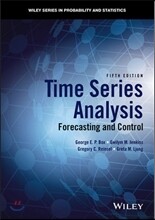
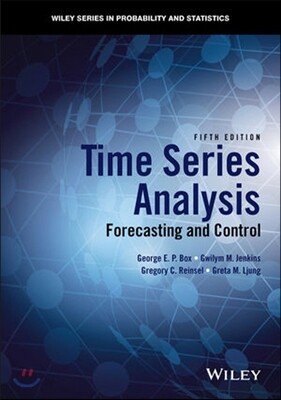
책소개
목차
|
PREFACE TO THE FIFTH EDITION xix
PREFACE TO THE FOURTH EDITION xxiii PREFACE TO THE THIRD EDITION xxv 1 Introduction 1 1.1 Five Important Practical Problems 2 1.2 Stochastic and Deterministic Dynamic Mathematical Models 6 1.3 Basic Ideas in Model Building 14 Appendix A1.1 Use of the R Software 17 Exercises 18 PART ONE STOCHASTIC MODELS AND THEIR FORECASTING 19 2 Autocorrelation Function and Spectrum of Stationary Processes 21 2.1 Autocorrelation Properties of Stationary Models 21 2.2 Spectral Properties of Stationary Models 34 Appendix A2.1 Link Between the Sample Spectrum and Autocovariance Function Estimate 43 Exercises 44 3 Linear Stationary Models 47 3.1 General Linear Process 47 3.2 Autoregressive Processes 54 3.3 Moving Average Processes 68 3.4 Mixed Autoregressive--Moving Average Processes 75 Appendix A3.1 Autocovariances Autocovariance Generating Function and Stationarity Conditions for a General Linear Process 82 Appendix A3.2 Recursive Method for Calculating Estimates of Autoregressive Parameters 84 Exercises 86 4 Linear Nonstationary Models 88 4.1 Autoregressive Integrated Moving Average Processes 88 4.2 Three Explicit Forms for the ARIMA Model 97 4.3 Integrated Moving Average Processes 106 Appendix A4.1 Linear Difference Equations 116 Appendix A4.2 IMA(0 1 1) Process with Deterministic Drift 121 Appendix A4.3 ARIMA Processes with Added Noise 122 Exercises 126 5 Forecasting 129 5.1 Minimum Mean Square Error Forecasts and Their Properties 129 5.2 Calculating Forecasts and Probability Limits 135 5.3 Forecast Function and Forecast Weights 139 5.4 Examples of Forecast Functions and Their Updating 144 5.5 Use of State-Space Model Formulation for Exact Forecasting 155 5.6 Summary 162 Appendix A5.1 Correlation Between Forecast Errors 164 Appendix A5.2 Forecast Weights for any Lead Time 166 Appendix A5.3 Forecasting in Terms of the General Integrated Form 168 Exercises 174 PART TWO STOCHASTIC MODEL BUILDING 177 6 Model Identification 179 6.1 Objectives of Identification 179 6.2 Identification Techniques 180 6.3 Initial Estimates for the Parameters 194 6.4 Model Multiplicity 202 Appendix A6.1 Expected Behavior of the Estimated Autocorrelation Function for a Nonstationary Process 206 Exercises 207 7 Parameter Estimation 209 7.1 Study of the Likelihood and Sum-of-Squares Functions 209 7.2 Nonlinear Estimation 226 7.3 Some Estimation Results for Specific Models 236 7.4 Likelihood Function Based on the State-Space Model 242 7.5 Estimation Using Bayes' Theorem 245 Appendix A7.1 Review of Normal Distribution Theory 251 Appendix A7.2 Review of Linear Least-Squares Theory 256 Appendix A7.3 Exact Likelihood Function for Moving Average and Mixed Processes 259 Appendix A7.4 Exact Likelihood Function for an Autoregressive Process 266 Appendix A7.5 Asymptotic Distribution of Estimators for Autoregressive Models 274 Appendix A7.6 Examples of the Effect of Parameter Estimation Errors on Variances of Forecast Errors and Probability Limits for Forecasts 277 Appendix A7.7 Special Note on Estimation ofMoving Average Parameters 280 Exercises 280 8 Model Diagnostic Checking 284 8.1 Checking the Stochastic Model 284 8.2 Diagnostic Checks Applied to Residuals 287 8.3 Use of Residuals to Modify the Model 301 Exercises 303 9 Analysis of Seasonal Time Series 305 9.1 Parsimonious Models for Seasonal Time Series 305 9.2 Representation of the Airline Data by a Multiplicative (0 1 1) (0 1 1)12 Model 310 9.3 Some Aspects of More General Seasonal ARIMA Models 325 9.4 Structural Component Models and Deterministic Seasonal Components 331 9.5 Regression Models with Time Series Error Terms 339 Appendix A9.1 Autocovariances for Some Seasonal Models 345 Exercises 349 10 Additional Topics and Extensions 352 10.1 Tests for Unit Roots in ARIMA Models 353 10.2 Conditional Heteroscedastic Models 361 10.3 Nonlinear Time Series Models 377 10.4 Long Memory Time Series Processes 385 Exercises 392 PART THREE TRANSFER FUNCTION AND MULTIVARIATE MODEL BUILDING 395 11 Transfer Function Models 397 11.1 Linear Transfer Function Models 397 11.2 Discrete Dynamic Models Represented by Difference Equations 404 11.3 Relation Between Discrete and Continuous Models 414 Appendix A11.1 Continuous Models with Pulsed Inputs 420 Appendix A11.2 Nonlinear Transfer Functions and Linearization 424 Exercises 426 12 Identification Fitting and Checking of Transfer Function Models 428 12.1 Cross-Correlation Function 429 12.2 Identification of Transfer Function Models 435 12.3 Fitting and Checking Transfer Function Models 446 12.4 Some Examples of Fitting and Checking Transfer Function Models 453 12.5 Forecasting with Transfer FunctionModels Using Leading Indicators 461 12.6 Some Aspects of the Design of Experiments to Estimate Transfer Functions 469 Appendix A12.1 Use of Cross-Spectral Analysis for Transfer Function Model Identification 471 Appendix A12.2 Choice of Input to Provide Optimal Parameter Estimates 473 Exercises 477 13 Intervention Analysis Outlier Detection and Missing Values 481 13.1 Intervention Analysis Methods 481 13.2 Outlier Analysis for Time Series 488 13.3 Estimation for ARMA Models with Missing Values 495 Exercises 502 14 Multivariate Time Series Analysis 505 14.1 Stationary Multivariate Time Series 506 14.2 Vector Autoregressive Models 509 14.3 Vector Moving Average Models 524 14.4 Vector Autoregressive--Moving Average Models 527 14.5 Forecasting for Vector Autoregressive--Moving Average Processes 534 14.6 State-Space Form of the VARMA Model 536 14.7 Further Discussion of VARMA Model Specification 539 14.8 Nonstationarity and Cointegration 546 Appendix A14.1 Spectral Characteristics and Linear Filtering Relations for Stationary Multivariate Processes 552 Exercises 554 PART FOUR DESIGN OF DISCRETE CONTROL SCHEMES 559 15 Aspects of Process Control 561 15.1 Process Monitoring and Process Adjustment 562 15.2 Process Adjustment Using Feedback Control 566 15.3 Excessive Adjustment Sometimes Required by MMSE Control 580 15.4 Minimum Cost Control with Fixed Costs of Adjustment and Monitoring 582 15.5 Feedforward Control 588 15.6 Monitoring Values of Parameters of Forecasting and Feedback Adjustment Schemes 599 Appendix A15.1 Feedback Control Schemes Where the Adjustment Variance Is Restricted 600 Appendix A15.2 Choice of the Sampling Interval 609 Exercises 613 PART FIVE CHARTS AND TABLES 617 COLLECTION OF TABLES AND CHARTS 619 COLLECTION OF TIME SERIES USED FOR EXAMPLES IN THE TEXT AND IN EXERCISES 625 REFERENCES 642 INDEX 659 |
저자 소개
The late George E. P. Box, PhD, was professor emeritus of statistics at the University of Wisconsin-Madison. He was a Fellow of the American Academy of Arts and Sciences and a recipient of the Samuel S. Wilks Memorial Medal of the American Statistical Association, the Shewhart Medal of the American Society for Quality, and the Guy Medal in Gold of the Royal Statistical Society. Dr. Box was also author of seven Wiley books.
The late Gwilym M. Jenkins, PhD, was professor of systems engineering at Lancaster University in the United Kingdom, where he was also founder and managing director of the International Systems Corporation of Lancaster. A Fellow of the Institute of Mathematical Statistics and the Institute of Statisticians, Dr. Jenkins had a prestigious career in both academia and consulting work that included positions at Imperial College London, Stanford University, Princeton University, and the University of Wisconsin-Madison. He was widely known for his work on time series analysis, most notably his groundbreaking work with Dr. Box on the Box-Jenkins models.
The late?Gregory C. Reinsel, PhD, was professor and former chair of the department of Statistics at the University of Wisconsin-Madison. Dr. Reinsel's expertise was focused on time series analysis and its applications in areas as diverse as economics, ecology, engineering, and meteorology. He authored over seventy refereed articles and three books, and was a Fellow of both the American Statistical Association and the Institute of Mathematical Statistics.
Greta M. Ljung, PhD, is a statistical consultant residing in Lexington, MA. She received her doctorate from the University of Wisconsin-Madison where she did her research in time series analysis under the direction of Professor George Box. Dr. Ljung's career includes teaching positions at Boston University and Massachusetts Institute of Technology, and a position as Principal Scientist at AIR Worldwide in Boston. Her many accomplishments include joint work with George Box on a time series goodness of fit test, which is widely applied in econometrics and other fields.
품목정보
- 발행일
- 2015년 06월 29일
- 쪽수, 무게, 크기
- 712쪽 | 1400g | 178*262*40mm
- ISBN13
- 9781118675021
사락 별점0
혜택 및 유의사항밑줄0
혜택 및 유의사항상품정보안내
(판형과 판수 등이 다양한 도서는 찾으시는 도서의 ISBN을 알려 주시면 보다 빠르고 정확한 안내가 가능합니다.)
해외거래처에서 품절인 경우, 2차 거래선을 통해 유럽과 미국 출판사로 직접 수입이 진행될 수 있습니다.
수입 진행 시점으로 부터 2~3주가 추가로 소요되며, 해외에서도 유통이 원활하지 않은 도서는 품절 안내가 지연될 수 있습니다.
해당 경우, 문자와 메일로 별도 안내를 드리고 있사오니 마이페이지에서 휴대전화번호와 메일주소를 다시 한번 확인해주시기 바랍니다.