
직수입외서는 변심/착오로 인해 주문을 취소할 경우 해외주문 취소수수료 20%가 부과됩니다.?
이미 소장하고 있다면 판매해 보세요.
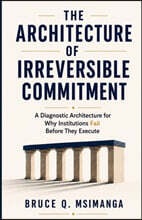
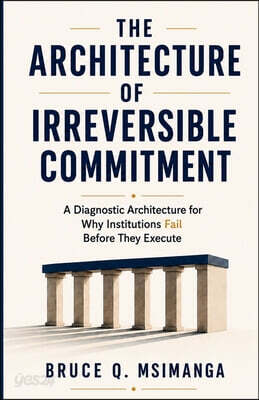
Why do intelligent institutions repeatedly fail-even when they plan well?
Conventional explanations point to poor execution. But what if execution is not the real problem? What if failure begins long before implementation starts?
In The Architecture of Irreversible Commitment, management consultant and strategist Bruce Q. Msimanga introduces the Architecture of Irreversible Commitment (AIC), a diagnostic framework for understanding why some organisations sustain high-stakes commitments while others collapse under pressure.
Drawing on examples from business, government, finance, healthcare, public policy, and organisational transformation, Msimanga argues that institutions are governed by a deeper architecture that determines what they can realistically commit to, sustain, and ultimately survive.
At the centre of this framework are five structural layers:
? Authority? Incentives? Information? Sequencing? Capital
When these layers become distorted, organisations often mistake architectural failure for execution failure, creating what Msimanga calls the False Execution Loop-a recurring cycle in which leaders intensify execution efforts while the underlying causes of failure remain unaddressed.
Whether evaluating a corporate transformation, acquisition, turnaround, governance challenge, investment decision, or public-sector reform, this book provides a new lens for identifying hidden vulnerabilities before they become visible crises.
For executives, policymakers, investors, strategists, consultants, and organisational leaders seeking to understand why some commitments endure while others unravel, The Architecture of Irreversible Commitment offers a practical framework for diagnosing institutional strength beneath the surface of performance.
Because institutions are defined less by what they decide-and more by what they can no longer reverse.
리뷰
첫번째 리뷰어가 되어주세요.
한줄평
첫번째 한줄평을 남겨주세요.
클린봇으로 착한 글만 확인해보세요!
클린봇이 부적절한 글을 감지 중입니다.