


이미 소장하고 있다면 판매해 보세요.
- 국내배송만 가능
- 문화비소득공제 가능
책소개
저자 소개
저자 : Robert Winston
Professor Lord Robert Winston, leading scientist and TV presenter.
Professor Robert Winston belongs to that rare breed of scientists who combine academic brilliance with charisma and a flair for communication with the general public.
A household name thanks to popular TV series that include The Human Body, which one three baftas, Superhuman, Walking with Cavemen, and The Human Mind, Lord Winston's personal charisma and zest for adventure have seen him riding rollercoasters and freezing in an igloo to help demonstrate science in action.
His pioneering work in the field of human fertility helped thousands of childless couples have "miracle babies" and earned him an outstanding international reputation.
A winner of the Royal Society's prestigious Michael Faraday Gold Award, he was made a life peer in 1995. He is Consultant in Reproductive Medicine at Hammersmith Hospital and Professor of Fertility Studies at Imperial College, London.
In his first DK book for adults, Human (DK, October 2004), Robert reveals the diversity of our lives and explores our extraordinary past, our fascinating present, and our astonishing future.
In his first book published for children, What Makes Me Me? (DK, July 2004) Robert explores how genes, experience and biology work together to make everybody unique and in 2005 it won the Aventis Junior Prize for Science.
Professor Robert Winston belongs to that rare breed of scientists who combine academic brilliance with charisma and a flair for communication with the general public.
A household name thanks to popular TV series that include The Human Body, which one three baftas, Superhuman, Walking with Cavemen, and The Human Mind, Lord Winston's personal charisma and zest for adventure have seen him riding rollercoasters and freezing in an igloo to help demonstrate science in action.
His pioneering work in the field of human fertility helped thousands of childless couples have "miracle babies" and earned him an outstanding international reputation.
A winner of the Royal Society's prestigious Michael Faraday Gold Award, he was made a life peer in 1995. He is Consultant in Reproductive Medicine at Hammersmith Hospital and Professor of Fertility Studies at Imperial College, London.
In his first DK book for adults, Human (DK, October 2004), Robert reveals the diversity of our lives and explores our extraordinary past, our fascinating present, and our astonishing future.
In his first book published for children, What Makes Me Me? (DK, July 2004) Robert explores how genes, experience and biology work together to make everybody unique and in 2005 it won the Aventis Junior Prize for Science.
관련 분류
품목정보
- 발행일
- 2005년 10월 06일
- 쪽수, 무게, 크기
- 96쪽 | 912g | 270*308*15mm
- ISBN13
- 9781405310420
관련 자료
|
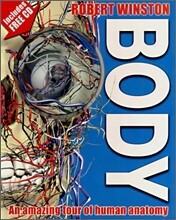
Body (DK, October 2005), Robert's second children's book is an irresistibly grisly, top-to-toe atlas that takes you on a thrilling journey of the human body. Revealing our internal structure from head to toe, layer-by-layer, system-by-system - it offer just the sort of gruesome stuff kids won't be able to resist!
Is there a lot we still don't know about the human body? Yes, indeed. We probably only know about half there is to know. Some of the most important unsolved questions are about how our brain works. Many of the biggest mysteries are concerned with learning exactly how the brain makes us think, remember, and feel. More research is now being done and science has some powerful tools for helping our understanding ? like big brain scanning machines and ways of recording the electrical impulses and chemical messages inside the brain. Do you think we will ever be able to clone humans? I am sure it would be possible ? though probably rather pointless. And at the moment quite dangerous as nearly all the animals that have been cloned have turned out to be abnormal or ill in various ways. It would be surely unthinkable to risk producing an abnormal or damaged human just because we wanted to clone somebody. What do you think is in you that makes you a top scientist instead of a trapeze artist? Both professions need special skills. To be a trapeze artist you need a very co-ordinated body. Perhaps to be a scientist you need a fairly co-ordinated mind. But to be good at most things you need to work hard and practise. What advice would you give to budding scientists? Like all jobs it may be exciting some of the time ? and science can be very exciting ? but there are moments when continuous effort is needed and there are moments of boredom. The best advice is to be single-minded, read as much as possible, listen to other good scientists, and get a wide education. And remember that when an experiment seems to go wrong or gives an unexpected result, this may give very important clues to what’s going on. And remember ? when doing any science always keep a really careful record of what you saw and what you did. Memory is never enough. Most discoveries have needed accurate record keeping. What's the most dangerous substance in the body? Possibly ? and surprisingly ? oxygen in a way. Oxygen is essential for life and how we create energy inside our body, but oxygen also leads to ageing and changes in cells such as the formation of cancer. In your TV shows you spend a lot of time watching people. Do you ever get bored? Yes I do ? actually I hate filming, though like preparing the programmes. Filming is essentially tedious and time-consuming and you spend an immense amount of time standing around. But I don’t mind watching people; it’s more the actual process of filming I don’t find very exciting. |
출판사 리뷰
|
* An irresistibly grisly, top-to-toe body atlas!
Join Robert Winston, award winning author and TV presenter, as he takes an incredible journey around the human body in this jaw-dropping tour of anatomy. From how your blood flows to how your food is digested, take a trip through your very own body and be astounded by its inner workings. - Features a free interactive CD showing the body and its movements in 3D detail - Includes acetate pages folded back to reveal how our most important organs work - Supports the National Science Curriculum at Key Stage 2 With more than 100 stunning full-colour images reproduced from the world's first complete 3-D graphic model of the human body, the internal structure of body parts is revealed layer by layer. A comprehensive and vivid journey from head to toe! * Professor Lord Robert Winston is a leading scientist and TV presenter and belongs to that rare breed of scientists who combine academic brilliance with charisma and a flair for communication with the general public. Body (DK, October 2005), Robert's second children's book is an irresistibly grisly, top-to-toe atlas that takes you on a thrilling journey of the human body, revealing our internal structure from head to toe. - Why did you want to be involved with this book (Body)? Because people show huge ignorance about the body and it's an important thing - we live in it. It has to be taken care of. - How did you feel about your first children’s book, What Makes Me Me?, winning the Junior Aventis prize for science books? Very surprised and delighted. It's very nice to win - if we can engage a child with science this will lead to adults being engaged in science. It's important for society for more people to understand more in this field. - When did you discover you were good at science? I still haven't discovered it! Since the age of 7 or 8 it was something I was always interested in. I went to lots of science museums as a child. - What advice would you give to those who find biology tricky at school? Every subject is tricky, like French or English literature but science is very rewarding if you persist. It becomes more and more interesting and is very important for everyone to understand. - Do you have any predictions of where science will take us in the next 10 years? I think it's utterly pointless to predict the future. There have been so many false predictions and these give the impression that science can solve and dominate everything. Natural forces are so unpredictable and we should be more humble about this. |
상품정보안내
직수입외서의 경우, 해외거래처에서 제공하는 정보가 부족하여 제목, 표지, 가격, 유통상태 등의 정보가 미비하거나 변경되는 경우가 있습니다. 정확한 확인을 원하시는 경우, 일대일 상담으로 문의하여 주시면 답변 드리겠습니다.
(판형과 판수 등이 다양한 도서는 찾으시는 도서의 ISBN을 알려 주시면 보다 빠르고 정확한 안내가 가능합니다.)
해외거래처에서 품절인 경우, 2차 거래선을 통해 유럽과 미국 출판사로 직접 수입이 진행될 수 있습니다.
수입 진행 시점으로 부터 2~3주가 추가로 소요되며, 해외에서도 유통이 원활하지 않은 도서는 품절 안내가 지연될 수 있습니다.
해당 경우, 문자와 메일로 별도 안내를 드리고 있사오니 마이페이지에서 휴대전화번호와 메일주소를 다시 한번 확인해주시기 바랍니다.
(판형과 판수 등이 다양한 도서는 찾으시는 도서의 ISBN을 알려 주시면 보다 빠르고 정확한 안내가 가능합니다.)
해외거래처에서 품절인 경우, 2차 거래선을 통해 유럽과 미국 출판사로 직접 수입이 진행될 수 있습니다.
수입 진행 시점으로 부터 2~3주가 추가로 소요되며, 해외에서도 유통이 원활하지 않은 도서는 품절 안내가 지연될 수 있습니다.
해당 경우, 문자와 메일로 별도 안내를 드리고 있사오니 마이페이지에서 휴대전화번호와 메일주소를 다시 한번 확인해주시기 바랍니다.
