
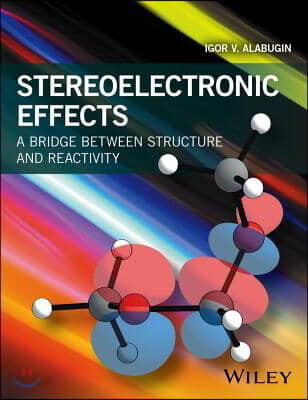
Alabugin, Igor V.
Wiley
2016.08.24.
- 판매자
-
에코서점
중고샵 판매자가 직접 등록/판매하는 상품으로 판매자가 해당 상품과 내용에 모든 책임을 집니다.
이미 소장하고 있다면 판매해 보세요.
- 한정판매의 특성상 재고 상황에 따라 품절 가능
중고외서 소개
|
책소개
목차
|
Acknowledgement ix Supplementory Material x 1 Introduction 1 1.1 Stereoelectronic effects ? orbital interactions in control of structure and reactivity 1 1.2 Orbital interactions in theoretical chemistry 3 1.3 The birth of stereoelectronic concepts in organic chemistry 4 References 6 2 Direct Effects of Orbital Overlap on Reactivity 8 2.1 Bond formation without bond breaking: types of overlap in two?orbital interactions 9 2.1.1 Factors controlling σ?bond overlap 12 2.2 Bond formation coupled with bond breaking 25 2.2.1 Three?orbital interactions: stereoelectronic reasons for the preferred trajectories of intermolecular attack at a chemical bond 25 2.3 Stereoelectronics of supramolecular interactions 29 2.3.1 FMO interactions in intermolecular complexes 29 2.3.2 Expanding the palette of supramolecular interactions: from H?bonding to Li?, halogen, pnictogen, chalcogen and tetrel binding 30 References 36 3 Beyond Orbital Overlap: Additional Factors Important for Orbital Interactions. Classifying Delocalizing Interactions 42 3.1 Electronic count: two?electron, one?electron and three?electron bonds 43 3.2 Isovalent vs. sacrificial conjugation 48 3.3 Neutral, negative, and positive hyperconjugation 49 References 52 4 Computational and Theoretical Approaches for Studies of Stereoelectronic Effects 54 4.1 Quantifying orbital interactions 54 4.2 Localized orbitals from delocalized wavefunctions 56 References 60 5 General Stereoelectronic Trends ? Donors, Acceptors, and Chameleons 62 5.1 Three types of delocalization: conjugation, hyperconjugation, and σ?conjugation 62 5.2 Geminal and vicinal interactions 63 5.3 Stereoelectronic main rule: antiperiplanarity 64 5.3.1 Effects of bond polarity 65 5.3.2 Polarity?induced acceptor anisotropy 68 5.4 Scales of donor and acceptor ability of orbitals: polarization, hybridization, and orbital energy effects 68 5.4.1 Donors 68 5.4.2 Acceptors 81 5.4.3 Stereoelectronic chameleons: donors masquerading as acceptors 84 5.5 Cooperativity of stereoelectronic effects and antiperiplanar lone pair hypothesis (ALPH) theory ? several donors working together 91 5.6 Summary 92 References 92 6 Stereoelectronic Effects with Donor and Acceptor Separated by a Single Bond Bridge: The Broad Spectrum of Orbital Contributions to Conformational Analysis 97 6.1 σ/σ?Interactions 99 6.1.1 Rotational barrier in ethane 99 6.1.2 Axial/equatorial equilibrium in methylcyclohexane 105 6.1.3 The gauche effect 110 6.2 σ/π?Interactions 113 6.2.1 “Eclipsed” and “staggered” conformations of alkenes ? stereoelectronic misnomers 114 6.2.2 Carbonyls 117 6.2.3 Strained bonds 121 6.3 p/σ?Interactions 122 6.3.1 Primary, secondary, tertiary carbocation stabilization 122 6.3.2 Hyperconjomers of cyclohexyl cations 124 6.3.3 β?Silicon effect and related β?effects 124 6.4 n/σ?Interactions 126 6.4.1 Anomeric effects 129 6.4.2 Reverse anomeric effect 142 6.4.3 “Anomeric effects without lone pairs”: beyond the n → σ* interactions 143 6.5 n/π?Interactions 147 6.5.1 Esters and related carboxylic acid derivatives 147 6.5.2 Vinyl ethers and enamines 157 6.6 π/π?Interactions 167 6.6.1 Hyperconjugation in alkynes and its relation to the “absence” of conjugation between two triple bonds in 1,3?diynes 168 References 170 7 Stereoelectronic Effects with Donor and Acceptor Separated by a Vinyl Bridge 183 7.1 σ/σ* interactions 184 7.1.1 Cis?effect: the case of two σ?acceptors 184 7.2 σ/π interactions: allenes vs. alkenes 185 7.2.1 Neutral systems 185 7.2.2 Anions 186 7.2.3 Positive conjugation and hyperconjugation in vinyl systems 187 7.2.4 σ → π* delocalization in allenes: allenyl silanes in reactions with electrophiles 188 7.3 Vinyl halides and their carbanions (transition from σC?H → σ*C?Hal to nc → σ*C?Hal interactions) 192 7.3.1 Heteroatom?containing systems 195 7.4 Diazenes and the isomerization of azo compounds 196 7.5 Antiperiplanarity in coordinated bond?breaking and bond?forming processes: eliminations, fragmentations and additions 199 7.6 Syn?periplanarity: the second best choice 207 References 208 8 Remote Stereoelectronic Effects 214 8.1 Extended through space interactions: homoconjugation and homohyperconjugation 215 8.1.1 Homoconjugation 215 8.1.2 Homoanomeric effects 217 8.1.3 Cross?hyperconjugation 223 8.2 Double hyperconjugation and through?bond interactions 223 8.3 Combined through?bond and through?space interactions 228 8.4 Symmetry and cooperativity effects in cyclic structures 229 8.4.1 Hyperaromaticity 229 8.4.2 σ?Aromaticity 230 8.4.3 Double aromaticity 231 References 231 9 Transition State Stabilization with Stereoelectronic Effects: Stereoelectronic Control of Reaction Bottlenecks 236 9.1 Torquoselectivity 240 9.2 Diastereoselection in nucleophilic addition to carbonyl compounds and other π?systems 243 9.3 Electrophilic addition to enamines 245 9.4 Hyperconjugative assistance to alkyne bending and alkyne cycloadditions 246 9.5 Negative conjugation ? donation from oxygen lone pairs to breaking bonds 248 9.6 Remote lone pairs in radical reactions: fragmentations 251 References 254 10 Stereoelectronic Effects in Reaction Design 257 10.1 Static stereoelectronics 257 10.2 Dynamic stereoelectronics 259 References 273 11 Stereoelectronic Effects in Action: The Many Doors Opened by Orbital Interactions 275 11.1 Gauche effect (σ → σ* interactions) 275 11.2 Trans?effect ? the cousin of gauche effect in organometallic chemistry 283 11.3 Anomeric effects (n → σ* interactions) 284 11.3.1 Cooperativity and anticooperativity in anomeric systems 288 11.3.2 Spectrum of armed and disarmed glycosides 289 11.3.3 Restoring exo?anomeric effect in carbasugars 294 11.4 Bioorganic chemistry and enzyme reactions 311 References 316 12 Probing Stereoelectronic Effects with Spectroscopic Methods 322 12.1 Infrared spectroscopy 323 12.1.1 Bohlmann effect 323 12.1.2 Red?shifting hydrogen bonds ? an intermolecular version of the Bohlmann effect 331 12.2 Nuclear magnetic resonance spectroscopy 335 12.2.1 Stereoelectronic effects on chemical shifts 335 12.2.2 Diamagnetic effects in 1H NMR 336 12.2.3 Paramagnetic effects in 13C NMR 338 12.2.4 Through?space interactions ? γ?substituent effects 340 12.2.5 Stereoelectronic effects on coupling constants 342 12.3 Conclusion 368 References 368 Index 376 |
저자 소개
Professor Igor V. Alabugin, Department of Chemistry and Biochemistry, Florida State University, USA
Over the last 12 years, Professor Alabugin has published a body of work dedicated to stereoelectronic effects and applied these concepts in practice to the development of new organic reactions. The wide appeal of these concepts is reflected in a large number citations for his papers on the topic (the top three papers have well over 600 citations). His expertise is in broadly defined computational and experimental organic chemistry and its applications to medicinal chemistry and materials science.
Over the last 12 years, Professor Alabugin has published a body of work dedicated to stereoelectronic effects and applied these concepts in practice to the development of new organic reactions. The wide appeal of these concepts is reflected in a large number citations for his papers on the topic (the top three papers have well over 600 citations). His expertise is in broadly defined computational and experimental organic chemistry and its applications to medicinal chemistry and materials science.
품목정보
- 발행일
- 2016년 08월 24일
- 쪽수, 무게, 크기
- 400쪽 | 816g | 188*244*23mm
- ISBN13
- 9781118906347
상품정보안내
- 주문 전 중고상품의 정확한 상태 및 재고 문의는 [판매자에게 문의하기]를 통해 문의해 주세요.
- 주문완료 후 중고상품의 취소 및 반품은 판매자와 별도 협의 후 진행 가능합니다. 마이페이지 > 주문내역 > 주문상세 > 판매자 정보보기 > 연락처로 문의해 주세요.
부적합 상품 신고하기
신고하기- 구매에 부적합한 상품은 신고해주세요.
- 구매하신 상품의 상태, 배송, 취소 및 반품 문의는 판매자 묻고 답하기를 이용해주세요.
- 상품정보 부정확(카테고리 오등록/상품오등록/상품정보 오등록/기타 허위등록) 부적합 상품(청소년 유해물품/기타 법규위반 상품)
- 전자상거래에 어긋나는 판매사례: 직거래 유도
98,400원
총 1개
98,400원
