

소득공제
외서
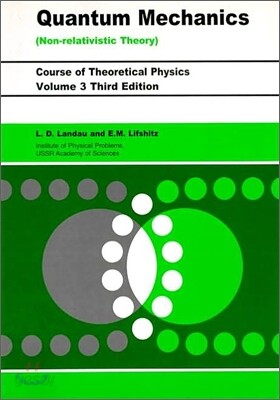
Quantum Mechanics (Non-Relativistic Theory), 3/E
Course of Theoretical Physics Series #3
Paperback, 3rd Edition
Butterworth-Heinemann
1981.01.01.
이미 소장하고 있다면 판매해 보세요.
- 국내배송만 가능
- 문화비소득공제 가능
Course of Theoretical Physics
-
 Quantum Mechanics (Non-Relativistic Theory), 3/E 이동Quantum Mechanics (Non-Relativistic Theory), 3/E99,000원
 -
Statistical Physics: Theory of the Condensed State 이동Statistical Physics: Theory of the Condensed State92,000원
책소개
목차
|
From the Preface to the first English edition xi
Preface to the second English edition xii Preface to the third Russian edition xiii Editor's Preface to the fourth Russian edition xiv Notation xv I. The Basic Concepts of Quantum Mechanics 1. The uncertainty principle 1 2. The principle of superposition 6 3. Operators 8 4. Addition and multiplication of operators 13 5. The continuous spectrum 15 6. The passage to the limiting case of classical mechanics 19 7. The wave function and measurements 21 II. Energy and Momentum 8. The Hamiltonian operator 25 9. The differentiation of operators with respect to time 26 10. Stationary states 27 11. Matrices 30 12. Transformation of matrices 35 13. The Heisenberg representation of operators 37 14. The density matrix 38 15. Momentum 41 16. Uncertainty relations 45 III. Schrodinger's Equation 17. Schrodinger's equation 50 18. The fundamental properties of Schrodinger's equation 53 19. The current density 55 20. The variational principle 58 21. General properties of motion in one dimension 60 22. The potential well 63 23. The linear oscillator 67 24. Motion in a homogeneous field 74 25. The transmission coefficient 76 IV. Angular Momentum 26. Angular momentum 82 27. Eigenvalues of the angular momentum 86 28. Eigenfunctions of the angular momentum 89 29. Matrix elements of vectors 92 30. Parity of a state 96 31. Addition of angular momenta 99 V. Motion in a Centrally Symmetric Field 32. Motion in a centrally symmetric field 102 33. Spherical waves 105 34. Resolution of a plane wave 112 35. Fall of a particle to the centre 114 36. Motion in a Coulomb field (spherical polar coordinates) 117 37. Motion in a Coulomb field (parabolic coordinates) 129 VI. Perturbation Theory 38. Perturbations independent of time 133 39. The secular equation 138 40. Perturbations depending on time 142 41. Transitions under a perturbation acting for a finite time 146 42. Transitions under the action of a periodic perturbation 151 43. Transitions in the continuous spectrum 154 44. The uncertainty relation for energy 157 45. Potential energy as a perturbation 159 VII. The Quasi-Classical Case 46. The wave function in the quasi-classical case 164 47. Boundary conditions in the quasi-classical case 167 48. Bohr and Sommerfeld's quantization rule 170 49. Quasi-classical motion in a centrally symmetric field 175 50. Penetration through a potential barrier 179 51. Calculation of the quasi-classical matrix elements 185 52. The transition probability in the quasi-classical case 191 53. Transitions under the action of adiabatic perturbations 195 VIII. Spin 54. Spin 199 55. The spin operator 203 56. Spinors 206 57. The wave functions of particles with arbitrary spin 210 58. The operator of finite rotations 215 59. Partial polarization of particles 221 60. Time reversal and Kramers' theorem 223 IX. Identity of Particles 61. The principle of indistinguishability of similar particles 227 62. Exchange interaction 230 63. Symmetry with respect to interchange 234 64. Second quantization. The case of Bose statistics 241 65. Second quantization. The case of Fermi statistics 247 X. The Atom 66. Atomic energy levels 251 67. Electron states in the atom 252 68. Hydrogen-like energy levels 256 69. The self-consistent field 257 70. The Thomas-Fermi equation 261 71. Wave functions of the outer electrons near the nucleus 266 72. Fine structure of atomic levels 267 73. The Mendeleev periodic system 271 74. X-ray terms 279 75. Multipole moments 281 76. An atom in an electric field 284 77. A hydrogen atom in an electric field 289 XI. The Diatomic Molecule 78. Electron terms in the diatomic molecule 300 79. The intersection of electron terms 302 80. The relation between molecular and atomic terms 305 81. Valency 309 82. Vibrational and rotational structures of singlet terms in the diatomic molecule 316 83. Multiplet terms. Case a 321 84. Multiplet terms. Case b 325 85. Multiplet terms. Cases c and d 329 86. Symmetry of molecular terms 331 87. Matrix elements for the diatomic molecule 334 88. A-doubling 338 89. The interaction of atoms at large distances 341 90. Pre-dissociation 344 XII. The Theory of Symmetry 91. Symmetry transformations 356 92. Transformation groups 359 93. Point groups 362 94. Representations of groups 370 95. Irreducible representations of point groups 378 96. Irreducible representations and the classification of terms 382 97. Selection rules for matrix elements 385 98. Continuous groups 389 99. Two-valued representations of finite point groups 393 XIII. Polyatomic Molecules 100. The classification of molecular vibrations 398 101. Vibrational energy levels 405 102. Stability of symmetrical configurations of the molecule 407 103. Quantization of the rotation of a top 412 104. The interaction between the vibrations and the rotation of the molecule 421 105. The classification of molecular terms 425 XIV. Addition of Angular Momenta 106. 3j-symbols 433 107. Matrix elements of tensors 441 108. 6j-symbols 444 109. Matrix elements for addition of angular momenta 450 110. Matrix elements for axially symmetric systems 452 XV. Motion in a Magnetic Field 111. Schrodinger's equation in a magnetic field 455 112. Motion in a uniform magnetic field 458 113. An atom in a magnetic field 463 114. Spin in a variable magnetic field 470 115. The current density in a magnetic field 472 XVI. Nuclear Structure 116. Isotopic invariance 474 117. Nuclear forces 478 118. The shell model 482 119. Non-spherical nuclei 491 120. Isotopic shift 496 121. Hyperfine structure of atomic levels 498 122. Hyperfine structure of molecular levels 501 XVII. Elastic Collisions 123. The general theory of scattering 504 124. An investigation of the general formula 508 125. The unitarity condition for scattering 511 126. Born's formula 515 127. The quasi-classical case 521 128. Analytical properties of the scattering amplitude 526 129. The dispersion relation 532 130. The scattering amplitude in the momentum representation 535 131. Scattering at high energies 538 132. The scattering of slow particles 545 133. Resonance scattering at low energies 552 134. Resonance at a quasi-discrete level 559 135. Rutherford's formula 564 136. The system of wave functions of the continuous spectrum 567 137. Collisions of like particles 571 138. Resonance scattering of charged particles 574 139. Elastic collisions between fast electrons and atoms 579 140. Scattering with spin-orbit interaction 583 141. Regge poles 589 XVIII. Inelastic Collisions 142. Elastic scattering in the presence of inelastic processes 595 143. Inelastic scattering of slow particles 601 144. The scattering matrix in the presence of reactions 603 145. Breit and Wigner's formulae 607 146. Interaction in the final state in reactions 615 147. Behaviour of cross-sections near the reaction threshold 618 148. Inelastic collisions between fast electrons and atoms 624 149. The effective retardation 633 150. Inelastic collisions between heavy particles and atoms 637 151. Scattering of neutrons 640 152. Inelastic scattering at high energies 644 Mathematical Appendices a. Hermite polynomials 651 b. The Airy function 654 c. Legendre polynomials 656 d. The confluent hypergeometric function 659 e. The hypergeometric function 663 f. The calculation of integrals containing confluent hypergeometric functions 666 Index 671 |
품목정보
- 발행일
- 1981년 01월 01일
- 쪽수, 무게, 크기
- 689쪽 | 1230g | 188*247*35mm
- ISBN13
- 9780750635394
사락 별점0
혜택 및 유의사항밑줄0
혜택 및 유의사항상품정보안내
직수입외서의 경우, 해외거래처에서 제공하는 정보가 부족하여 제목, 표지, 가격, 유통상태 등의 정보가 미비하거나 변경되는 경우가 있습니다. 정확한 확인을 원하시는 경우, 일대일 상담으로 문의하여 주시면 답변 드리겠습니다.
(판형과 판수 등이 다양한 도서는 찾으시는 도서의 ISBN을 알려 주시면 보다 빠르고 정확한 안내가 가능합니다.)
해외거래처에서 품절인 경우, 2차 거래선을 통해 유럽과 미국 출판사로 직접 수입이 진행될 수 있습니다.
수입 진행 시점으로 부터 2~3주가 추가로 소요되며, 해외에서도 유통이 원활하지 않은 도서는 품절 안내가 지연될 수 있습니다.
해당 경우, 문자와 메일로 별도 안내를 드리고 있사오니 마이페이지에서 휴대전화번호와 메일주소를 다시 한번 확인해주시기 바랍니다.
(판형과 판수 등이 다양한 도서는 찾으시는 도서의 ISBN을 알려 주시면 보다 빠르고 정확한 안내가 가능합니다.)
해외거래처에서 품절인 경우, 2차 거래선을 통해 유럽과 미국 출판사로 직접 수입이 진행될 수 있습니다.
수입 진행 시점으로 부터 2~3주가 추가로 소요되며, 해외에서도 유통이 원활하지 않은 도서는 품절 안내가 지연될 수 있습니다.
해당 경우, 문자와 메일로 별도 안내를 드리고 있사오니 마이페이지에서 휴대전화번호와 메일주소를 다시 한번 확인해주시기 바랍니다.