
소득공제
수입
직수입양서
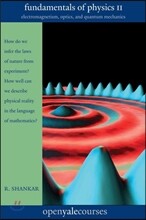
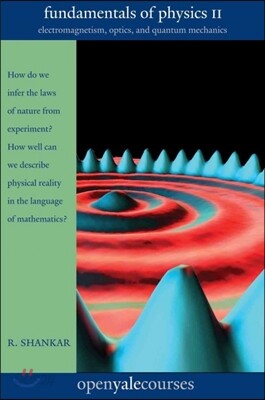
Fundamentals of Physics II, Volume 2: Electromagnetism, Optics, and Quantum Mechanics
Electromagnetism, Optics, and Quantum Mechanics #2
Paperback
R. Shankar
Yale University Press
2016.07.19.
이미 소장하고 있다면 판매해 보세요.
- 국내배송만 가능
- 해외 거래처 사정에 의하여 품절/지연 가능
- 도서 정보 중 미표기 사항 안내?
- 문화비소득공제 가능
Open Yale Courses
-
 Epidemics and Society: From the Black Death to the Present 이동Epidemics and Society: From the Black Death to the Present18% 30,880원
 -
Fundamentals of Physics II, Volume 2: Electromagnetism, Optics, and Quantum Mechanics 이동Fundamentals of Physics II, Volume 2: Electromagnetism, Optics, and Quantum Mechanics10% 38,520원
책소개
목차
|
Preface xv
1. Electrostatics I 1 1.1 Review of F = ma 1 1.2 Enter electricity 3 1.3 Coulomb's law 8 1.4 Properties of charge 10 1.4.1 Superposition principle 12 1.5 Verifying Coulomb's law 13 1.6 The ratio of gravitational to electric forces 15 1.7 Coulomb's law for continuous charge density 17 2. The Electric Field 19 2.1 Review of key ideas 19 2.2 Digression on nuclear forces 20 2.3 The electric field E 22 2.4 Visualizing the field 25 2.5 Field of a dipole 33 2.5.1 Far field of dipole: general case 36 2.6 Response to a field 38 2.6.1 Dipole in a uniform field 39 3. Gauss's Law I 42 3.1 Field of an infinite line charge 43 3.2 Field of an infinite sheet of charge 47 3.3 Spherical charge distribution: Gauss's law 52 3.4 Digression on the area vector dA 53 3.4.1 Composition of areas 55 3.4.2 An application of the area vector 57 3.5 Gauss's law through pictures 59 3.5.1 Continuous charge density 64 4. Gauss's Law II: Applications 65 4.1 Applications of Gauss's law 66 4.2 Field inside a shell 69 4.3 Field of an infinite charged wire, redux 72 4.4 Field of an infinite plane, redux 74 4.5 Conductors 75 4.5.1 Field inside a perfect conductor is zero 76 4.5.2 The net charge on a conductor will reside at the surface 77 4.5.3 A conductor with a hole inside 78 4.5.4 Field on the surface of a conductor 79 5. The Coulomb Potential 81 5.1 Conservative forces and potential energy 82 5.2 Is the electrostatic field conservative? 88 5.3 Path independence through pictures 92 5.4 Potential and field of a dipole 93 6. Conductors and Capacitors 97 6.1 Cases where computing V from E is easier 99 6.2 Visualizing V 101 6.3 Equipotentials 103 6.4 Method of images 104 6.4.1 Proof of uniqueness (optional section) 110 6.4.2 Additional properties of the potential V(r) 112 6.5 Capacitors 113 6.6 Energy stored in a capacitor 115 6.7 Energy of a charge distribution 116 7. Circuits and Currents 119 7.1 Energy in the electric field 120 7.2 Circuits and conductivity 121 7.3 Circuits 126 7.4 The battery and the EMF ε 130 7.5 The RC circuit with a battery 135 7.6 Miscellaneous circuits 138 8. Magnetism I 142 8.1 Experiments pointing to magnetism 142 8.2 Examples of the Lorentz force, the cyclotron 147 8.3 Lorentz force on current-carrying wires 151 8.4 The magnetic dipole 154 8.5 The DC motor 156 9. Magnetism II: Biot-Savart Law 158 9.1 Practice with Biot-Savart: field of a loop 160 9.2 Microscopic description of a bar magnet 162 9.3 Magnetic field of an infinite wire 164 9.4 Ampére's law 167 9.5 Maxwell's equations (static case) 172 10. Ampère II, Faraday, and Lenz 174 10.1 Field of an infinite wire, redux 175 10.2 Field of a solenoid 179 10.3 Faraday and Lenz 184 10.4 Optional digression on Faraday's law 195 11. More Faraday 200 11.1 Betatron 200 11.2 Generators 205 11.3 Inductance 208 11.4 Mutual inductance 211 11.5 Self-inductance 214 11.6 Energy in the magnetic field 217 12. AC Circuits 220 12.1 Review of inductors 226 12.2 The LC circuit 226 12.2.1 Driven LC circuit 229 12.3 The LCR circuit 231 12.3.1 Review of complex numbers 231 12.3.2 Solving the LCR equation 236 12.3.3 Visualizing Z 239 12.4 Complex form of Ohm's law 241 13. LCR Circuits and Displacement Current 244 13.1 Analysis of LCR results 246 13.1.1 Transients and the complementary solution 251 13.2 Power of the complex numbers 253 13.3 Displacement current 259 14. Electromagnetic Waves 263 14.1 The wave equation 266 14.2 Restricted Maxwell equations in vacuum 270 14.2.1 Maxwell equations involving infinitesimal cubes 270 14.2.2 Maxwell equations involving infinitesimal loops 272 14.3 The wave! 275 14.4 Sinusoidal solution to the wave equation 277 14.5 Energy in the electromagnetic wave 283 14.6 Origin of electromagnetic waves 285 14.7 Maxwell equations-the general case (optional) 286 14.7.1 Maxwell equations involving infinitesimal cubes 286 14.7.2 Maxwell equations involving infinitesimal loops 288 14.7.3 Consequences for the restricted E and B 293 14.8 From microscopic to macroscopic (optional) 294 14.8.1 Maxwell equations involving cubes 295 14.8.2 Maxwell equations involving loops 297 15. Electromagnetism and Relativity 300 15.1 Magnetism from Coulomb's law and relativity 301 15.2 Relativistic invariance of electrodynamics 305 15.3 Review of Lorentz transformations 305 15.3.1 Implications for Newtonian mechanics 307 15.4 Scalar and vector fields 309 15.5 The derivative operator 312 15.6 Lorentz scalars and vectors 315 15.7 The four-current J 317 15.7.1 Charge conservation and the four-current J 318 15.8 The four-potential A 319 15.8.1 Gauge invariance 322 15.9 Wave equation for the four-vector A 324 15.9.1 Why work with Vand A? 327 15.10 The electromagnetic tensor F 328 15.10.1 Tensors 328 15.10.2 The electromagnetic field tensor F 332 16. Optics I: Geometric Optics Revisited 336 16.1 Geometric or ray optics 336 16.2 Brief history of c 338 16.3 Some highlights of geometric optics 340 16.4 The law of reflection from Fermat's principle 343 16.5 Snell's law from Fermat's principle 344 16.6 Reflection off a curved surface by Fermat 346 16.7 Elliptical mirrors and Fermat's principle 349 16.8 Parabolic mirrors 352 17. Optics II: More Mirrors and Lenses 355 17.1 Spherical approximations to parabolic mirrors 355 17.2 Image formation: geometric optics 357 17.2.1 A midlife crisis 359 17.3 Image formation by Fermat's principle 360 17.4 Tricky cases 364 17.4.1 Fermat's principle for virtual focal points 365 17.4.2 Ray optics for virtual images 366 17.5 Lenses à la Fermat 368 17.6 Principle of least action 370 17.7 The eye 372 18. Wave Theory of Light 377 18.1 Interference of waves 381 18.2 Adding waves using real numbers 383 18.3 Adding waves with complex numbers 385 18.4 Analysis of interference 388 18.5 Diffraction grating 394 18.6 Single-slit diffraction 397 18.7 Understanding reflection and crystal diffraction 398 18.8 Light incident on an oil slick 401 18.8.1 Normal incidence 401 18.8.2 Oblique incidence 404 19. Quantum Mechanics: The Main Experiment 406 19.1 Double-slit experiment with light 407 19.2 Trouble with Maxwell 407 19.3 Digression on photons 412 19.3.1 Photoelectric effect 412 19.3.2 Compton effect 414 19.4 Matter waves 415 19.5 Photons versus electrons 420 19.6 The Heisenberg uncertainty principle 422 19.6.1 There are no states of well-defined position and momentum 423 19.6.2 Heisenberg microscope 427 19.7 Let there be light 430 19.8 The wave function Ψ 435 19.9 Collapse of the wave function 438 19.10 Summary 439 20. The Wave Function and Its Interpretation 442 20.1 Probability in classical and quantum mechanics 446 20.2 Getting to know Ψ 451 20.3 Statistical concepts: mean and uncertainty 456 21. Quantization and Measurement 460 21.1 More on momentum states 462 21.2 Single-valuedness and quantization of momentum 464 21.2.1 Quantization 467 21.2.2 The integral of Ψp(x) 468 21.3 Measurement postulate: momentum 469 21.3.1 An example solvable by inspection 476 21.3.2 Using a normalized Ψ 478 21.4 Finding A(p) by computation 480 21.5 More on Fourier's theorems 486 21.6 Measurement postulate: general 491 21.7 More than one variable 493 22. States of Definite Energy 495 22.1 Free particle on a ring 500 22.1.1 Analysis of energy levels: degeneracy 503 22.2 Thinking inside the box 507 22.2.1 Particle in a well 507 22.2.2 The box: an exact solution 516 22.3 Energy measurement in the box 521 23. Scattering and Dynamics 524 23.1 Quantum scattering 524 23.1.1 Scattering for E > V0 526 23.1.2 Scattering for E < V0 530 23.2 Tunneling 531 23.3 Quantum dynamics 533 23.3.1 A solution of the time-dependent Schrödinger equation 535 23.3.2 Derivation of the particular solution ΨE(x,t) 536 23.4 Special properties of the product solution 538 23.5 General solution for time evolution 541 23.5.1 Time evolution: a more complicated example 545 24. Summary and Outlook 550 24.1 Postulates: first pass 550 24.2 Refining the postulates 554 24.2.1 Toward a compact set of postulates 555 24.2.2 Eigenvalue problem 556 24.2.3 The Dirac delta function and the operator X 558 24.3 Postulates: final 565 24.4 Many particles, bosons, and fermions 566 24.4.1 Identical versus indistinguishable 567 24.4.2 Implications for atomic structure 574 24.5 Energy-time uncertainty principle 576 24.6 What next? 583 Constants 585 Index 587 |
품목정보
- 발행일
- 2016년 07월 19일
- 쪽수, 무게, 크기
- 608쪽 | 820g | 155*231*36mm
- ISBN13
- 9780300212365
리뷰/한줄평0
상품정보안내
직수입외서의 경우, 해외거래처에서 제공하는 정보가 부족하여 제목, 표지, 가격, 유통상태 등의 정보가 미비하거나 변경되는 경우가 있습니다. 정확한 확인을 원하시는 경우, 일대일 상담으로 문의하여 주시면 답변 드리겠습니다.
(판형과 판수 등이 다양한 도서는 찾으시는 도서의 ISBN을 알려 주시면 보다 빠르고 정확한 안내가 가능합니다.)
해외거래처에서 품절인 경우, 2차 거래선을 통해 유럽과 미국 출판사로 직접 수입이 진행될 수 있습니다.
수입 진행 시점으로 부터 2~3주가 추가로 소요되며, 해외에서도 유통이 원활하지 않은 도서는 품절 안내가 지연될 수 있습니다.
해당 경우, 문자와 메일로 별도 안내를 드리고 있사오니 마이페이지에서 휴대전화번호와 메일주소를 다시 한번 확인해주시기 바랍니다.
(판형과 판수 등이 다양한 도서는 찾으시는 도서의 ISBN을 알려 주시면 보다 빠르고 정확한 안내가 가능합니다.)
해외거래처에서 품절인 경우, 2차 거래선을 통해 유럽과 미국 출판사로 직접 수입이 진행될 수 있습니다.
수입 진행 시점으로 부터 2~3주가 추가로 소요되며, 해외에서도 유통이 원활하지 않은 도서는 품절 안내가 지연될 수 있습니다.
해당 경우, 문자와 메일로 별도 안내를 드리고 있사오니 마이페이지에서 휴대전화번호와 메일주소를 다시 한번 확인해주시기 바랍니다.