

이미 소장하고 있다면 판매해 보세요.
- 국내배송만 가능
- 해외 거래처 사정에 의하여 품절/지연 가능
- 도서 정보 중 미표기 사항 안내?
- 문화비소득공제 가능
책소개
목차
|
Preface.
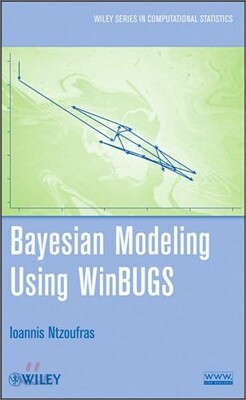
Acknowledgments. Acronyms. 1. Introduction to Bayesian inference. 1.1 Introduction: Bayesian modeling in the 21st century. 1.2 Definition of statistical models. 1.3 Bayes theorem. 1.4 Model-based Bayesian Inference. 1.5 Inference using conjugate prior distributions. 1.6 Nonconjugate Analysis. Problems. 2. Markov Chain Monte Carlo Algorithms in Bayesian Inference. 2.1 Simulation, Monte Carlo integration, and their implementation in Bayesian inference. 2.2 Markov chain Monte Carlo methods. 2.3 Popular MCMC algorithms. 2.4 Summary and closing remarks. Problems. 3. WinBUGS Software: Introduction, Setup and Basic Analysis. 3.1 Introduction and historical background. 3.2 The WinBUGS environment. 3.3 Preliminaries on using WinBUGS. 3.4 Building Bayesian models in WinBUGS. 3.5 Compiling the model and simulating values. 3.6 Basic output analysis using the sample monitor tool. 3.7 Summarizing the procedure. 3.8 Chapter summary and concluding comments. Problems. 4. WinBUGS Software: Illustration, Results, and Further Analysis. 4.1 A complete example of running MCMC in WinBUGS for a simple model. 4.2 Further output analysis using the inference menu. 4.3 Multiple chains. 4.4 Changing the properties of a figure. 4.5 Other tools and menus. 4.6 Summary and concluding remarks. Problems. 5. Introduction to Bayesian Models: Normal models. 5.1 General modeling principles. 5.2 Model specification in normal regression models. 5.3 Using vectors and multivariate priors in normal regression models. 5.4 Analysis of variance models. Problems. 6. Incorporating Categorical Variables in Normal Models and Further Modeling Issues. 6.1 Analysis of variance models using dummy variables. 6.2 Analysis of covariance models. 6.3 A Bioassay example. 6.4 Further modeling issues. 6.5 Closing remarks. Problems. 7. Introduction to Generalized Linear Models: Binomial and Poisson Data. 7.1 Introduction. 7.2 Prior distributions. 7.3 Posterior inference. 7.4 Poisson regression models. 7.5 Binomial response models. 7.6 Models for contingency tables. Problems. 8. Models for Positive Continuous Data, Count Data, and Other GLM-Based Extensions. 8.1 Models with nonstandard distributions. 8.2 Models for positive continuous response variables. 8.3 Additional models for count data. 8.4 Further GLM-based models and extensions. Problems. 9. Bayesian Hierarchical Models. 9.1 Introduction. 9.2 Some simple examples. 9.3 The generalized linear mixed model formulation. 9.4 Discussion, closing remarks, and further reading. Problems. 10. The Predictive Distribution and Model Checking. 10.1 Introduction. 10.2 Estimating the predictive distribution for future or missing observations using MCMC. 10.3 Using the predictive distribution for model checking. 10.4 Using cross-validation predictive densities for model checking, evaluation, and comparison. 10.5 Illustration of a complete predictive analysis: Normal regression models. 10.6 Discussion. Problems. 11. Bayesian Model and Variable Evaluation. 11.1 Prior predictive distributions as measures of model comparison: Posterior model odds and Bayes factors. 11.2 Sensitivity of the posterior model probabilities: The Lindley-Bartlett paradox. 11.3 Computation of the marginal likelihood. 11.4 Computation of the marginal likelihood using WinBUGS. 11.5 Bayesian variable selection using Gibbs-based methods. 11.6 Posterior inference using the output of Bayesian variable selection samplers. 11.7 Implementation of Gibbs variable selection in WinBUGS using an illustrative example. 11.8 The Carlin Chib’s method. 11.9 Reversible jump MCMC (RJMCMC). 11.10 Using posterior predictive densities for model evaluation. 11.11 Information criteria. 11.12 Discussion and further reading. Problems. Appendix A: Model Specification via Directed Acyclic Graphs: The Doodle Menu. A.1 Introduction: Starting with DOODLE. A.2 Nodes. A.3 Edges. A.4 Panels. A.5 A simple example. Appendix B: The Batch Mode: Running a Model in the Background Using Scripts. B.1 Introduction. B.2 Basic commands: Compiling and running the model. Appendix C: Checking Convergence Using CODA/BOA. C.1 Introduction. C.2 A short historical review. C.3 Diagnostics implemented by CODA/BOA. C.4 A first look of CODA/BOA. C.5 A simple example. Appendix D: Notation Summary. D.1 MCMC. D.2 Subscripts and indices. D.3 Parameters. D.4 Random variables and data. D.5 Sample estimates. D.6 Special functions, vectors and matrices. D.7 Distributions. D.8 Distribution-related notation. D.9 Notation used in ANOVA and ANCOVA. D.10 Variable and model specification. D.11 Deviance information criterion (DIC). D.12 Predictive measures. References. Index. |
저자 소개
Ioannis Ntzoufras, PhD, is Assistant Professor of Statistics at Athens University of Economics and Business (Greece). Dr. Ntzoufras has published numerous journal articles in his areas of research interest, which include Bayesian statistics, statistical analysis and programming, and generalized linear models.
품목정보
- 발행일
- 2009년 01월 20일
- 쪽수, 무게, 크기
- 520쪽 | 816g | 165*244*32mm
- ISBN13
- 9780470141144
사락 별점0
혜택 및 유의사항밑줄0
혜택 및 유의사항상품정보안내
직수입외서의 경우, 해외거래처에서 제공하는 정보가 부족하여 제목, 표지, 가격, 유통상태 등의 정보가 미비하거나 변경되는 경우가 있습니다. 정확한 확인을 원하시는 경우, 일대일 상담으로 문의하여 주시면 답변 드리겠습니다.
(판형과 판수 등이 다양한 도서는 찾으시는 도서의 ISBN을 알려 주시면 보다 빠르고 정확한 안내가 가능합니다.)
해외거래처에서 품절인 경우, 2차 거래선을 통해 유럽과 미국 출판사로 직접 수입이 진행될 수 있습니다.
수입 진행 시점으로 부터 2~3주가 추가로 소요되며, 해외에서도 유통이 원활하지 않은 도서는 품절 안내가 지연될 수 있습니다.
해당 경우, 문자와 메일로 별도 안내를 드리고 있사오니 마이페이지에서 휴대전화번호와 메일주소를 다시 한번 확인해주시기 바랍니다.
(판형과 판수 등이 다양한 도서는 찾으시는 도서의 ISBN을 알려 주시면 보다 빠르고 정확한 안내가 가능합니다.)
해외거래처에서 품절인 경우, 2차 거래선을 통해 유럽과 미국 출판사로 직접 수입이 진행될 수 있습니다.
수입 진행 시점으로 부터 2~3주가 추가로 소요되며, 해외에서도 유통이 원활하지 않은 도서는 품절 안내가 지연될 수 있습니다.
해당 경우, 문자와 메일로 별도 안내를 드리고 있사오니 마이페이지에서 휴대전화번호와 메일주소를 다시 한번 확인해주시기 바랍니다.
252,240원
총 1개
252,240원
