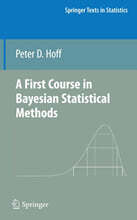

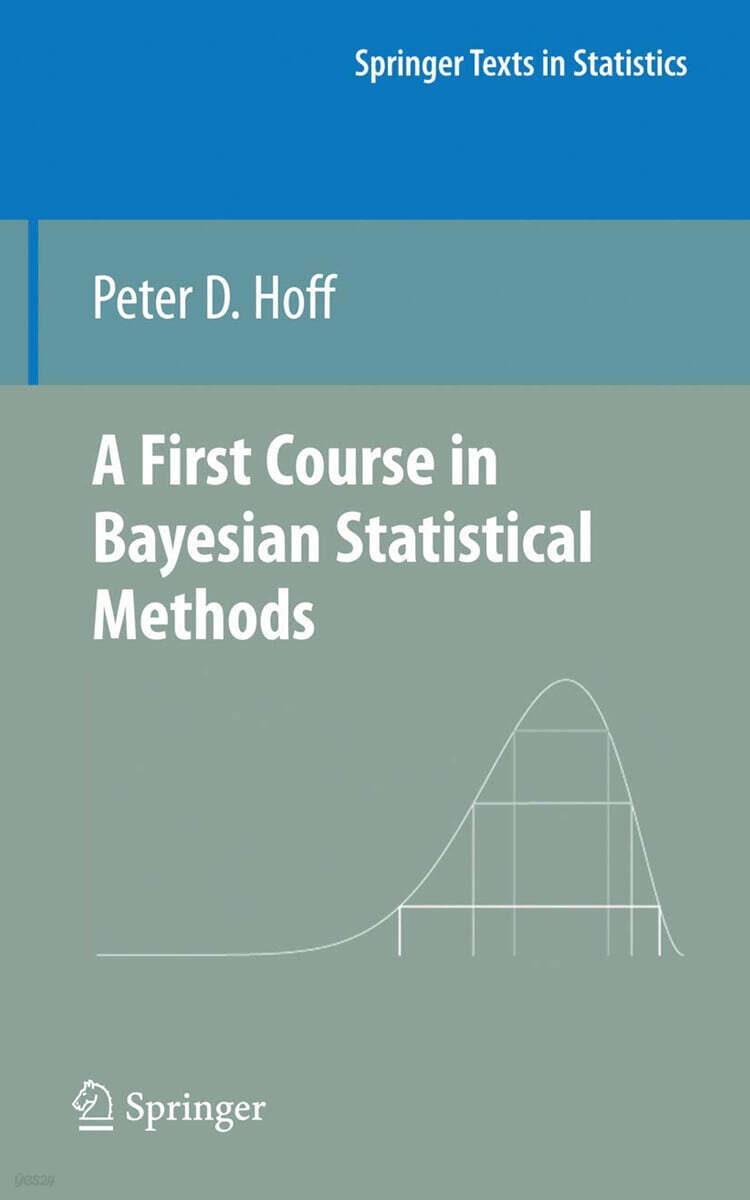
- 주문 제작 (POD) 도서로 제본 및 인쇄 품질이 다소 미흡할 수 있습니다 (해당 사유 반품 불가)
이미 소장하고 있다면 판매해 보세요.
- 국내배송만 가능
- 문화비소득공제 가능
Springer Texts in Statistics
-
 An Introduction to Statistical Learning: With Applications in Python 이동An Introduction to Statistical Learning: With Applications in Python110,000원
-
A First Course in Bayesian Statistical Methods 이동A First Course in Bayesian Statistical Methods70,000원
-
A First Course in Bayesian Statistical Methods 이동A First Course in Bayesian Statistical Methods110,000원
-
All of Statistics: A Concise Course in Statistical Inference 이동All of Statistics: A Concise Course in Statistical Inference96,000원
-
Statistical Methods for the Analysis of Repeated Measurements 이동Statistical Methods for the Analysis of Repeated Measurements92,790원
-
Advanced Linear Modeling: Multivariate, Time Series, and Spatial Data; Nonparametric Regression and Response Surface Maximization 이동Advanced Linear Modeling: Multivariate, Time Series, and Spatial Data; Nonparametric Regression and Response Surface Maximization92,790원
-
The Bayesian Choice: From Decision-Theoretic Foundations to Computational Implementation 이동The Bayesian Choice: From Decision-Theoretic Foundations to Computational Implementation236,230원
-
Stat Labs: Mathematical Statistics Through Applications 이동Stat Labs: Mathematical Statistics Through Applications151,850원
-
Mathematical Statistics: A Unified Introduction 이동Mathematical Statistics: A Unified Introduction92,790원
-
Applied Regression Analysis: A Research Tool 이동Applied Regression Analysis: A Research Tool219,350원
-
Fundamentals of Mathematical Statistics: Probability for Statistics 이동Fundamentals of Mathematical Statistics: Probability for Statistics92,790원
Springer 텍스트북 할인 2025.7.1~8.31
-
Probability and Statistics for Stem: A Course in One Semester 이동Probability and Statistics for Stem: A Course in One Semester15% 62,880원
-
Perturbation Methods and Nonlinear Phenomena: Applications to Continuous Mechanical Systems 이동Perturbation Methods and Nonlinear Phenomena: Applications to Continuous Mechanical Systems15% 62,880원
-
Managing Emotions in Journalism: A Guide to Enhancing Resilience 이동Managing Emotions in Journalism: A Guide to Enhancing Resilience15% 59,730원
-
Introduction to Quantum Computing: From a Layperson to a Programmer in 30 Steps 이동Introduction to Quantum Computing: From a Layperson to a Programmer in 30 Steps15% 86,470원
-
Entrepreneurial Family Businesses: A Textbook on Innovation, Governance, and Succession, with Case Studies 이동Entrepreneurial Family Businesses: A Textbook on Innovation, Governance, and Succession, with Case Studies219,350원
-
Statistics with Posterior Probability and a Phc Curve 이동Statistics with Posterior Probability and a Phc Curve15% 188,680원
-
Industrial Statistics: A Computer-Based Approach with Python 이동Industrial Statistics: A Computer-Based Approach with Python15% 157,230원
-
Key 5g/5g-Advanced Physical Layer Technologies: Enabling Mobile and Fixed Wireless Access 이동Key 5g/5g-Advanced Physical Layer Technologies: Enabling Mobile and Fixed Wireless Access185,600원
-
Contemporary Irish Theatre: Histories and Theories 이동Contemporary Irish Theatre: Histories and Theories84,350원
-
Quantum Mechanics for Material Science: An Introduction 이동Quantum Mechanics for Material Science: An Introduction134,980원
-
Quantum Optics: Including Noise Reduction, Trapped Ions, Quantum Trajectories, and Decoherence 이동Quantum Optics: Including Noise Reduction, Trapped Ions, Quantum Trajectories, and Decoherence202,480원
-
Introduction to the Development of Web Applications Using ASP .Net (Core) MVC 이동Introduction to the Development of Web Applications Using ASP .Net (Core) MVC15% 62,880원
-
Economics and Computation: An Introduction to Algorithmic Game Theory, Computational Social Choice, and Fair Division 이동Economics and Computation: An Introduction to Algorithmic Game Theory, Computational Social Choice, and Fair Division236,230원
-
A Beginner's Guide to Introduce Artificial Intelligence in Teaching and Learning 이동A Beginner's Guide to Introduce Artificial Intelligence in Teaching and Learning15% 78,600원
책소개
목차
|
1. Introduction and examples 1
1.1 Introduction 1 1.2 Why Bayes? 2 1.2.1 Estimating the probability of a rare event 3 1.2.2 Building a predictive model 8 1.3 Where we are going 11 1.4 Discussion and further references 12 2. Belief, probability and exchangeability 13 2.1 Belief functions and probabilities 13 2.2 Events, partitions and Bayes' rule 14 2.3 Independence 17 2.4 Random variables 17 2.4.1 Discrete random variables 18 2.4.2 Continuous random variables 19 2.4.3 Descriptions of distributions 21 2.5 Joint distributions 23 2.6 Independent random variables 26 2.7 Exchangeability 27 2.8 de Finetti's theorem 29 2.9 Discussion and further references 30 3. One-parameter models 31 3.1 The binomial model 31 3.1.1 Inference for exchangeable binary data 35 3.1.2 Confidence regions 41 3.2 The Poisson model 43 3.2.1 Posterior inference 45 3.2.2 Example: Birth rates 48 3.3 Exponential families and conjugate priors 51 3.4 Discussion and further references 52 4. Monte Carlo approximation 53 4.1 The Monte Carlo method 53 4.2 Posterior inference for arbitrary functions 57 4.3 Sampling from predictive distributions 60 4.4 Posterior predictive model checking 62 4.5 Discussion and further references 65 5. The normal model 67 5.1 The normal model 67 5.2 Inference for the mean, conditional on the variance 69 5.3 Joint inference for the mean and variance 73 5.4 Bias, variance and mean squared error 79 5.5 Prior specification based on expectations 83 5.6 The normal model for non-normal data 84 5.7 Discussion and further references 86 6. Posterior approximation with the Gibbs sampler 89 6.1 A semiconjugate prior distribution 89 6.2 Discrete approximations 90 6.3 Sampling from the conditional distributions 92 6.4 Gibbs sampling 93 6.5 General properties of the Gibbs sampler 96 6.6 Introduction to MCMC diagnostics 98 6.7 Discussion and further references 104 7. The multivariate normal model 105 7.1 The multivariate normal density 105 7.2 A semiconjugate prior distribution for the mean 107 7.3 The inverse-Wishart distribution 109 7.4 Gibbs sampling of the mean and covariance 112 7.5 Missing data and imputation 115 7.6 Discussion and further references 123 8. Group comparisons and hierarchical modeling 125 8.1 Comparing two groups 125 8.2 Comparing multiple groups 130 8.2.1 Exchangeability and hierarchical models 131 8.3 The hierarchical normal model 132 8.3.1 Posterior inference 133 8.4 Example: Math scores in U.S. public schools 135 8.4.1 Prior distributions and posterior approximation 137 8.4.2 Posterior summaries and shrinkage 140 8.5 Hierarchical modeling of means and variances 143 8.5.1 Analysis of math score data 145 8.6 Discussion and further references 146 9. Linear regression 149 9.1 The linear regression model 149 9.1.1 Least squares estimation for the oxygen uptake data 153 9.2 Bayesian estimation for a regression model 154 9.2.1 A semiconjugate prior distribution 154 9.2.2 Default and weakly informative prior distributions 155 9.3 Model selection 160 9.3.1 Bayesian model comparison 163 9.3.2 Gibbs sampling and model averaging 167 9.4 Discussion and further references 170 10. Nonconjugate priors and Metropolis-Hastings algorithms 171 10.1 Generalized linear models 171 10.2 The Metropolis algorithm 173 10.3 The Metropolis algorithm for Poisson regression 179 10.4 Metropolis, Metropolis-Hastings and Gibbs 181 10.4.1 The Metropolis-Hastings algorithm 182 10.4.2 Why does the Metropolis-Hastings algorithm work? 184 10.5 Combining the Metropolis and Gibbs algorithms 187 10.5.1 A regression model with correlated errors 188 10.5.2 Analysis of the ice core data 191 10.6 Discussion and further references 192 11. Linear and generalized linear mixed effects models 195 11.1 A hierarchical regression model 195 11.2 Full conditional distributions 198 11.3 Posterior analysis of the math score data 200 11.4 Generalized linear mixed effects models 201 11.4.1 A Metropolis-Gibbs algorithm for posterior approximation 202 11.4.2 Analysis of tumor location data 203 11.5 Discussion and further references 207 12. Latent variable methods for ordinal data 209 12.1 Ordered probit regression and the rank likelihood 209 12.1.1 Probit regression 211 12.1.2 Transformation models and the rank likelihood 214 12.2 The Gaussian copula model 217 12.2.1 Rank likelihood for copula estimation 218 12.3 Discussion and further references 223 Exercises 225 Common distributions 253 References 259 Index 267 |
품목정보
- 발행일
- 2009년 06월 26일
- 쪽수, 무게, 크기
- 270쪽 | 580g | 156*234*17mm
- ISBN13
- 9780387922997
사락 별점0
혜택 및 유의사항밑줄0
혜택 및 유의사항상품정보안내
직수입외서의 경우, 해외거래처에서 제공하는 정보가 부족하여 제목, 표지, 가격, 유통상태 등의 정보가 미비하거나 변경되는 경우가 있습니다. 정확한 확인을 원하시는 경우, 일대일 상담으로 문의하여 주시면 답변 드리겠습니다.
(판형과 판수 등이 다양한 도서는 찾으시는 도서의 ISBN을 알려 주시면 보다 빠르고 정확한 안내가 가능합니다.)
해외거래처에서 품절인 경우, 2차 거래선을 통해 유럽과 미국 출판사로 직접 수입이 진행될 수 있습니다.
수입 진행 시점으로 부터 2~3주가 추가로 소요되며, 해외에서도 유통이 원활하지 않은 도서는 품절 안내가 지연될 수 있습니다.
해당 경우, 문자와 메일로 별도 안내를 드리고 있사오니 마이페이지에서 휴대전화번호와 메일주소를 다시 한번 확인해주시기 바랍니다.
110,000원
총 1개
110,000원