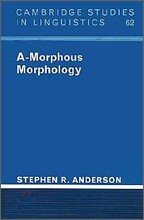

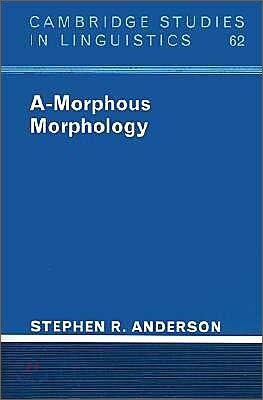
- POD (Publish On Demand) 도서로 표지재질, 제본상태 등이 일반 도서와 차이가 있을 수 있습니다.
이미 소장하고 있다면 판매해 보세요.
- 국내배송만 가능
- 문화비소득공제 가능
Cambridge Studies in Linguistics (Paperback)
-
 Historical Syntax in Cross-Linguistic Perspective 이동Historical Syntax in Cross-Linguistic Perspective147,900원
 -
A Performance Theory of Order and Constituency 이동A Performance Theory of Order and Constituency98,600원
책소개
목차
|
1 The study of word structure 7
1.1 How are words composed? 9 1.2 The nature of words 17 2 Why have a morphology at all? 22 2.1 Morphology and syntax in [actual symbols not reproducible] 23 2.2 Morphology vs. syntax in general 37 2.3 Morphology vs. phonology 42 2.4 Conclusion 47 3 Is morphology really about morphemes? 48 3.1 Classical morphemes 48 3.2 Classical problems with morphemes 51 3.3 Generalizing the structure of the morpheme 56 3.4 Items vs. processes in morphology 59 3.5 Word-based vs. morpheme-based morphology 69 3.6 Conclusion 71 4 The interaction of morphology and syntax 73 4.1 What is inflection? 74 4.2 Morphosyntactic Representations 85 4.3 Conclusion 100 5 The theory of inflection 102 5.1 Agreement 103 5.2 The assignment of configurational properties 118 5.3 Deriving the phonological form of inflected words 122 5.4 Conclusion 135 6 Some complex inflectional systems 136 6.1 Georgian Verb agreement 137 6.2 Potawatomi inflectional morphology 156 Appendix: summary of Potawatomi rules 177 7 Morphology in the lexicon: derivation 180 7.1 The lexicon 180 7.2 Derivational rules 184 7.3 Productivity and lexicalization 195 7.4 Conclusion 197 8 Clitics are phrasal affixes 198 8.1 The nature of clitics 199 8.2 The nature of affixes 205 8.3 Clitics as phrase-level morphology 210 8.4 The formal expression of 'clitic placement' 216 8.5 Conclusions 221 9 The relation of morphology to phonology 224 9.1 Boundary elements in phonological theory 227 9.2 The interaction of morphology and phonology 249 9.3 Conclusion 255 10 How much structure do words have? 256 10.1 Eliminating word-internal structure 256 10.2 Possible motivations for word-internal structure 261 10.3 Conclusion 290 11 Composites: words with internal structure 292 11.1 Compounds and their structure 294 11.2 Generalizing the notion of 'compound' 299 11.3 Word-internal structure and theories of the lexicon 305 11.4 The notion 'head of a word' 310 11.5 Summary and conclusion 318 12 Morphology and the typology of languages 320 12.1 Goals of a morphological typology of languages 320 12.2 Sapir's typology of word structure 325 12.3 Conclusion 334 13 Morphological change 336 13.1 Morphological change and synchronic morphology 337 13.2 The morphologization of phonological rules 339 13.3 The morphologization of syntactic structures 346 13.4 Analogy, or changes in morphological rules 365 13.5 Conclusion 372 14 Morphology as a computational problem 373 14.1 Reasons to study morphology as parsing 373 14.2 Approaches to computational morphology 376 14.3 Some general problems 387 14.4 Alternatives to existing approaches 393 14.5 Conclusion |
품목정보
- 발행일
- 1992년 06월 25일
- 쪽수, 무게, 크기
- 448쪽 | 717g | 150*230*30mm
- ISBN13
- 9780521378666
사락 별점0
혜택 및 유의사항밑줄0
혜택 및 유의사항상품정보안내
직수입외서의 경우, 해외거래처에서 제공하는 정보가 부족하여 제목, 표지, 가격, 유통상태 등의 정보가 미비하거나 변경되는 경우가 있습니다. 정확한 확인을 원하시는 경우, 일대일 상담으로 문의하여 주시면 답변 드리겠습니다.
(판형과 판수 등이 다양한 도서는 찾으시는 도서의 ISBN을 알려 주시면 보다 빠르고 정확한 안내가 가능합니다.)
해외거래처에서 품절인 경우, 2차 거래선을 통해 유럽과 미국 출판사로 직접 수입이 진행될 수 있습니다.
수입 진행 시점으로 부터 2~3주가 추가로 소요되며, 해외에서도 유통이 원활하지 않은 도서는 품절 안내가 지연될 수 있습니다.
해당 경우, 문자와 메일로 별도 안내를 드리고 있사오니 마이페이지에서 휴대전화번호와 메일주소를 다시 한번 확인해주시기 바랍니다.
(판형과 판수 등이 다양한 도서는 찾으시는 도서의 ISBN을 알려 주시면 보다 빠르고 정확한 안내가 가능합니다.)
해외거래처에서 품절인 경우, 2차 거래선을 통해 유럽과 미국 출판사로 직접 수입이 진행될 수 있습니다.
수입 진행 시점으로 부터 2~3주가 추가로 소요되며, 해외에서도 유통이 원활하지 않은 도서는 품절 안내가 지연될 수 있습니다.
해당 경우, 문자와 메일로 별도 안내를 드리고 있사오니 마이페이지에서 휴대전화번호와 메일주소를 다시 한번 확인해주시기 바랍니다.
70,000원
총 1개
70,000원