
소득공제
수입
직수입양서
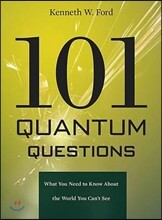
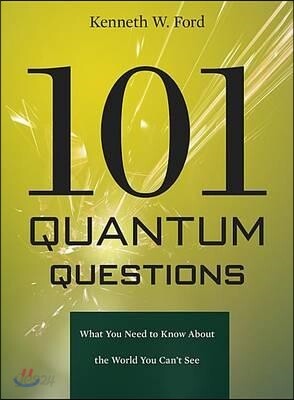
101 Quantum Questions: What You Need to Know about the World You Can't See
What You Need to Know About the World You Can't See
Paperback
Harvard University Press
2012.10.22.
이미 소장하고 있다면 판매해 보세요.
- 국내배송만 가능
- 해외 거래처 사정에 의하여 품절/지연 가능
- 도서 정보 중 미표기 사항 안내?
- 문화비소득공제 가능
책소개
목차
|
Introduction 1
I The Subatomic World 1. What is a quantum, anyway? 3 2. Where do the laws of quantum physics hold sway? 5 3. What is the correspondence principle? 7 4. How big is an atom? 9 5. What is inside an atom? 9 6. Why is solid matter solid if it is mostly empty space? 13 7. How big is an electron? Is there anything inside it? 14 II Digging Deeper 8. How big is a nucleus? What is inside it? 18 9. How big are protons and neutrons? What is inside them? 22 10. What is Planck's constant and what is its significance? 24 11. What is a photon? 27 12. What is the photoelectric effect? 29 13. What particles are believed to be fundamental? What particles are composite? 30 14. What is the standard model? 33 III The Small and the Swift 15. What are some quantum scales of distance? 34 16. How far can one particle "reach out" to influence another one? 35 17. How fast do particles move? 38 18. What are some quantum scales of time? 40 19. What is the meaning of E = mc2? 41 20. What is electric charge? 44 21. What is spin? 46 IV Quantum Lumps and Quantum Jumps 22. What are some things that are lumpy (and some that are not)? 50 23. What is a "state of motion"? 52 24. Is a hydrogen atom in an excited state of motion the same atom in a different state or is it a different atom? 54 25. What are quantum numbers? What are the rules for combining them? 56 26. What is a quantum jump? 61 27. What is the role of probability in quantum physics? 64 28. Is there any certainty in the quantum world? 68 V Atoms and Nuclei 29. What is a line spectrum? What does it reveal about atoms? 70 30. Why is the chart of the elements periodic? 75 31. Why are heavy atoms nearly the same size as lightweight atoms? 78 32. How do protons and neutrons move within a nucleus? 79 33. What are atomic number and atomic mass? 83 VI And More about Nuclei 34. Why does the periodic table end? 85 35. What is radioactivity? What are its forms? 87 36. Why is the neutron stable within a nucleus but unstable when alone? 92 37. What is nuclear fission? Why does it release energy? 94 38. What about nuclear fusion? 98 VII Particles 39. What is a lepton? What are its flavors? 101 40. How many distinct neutrinos are there? How do we know? 105 41. Do neutrinos have mass? Why do they "oscillate"? 108 42. Are there really only three generations of particles? 114 43. How do we know that all electrons are identical? 116 VIII And More Particles 44. Names, names, names. What do they all mean? 118 45. What are the properties of quarks? How do they combine? 119 46. What are the composite particles? How many are there? 123 47. Does every particle have to be a fermion or a boson? What sets these two classes apart? 126 48. What is a Bose-Einstein condensate? 130 49. How did bosons and fermions get their names? 133 IX Interactions 50. What is a Feynman diagram? 137 51. What are the essential features of Feynman diagrams? 141 52. How do Feynman diagrams illustrate the strong, weak, and electromagnetic interactions? 144 53. Which particles are stable? Which are unstable? What does it mean to say that a particle decays? 148 54. What is scattering? 149 55. What is the same before and after a scattering or a decay? 151 56. What changes during a scattering or decay? 152 X Constancy during Change 57. What are the "big four" absolute conservation laws? 154 58. What additional absolute conservation laws operate in the quantum world? 156 59. What is the TCP theorem? 157 60. What conservation laws are only "partial"? 160 61. What symmetry principles are only "partial"? 163 62. What are laws of compulsion and of prohibition? 167 63. . How are the concepts of symmetry, invariance, and conservation related? 169 XI Waves and Particles 64. What do waves and particles have in common? How do they differ? 173 65. What is the de Broglie equation? What is its significance? 174 66. How are waves related to quantum lumps? 177 67. How do waves relate to the size of atoms? 180 68. What is diffraction? What is interference? 182 69. What is the two-slit experiment? Why is it important? 183 70. What is tunneling? 186 XII Waves and Probability 71. What is a wave function? What is Schrödinger's equation? 189 72. How do waves determine probabilities? 192 73. How do waves prevent particles from having fixed positions? 195 74. What is the uncertainty principle? 197 75. How does the uncertainty principle relate to the wave nature of matter? 199 76. What is superposition? 202 77. Are waves necessary? 204 XIII Quantum Physics and Technology 78. How are particles pushed close to the speed of light? 207 79. How are high-energy particles detected? 211 80. How does a laser work? 215 81. How do electrons behave in a metal? 218 82. What is a semiconductor? 220 83. What is a p-n junction? Why is it a diode? 222 84. What are some uses of diodes? 224 85. What is a transistor? 226 XIV Quantum Physics at Every Scale 86. Why do black holes evaporate? 228 87. How does quantum physics operate in the center of the Sun? 231 88. What is superconductivity? 233 89. What is superfluidity? 236 90. What is a Josephson junction? 237 91. What is a quantum dot? 239 92. What is a quark-gluon plasma? 240 93. What is the Planck length? What is quantum foam? 242 XV Frontiers and Puzzles 94. Why are physicists in love with the number 137? 244 95. What is entanglement? 247 96. What is Bell's inequality? 250 97. What is a qubit? What is quantum computing? 253 98. What is the Higgs particle? Why is it important? 255 99. What is string theory? 257 100. What is the "measurement problem"? 259 101. How come the quantum? 263 Appendix A 265 Appendix B 271 Acknowledgments 275 Index 277 |
저자 소개 1
Kenneth W. Ford
뛰어난 물리학자인 동시에 뛰어난 물리 교사인 케네스 W. 포드는 1926년 플로리다에서 태어났다. 1953년 프린스턴 대학교에서 물리학 박사 학위를 받고, 1953년부터 1975년까지 캘리포니아 대학교 어바인, 보스턴 대학교 등에서 교수를 역임했다. 1972년에는 미국 물리교사 협회 회장을, 1987년부터 1993년까지 미국 물리학회(API) 운영위원장을 지냈다. 2006년에는 리처드 파인먼과 칼 세이건, 프리먼 다이슨 등이 수상한, 미국 물리교사 협회(AAPT)가 최고의 물리 교사에게 수여하는 외르스테드 메달을 수상한 바 있다. 저서로 미국의 저명한 물리학자 존 휠러와 공동 집
뛰어난 물리학자인 동시에 뛰어난 물리 교사인 케네스 W. 포드는 1926년 플로리다에서 태어났다. 1953년 프린스턴 대학교에서 물리학 박사 학위를 받고, 1953년부터 1975년까지 캘리포니아 대학교 어바인, 보스턴 대학교 등에서 교수를 역임했다. 1972년에는 미국 물리교사 협회 회장을, 1987년부터 1993년까지 미국 물리학회(API) 운영위원장을 지냈다. 2006년에는 리처드 파인먼과 칼 세이건, 프리먼 다이슨 등이 수상한, 미국 물리교사 협회(AAPT)가 최고의 물리 교사에게 수여하는 외르스테드 메달을 수상한 바 있다. 저서로 미국의 저명한 물리학자 존 휠러와 공동 집필한 『게온, 블랙홀, 양자 거품Geons, Black Holes, and Quantum Foam』 등이 있다.
품목정보
- 발행일
- 2012년 10월 22일
- 쪽수, 무게, 크기
- 291쪽 | 430g | 162*215*18mm
- ISBN13
- 9780674066076
사락 별점0
혜택 및 유의사항밑줄0
혜택 및 유의사항상품정보안내
직수입외서의 경우, 해외거래처에서 제공하는 정보가 부족하여 제목, 표지, 가격, 유통상태 등의 정보가 미비하거나 변경되는 경우가 있습니다. 정확한 확인을 원하시는 경우, 일대일 상담으로 문의하여 주시면 답변 드리겠습니다.
(판형과 판수 등이 다양한 도서는 찾으시는 도서의 ISBN을 알려 주시면 보다 빠르고 정확한 안내가 가능합니다.)
해외거래처에서 품절인 경우, 2차 거래선을 통해 유럽과 미국 출판사로 직접 수입이 진행될 수 있습니다.
수입 진행 시점으로 부터 2~3주가 추가로 소요되며, 해외에서도 유통이 원활하지 않은 도서는 품절 안내가 지연될 수 있습니다.
해당 경우, 문자와 메일로 별도 안내를 드리고 있사오니 마이페이지에서 휴대전화번호와 메일주소를 다시 한번 확인해주시기 바랍니다.
(판형과 판수 등이 다양한 도서는 찾으시는 도서의 ISBN을 알려 주시면 보다 빠르고 정확한 안내가 가능합니다.)
해외거래처에서 품절인 경우, 2차 거래선을 통해 유럽과 미국 출판사로 직접 수입이 진행될 수 있습니다.
수입 진행 시점으로 부터 2~3주가 추가로 소요되며, 해외에서도 유통이 원활하지 않은 도서는 품절 안내가 지연될 수 있습니다.
해당 경우, 문자와 메일로 별도 안내를 드리고 있사오니 마이페이지에서 휴대전화번호와 메일주소를 다시 한번 확인해주시기 바랍니다.
44,600원
총 1개
44,600원