
- 구매혜택
-
특별할인도서
- 염가 판매 도서로 상태가 좋지 않을 수 있습니다
이미 소장하고 있다면 판매해 보세요.
- 국내배송만 가능
- 문화비소득공제 가능
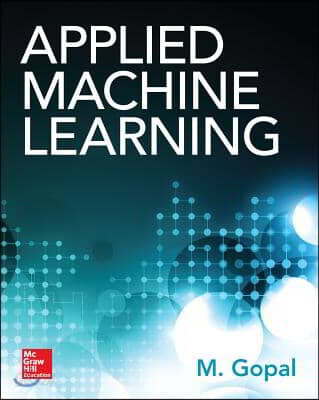
책소개
목차
|
1. Introduction
1.1 Towards Intelligent Machines 1.2 Well-Posed Machine Learning Problems 1.3 Examples of Application in Diverse Fields 1.4 Data Representation 1.5 Domain Knowledge for Productive use of Machine Learning 1.6 Diversity of Data: Structured/Unstructured 1.7 Forms of Learning 1.8 Machine Learning and Data Mining 1.9 Bacic Linear Algebra in Machine Learning Techniques 1.10 Relevant Resources for Machine Learning 2. Supervised Learnig: Rationale and Basics 2.1 Learning From Observations 2.2 Bias and Variance 2.3 Why Learning Works; Computational Learning Theory 2.4 Occam's Razor Principle and Overfitting Avoidance 2.5 Heuristic Search in Induvtive Learning 2.6 Estimating Generalization Errors 2.7 Metrics for Assessing Regression (Numeric Prediction) Accuracy 2.8 Metrics for Assessing Classification (Pattern Recognition) Accuracy 2.9 An Overview of the Design Cycle and Issues in Machine Learning 3. Statistical Learning 3.1 Mavhine Learning and Inferential Statistical Analysis 3.2 Descriptive Statistics in Learning Techniques 3.3 Bayesian Reasoning: A Probabilistic Approach to Inference 3.4 K-Nearest Neighbor (k-NN) Classifier 3.5 Discriminant Functions and Regression Functions 3.6 Linear Reggression with Least Square Error Criterion 3.7 Logistic Regression for Classification Tasks 3.8 Fisher's Linear Discriminant and Thresholding for Classification 3.9 Minimum Description Length Principle 4. Learning With Support Vector Machines 4.1 Introduction 4.2 Linear Discriminant Functions for Binary Classification 4.3 Perceptron Algorithm 4.4 Linear Maximal Margin Classifier for Linearly Separable Data 4.5 Linear Soft Margin Classifier for Overlapping Classes 4.6 Kernel-Induced Fearure Spaces 4.7 Nonlinear Classifier 4.8 Regression by Support Vector Machines 4.9 Decomposing Multiclass Classification Problem Into Binary Classification Tasks 4.10 Variants of Basic SVM Techniques 5. Learning With Neural Networks (NN) 5.1 Towards Cognitive Machine 5.2 Neuron Models 5.3 Network Architectures 5.4 Perceptrons 5.5 Linear Neuron and the Widrow-Hoff Learning Rule 5.6 The Error-Correction Delta Rule 5.7 Multi-Layer Perceptron (MLP) Networks and the Error-Backpropagation 5.8 Multi-Class Discrimination with MLP Networks 5.9 Radial Basis Functions (RBF) Network 5.10 Genetic-Neural Systems 6. Fuzzy Inference System 6.1 Introduction 6.2 Cognitive Uncertainty and Fuzzy Rule-Base 6.3 Fuzzy Quantification of Knowledge 6.4 Fuzzy Rule-Base and Approximate Reasoning 6.5 Mamdani Model for Fuzzy Inference Systems 6.6 Takagi-Sugeno Fuzzy Model 6.7 Neuro-Fuzzy Inference Systems 6.8 Gentic-Fuzzy Systems 7. Data Clustering and Data Transformations 7.1 Unsupervised Learning 7.2 Engineering the Data 7.3 Overview of Basic Clustering Methods 7.4 K-Means Clustering 7.5 Fuzzy K-Means Clustering 7.6 Expectation-Maximization (EM) Algorithm and Gaussian Mixtures Clustering 7.7 Some Useful Data Transformations 7.8 Entropy-Based Method for Attribute Discretization 7.9 Principal Component Analysis (PCA) for Attribute Reduction 7.10 Rough Sets-Based Methods for Attribute Reduction. 8. Decision Tree Learning 8.1 Introduction 8.2 Example of a Classification Decision Tree 8.3 Measures of Impurity for Evaluating Splits in Decision Trees 8.4 ID3, C4.5 and CART Decision Trees 8.5 Pruning the Tree 8.6 Strengths and Weaknesses of Decision-Tree Appoach 8.7 Fuzzy Decision Trees 9. Business Intelligence and Data Mining: Techniques and Applications 9.1 An Introduction to Analytics 9.2 The CRISP-DM (Cross Industry Standard Process for Data Mining) Model 9.3 Data Warehousing and Online Analytical Processing 9.4 Mining Frequent Patterns and Association Rules 9.5 Intelligent Information Retrieval Systems 9.6 Applications snd Trends 9.7 Technologies dor Big Data Appendix A Genetic Algorithm (GA) For Search Optimization Appendix B Reinforcement Learning (RL) Datasets form Real-Life Applications for Mavhine Kearning Experiments Problems References Index |
품목정보
- 발행일
- 2019년 06월 05일
- 쪽수, 무게, 크기
- 656쪽 | 1500g | 206*259*38mm
- ISBN13
- 9781260456844
리뷰/한줄평0
상품정보안내
직수입외서의 경우, 해외거래처에서 제공하는 정보가 부족하여 제목, 표지, 가격, 유통상태 등의 정보가 미비하거나 변경되는 경우가 있습니다. 정확한 확인을 원하시는 경우, 일대일 상담으로 문의하여 주시면 답변 드리겠습니다.
(판형과 판수 등이 다양한 도서는 찾으시는 도서의 ISBN을 알려 주시면 보다 빠르고 정확한 안내가 가능합니다.)
해외거래처에서 품절인 경우, 2차 거래선을 통해 유럽과 미국 출판사로 직접 수입이 진행될 수 있습니다.
수입 진행 시점으로 부터 2~3주가 추가로 소요되며, 해외에서도 유통이 원활하지 않은 도서는 품절 안내가 지연될 수 있습니다.
해당 경우, 문자와 메일로 별도 안내를 드리고 있사오니 마이페이지에서 휴대전화번호와 메일주소를 다시 한번 확인해주시기 바랍니다.
(판형과 판수 등이 다양한 도서는 찾으시는 도서의 ISBN을 알려 주시면 보다 빠르고 정확한 안내가 가능합니다.)
해외거래처에서 품절인 경우, 2차 거래선을 통해 유럽과 미국 출판사로 직접 수입이 진행될 수 있습니다.
수입 진행 시점으로 부터 2~3주가 추가로 소요되며, 해외에서도 유통이 원활하지 않은 도서는 품절 안내가 지연될 수 있습니다.
해당 경우, 문자와 메일로 별도 안내를 드리고 있사오니 마이페이지에서 휴대전화번호와 메일주소를 다시 한번 확인해주시기 바랍니다.
10,000원
총 1개
10,000원