
이미 소장하고 있다면 판매해 보세요.
- 국내배송만 가능
- 문화비소득공제 가능
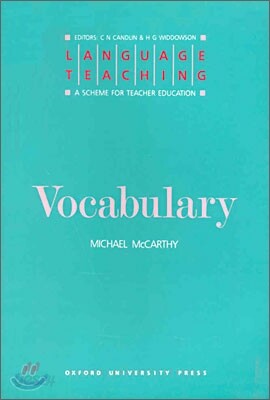
A Scheme for Teacher Education
-
 Language Teaching : Roles of Teachers and Learners 이동Language Teaching : Roles of Teachers and Learners10% 20,250원
책소개
목차
|
The author and series editors
Introduction Section One: Explaining vocabulary 1. Words 1.1. Introduction 1.2. Word-formation 1.3. Multi-word units 2. Lexical relations 2.1. Collocation 2.2. Sense relations 2.3. Semantic fields 2.4. Homonymy and polysemy 2.5. Metaphor 2.6. Componential analysis 3. The mental lexicon 3.1. Introduction 3.2. Input, storage, and retrieval 3.3. Prototypes 3.4. Meaning and cognition 4. Vocabulary in use 4.1. Core vocabulary 4.2. Procedural vocabulary 4.3. Discourse 4.4. Register 5. Vocabulary as data for learning 5.1. Frequency 5.2. Range 5.3. Lexical density and variation 5.4. Concordances Section Two: Demonstrating vocabulary 6. Selecting what to teach 6.1. Frequency and range 6.2. Learnability 6.3. Learners' needs 7. Organizing vocabulary 7.1. Topic 7.2. Meaning 7.3. Form 7.4. Contextual relations: register and discourse 8. Presenting vocabulary in the classroom 8.1. Pre-teaching 8.2. Form and meaning 8.3. Types of stimuli 8.4. Input, reinforcement, and uptake 9. Teachers and learners 9.1. Classroom interaction 9.2. Learning strategies 9.3. Note-taking 9.4. Learner autonomy 10. Lexical reference 10.1. Types of reference book 10.2. Workbooks and reference activities 10.3. Conclusion Section Three: Exploring vocabulary 11. Investigating vocabulary problems in the classroom Glossary Further reading Bibliography Index |
관련 분류
- 카테고리 분류
품목정보
- 발행일
- 1999년 01월 01일
- 쪽수, 무게, 크기
- 173쪽 | 크기확인중
- ISBN13
- 9780194371360
리뷰/한줄평0
상품정보안내
직수입외서의 경우, 해외거래처에서 제공하는 정보가 부족하여 제목, 표지, 가격, 유통상태 등의 정보가 미비하거나 변경되는 경우가 있습니다. 정확한 확인을 원하시는 경우, 일대일 상담으로 문의하여 주시면 답변 드리겠습니다.
(판형과 판수 등이 다양한 도서는 찾으시는 도서의 ISBN을 알려 주시면 보다 빠르고 정확한 안내가 가능합니다.)
해외거래처에서 품절인 경우, 2차 거래선을 통해 유럽과 미국 출판사로 직접 수입이 진행될 수 있습니다.
수입 진행 시점으로 부터 2~3주가 추가로 소요되며, 해외에서도 유통이 원활하지 않은 도서는 품절 안내가 지연될 수 있습니다.
해당 경우, 문자와 메일로 별도 안내를 드리고 있사오니 마이페이지에서 휴대전화번호와 메일주소를 다시 한번 확인해주시기 바랍니다.
(판형과 판수 등이 다양한 도서는 찾으시는 도서의 ISBN을 알려 주시면 보다 빠르고 정확한 안내가 가능합니다.)
해외거래처에서 품절인 경우, 2차 거래선을 통해 유럽과 미국 출판사로 직접 수입이 진행될 수 있습니다.
수입 진행 시점으로 부터 2~3주가 추가로 소요되며, 해외에서도 유통이 원활하지 않은 도서는 품절 안내가 지연될 수 있습니다.
해당 경우, 문자와 메일로 별도 안내를 드리고 있사오니 마이페이지에서 휴대전화번호와 메일주소를 다시 한번 확인해주시기 바랍니다.
34,850원
총 1개
34,850원